Industrial robots vs cobots is a common comparison for manufacturers planning automation, but the right choice depends on the task rather than the label. Industrial robots are typically used for faster, higher-volume work in separated automation cells, while cobots are designed for closer human interaction in suitable applications. This guide explains the key differences in safety, speed, payload, flexibility and factory fit, with practical context for manufacturers in Malaysia.
Industrial robots vs cobots: what is the difference?
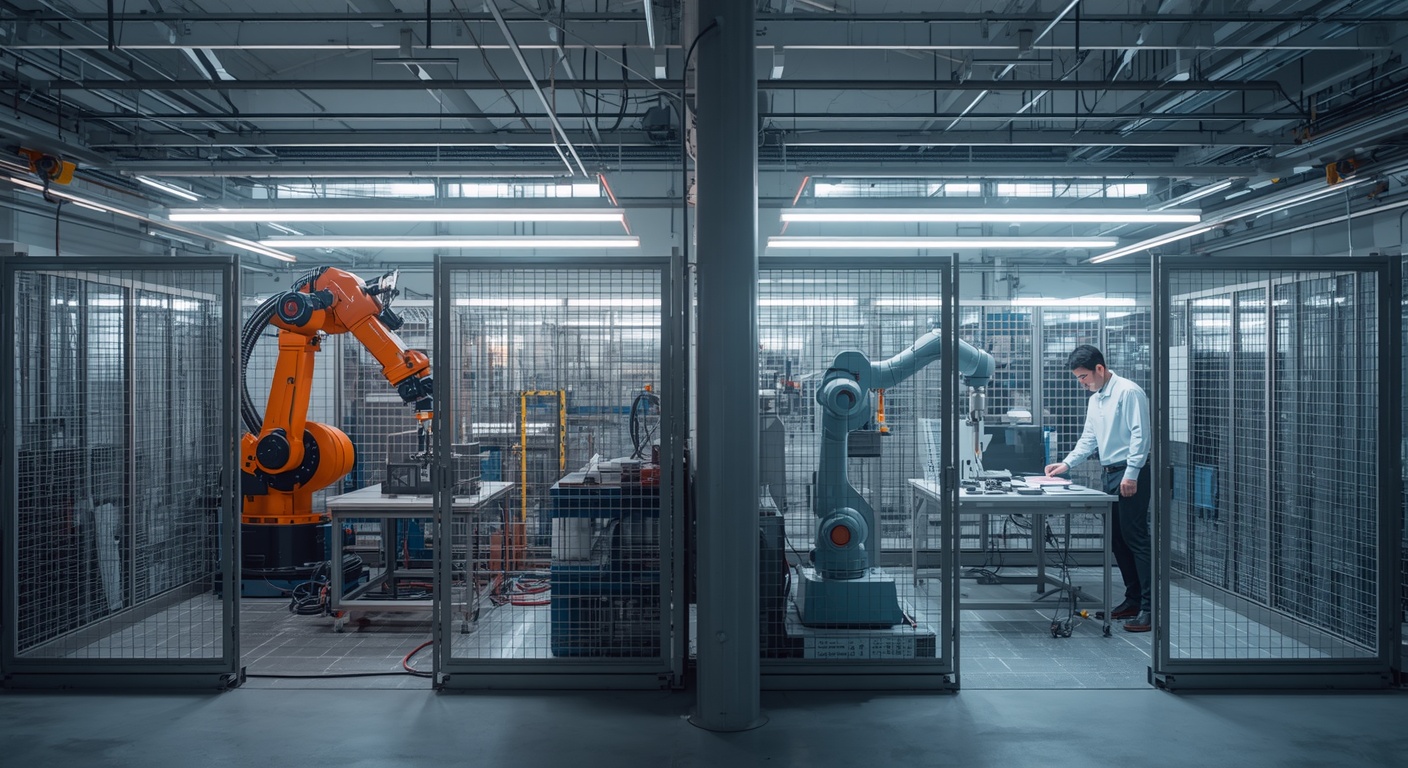
Industrial robots are usually built for high-speed, repetitive production tasks inside guarded or separated work cells. Cobots, or collaborative robots, are designed to work more closely with people in shared or semi-shared spaces under defined operating conditions. In practice, industrial robots often suit heavier, faster and more demanding automation jobs, while cobots often suit flexible, lighter-duty tasks that benefit from human robot collaboration.
The difference is not simply about old versus new technology. It is mainly about application design. A factory choosing between the two should look at cycle time, part weight, reach, operator involvement, safety approach and how often the process changes.
What are industrial robots?
An industrial robot is a programmable machine used to automate production tasks such as handling, moving, processing or assembling parts. In manufacturing, the term usually refers to robot arms installed as part of a dedicated automation system.
Industrial robots are commonly selected for work that is repetitive, physically demanding or potentially hazardous. They are often integrated with conveyors, fixtures, sensors, vision systems, programmable logic controller systems and custom end effectors to perform a defined sequence with consistent repeatability.
Typical characteristics of industrial robots include:
- Operation inside enclosed or protected cells
- Strong suitability for repetitive, cycle-based production
- Broader payload and reach options depending on the application
- Compatibility with more complex tooling and automation systems
- Use in environments where speed and throughput are important
Common industrial robot applications include:
- Welding
- Palletising
- Machine tending
- Material handling
- Pick and place at continuous production speed
- Assembly line automation with fixed workflows
These robots are a core part of many broader factory automation in Malaysia initiatives, especially where manufacturers want to increase consistency, reduce manual handling or build a dedicated automated production cell.
What are cobots?
A cobot, short for collaborative robot, is a robot designed for applications where people and robots may work more closely together. The main design philosophy is not maximum speed, but practical collaboration, easier deployment and greater flexibility in suitable production tasks.
Cobots are often used by factories that want automation without building a large enclosed robot cell for every process. They are popular for bench-level tasks, operator-assisted processes and applications with frequent changeovers.
Common cobot characteristics include:
- Smaller footprint compared with many traditional industrial robot cells
- Easier reprogramming or task adjustment in some setups
- Suitability for flexible, lower-volume or mixed-product work
- Use near workers when the application has been properly assessed
- Strong appeal for manufacturers starting with robotics in manufacturing
Typical cobot applications include light assembly, packaging support, inspection support, machine loading and unloading, and simple pick and place work.
It is important not to oversimplify cobot safety. A cobot is not automatically risk-free just because it is collaborative. The actual safety of the installation depends on the tool, part shape, speed, force, work area, surrounding equipment and the specific task. A cobot handling a sharp part or operating in a poorly planned workspace may still require additional protective measures and application review.
Industrial robots vs cobots: side-by-side comparison
| Factor | Industrial Robots | Cobots |
|---|---|---|
| Safety approach | Usually operate in guarded, fenced or separated cells | Designed for closer human interaction in assessed applications |
| Speed | Often better suited to faster cycle-intensive work | Often used at more moderate operating speeds where collaboration matters |
| Payload | Often preferred for heavier parts and more demanding tooling | Often better for lighter-duty handling and assembly tasks |
| Reach | Often more suitable for larger work envelopes and cell-based automation | Often suited to shorter-reach, workstation-level tasks |
| Guarding needs | Commonly require dedicated separation and cell design | May need less guarding in some applications, but still require risk assessment and may still need protective measures |
| Programming complexity | Can involve more complex integration and programming | Often chosen for easier setup and task adjustment |
| Flexibility | Best for stable, repetitive processes with limited variation | Often better for frequent product changeovers or reassigned tasks |
| Floor space | Usually part of a larger automation cell | Often easier to place at benches or compact workstations |
| Typical use cases | Welding, palletising, heavy handling, high-volume machine tending | Light assembly, packaging support, bench automation, operator-assisted machine tending |
| Suitability for SMEs | Suitable when production volume and task demands justify dedicated automation | Often attractive for SMEs seeking flexible entry into automation |
This comparison is a useful starting point, but real selection should be based on process requirements rather than broad assumptions. Some factories use both technologies side by side.
Safety differences manufacturers need to understand
The most important safety difference is the operating model. Industrial robots are commonly kept separate from people through cell design, guarding and controlled access. Cobots are designed for more direct human interaction, but only within conditions that have been properly evaluated.
For manufacturers, that means two practical points:
- Industrial robots usually control risk through separation. Workers are kept out of the active robot space during normal automatic operation.
- Cobots usually control risk through collaborative application design. The robot, tooling, part movement and workspace must all be reviewed so people can work nearby safely.
Neither approach removes the need for application-specific risk assessment. Safety depends on the complete system, not only on the robot arm. The end effector, part edges, pinch points, machine interface, fixture layout and operator movement all affect the final risk level.
Manufacturers should also avoid assuming that a cobot can be installed without integration planning. Even in a flexible deployment, the full setup may include grippers, sensors, vision systems, feeders and connected machines, each of which can introduce additional hazards or operating constraints.
Where safety, machinery compliance or workplace requirements may apply, manufacturers should verify the specific obligations for their equipment, process and site conditions before implementation.
How speed, payload and precision affect the choice
In many projects, the decision between industrial robots and cobots comes down to process demands rather than budget discussions alone. Three of the most important operational factors are speed, payload and precision.
Speed and cycle time
Industrial robots are often selected when the process depends on short, repeatable cycle times. A packaging line, palletising station or high-volume machine tending cell may require continuous motion with limited pauses. In these cases, the robot must keep up with upstream and downstream equipment.
Cobots can automate many of the same basic motions, but they are more often preferred where flexibility and human interaction matter more than maximum throughput. For example, if an operator loads variable parts and the robot completes a secondary handling step, a cobot may fit the process well.
Payload and tooling
Payload is the amount of weight the robot must handle, including the part and the end effector. Heavier parts, larger grippers and complex tooling often push a project toward an industrial robot. This is especially true when the application also demands faster acceleration or longer reach.
Cobots are often a better match for lighter products such as small components, packaged goods, finished consumer items or bench-level subassemblies. If the part is light and the motion is simple, a cobot may handle the task without the complexity of a larger robot cell.
Precision and consistency
Both industrial robots and cobots can improve consistency compared with purely manual work, but the required level of positional control depends on the process. A repetitive loading task may tolerate more variation than a precision assembly step with tight fixture alignment.
Manufacturers should assess:
- Part weight and shape
- Required takt time or output pace
- Travel distance across the workspace
- Consistency of incoming part presentation
- Tooling weight and complexity
- Need for vision guidance or sensor feedback
As a practical example, a high-throughput metalworking line with fixed part orientation may favour an industrial robot, while a mixed-product electronics or light assembly workstation may favour a cobot.
Best applications for industrial robots
Industrial robots are usually the better fit when production conditions are demanding, repetitive and easier to define in a dedicated cell.
- High-volume production: When the same motion runs continuously over long production periods, industrial robots often deliver the stability needed for dedicated automation.
- Hazardous processes: Tasks involving heat, fumes, sparks or physically strenuous handling are often better isolated from workers.
- Heavy material handling: Larger parts, bulk movement and loaded fixtures often require more robust robot and tooling options.
- Cycle-intensive machine tending: Where multiple CNC machines, presses or process stations must be served at a steady pace, an industrial robot cell may be more practical.
- Large work envelopes: Applications that require longer reach across conveyors, pallets or bigger fixtures often favour industrial robots.
Examples relevant to manufacturing sectors common in Malaysia include:
- Palletising finished cartons in food or consumer goods production
- Material transfer between process stations in plastics manufacturing
- Dedicated machine tending in metal fabrication or machining operations
- Handling repetitive loading tasks in electronics or component manufacturing where throughput is a priority
Industrial robots also fit well within larger automation programmes tied to digital production planning, data collection and connected equipment. For manufacturers exploring wider transformation, it helps to understand how robotics connects with Industry 4.0 and smart manufacturing in Malaysia.
Best applications for cobots
Cobots are often most useful where the factory needs flexibility, easier redeployment or closer operator involvement rather than a fully isolated high-speed cell.
- Low-to-medium volume production: When product volumes do not justify a large dedicated cell, a cobot may offer a practical automation step.
- Frequent changeovers: Production environments with short runs or multiple product variants often benefit from simpler task adjustment.
- Operator-assisted tasks: A cobot can take over repetitive movement while the worker manages judgment-based or value-added steps.
- Bench-level automation: Compact workstations for light assembly, screwdriving, dispensing or inspection support often suit cobot deployment.
- SME entry into automation: Smaller manufacturers may prefer cobots when they want to start with one process and scale gradually.
Typical cobot applications include:
- Light assembly support
- Pick and place of small parts
- Packaging and repacking tasks
- Simple machine tending for lighter components
- Inspection support with cameras or basic vision systems
- Loading trays, fixtures or test stations
For example, a manufacturer with several product variants may use a cobot to load parts into a semi-automatic station while an operator performs inspection and final decision-making. In that situation, the value comes from reduced repetitive handling and easier adaptation to product changes.
Which is better for SMEs and growing factories in Malaysia?
For SMEs and growing factories in Malaysia, the better choice depends on production reality, not automation trends. Cobots often attract attention because they can be easier to place into existing work areas and may involve less complex integration in some applications. That can make them a practical starting point for companies with limited floor space, smaller engineering teams or a need for flexible deployment.
Industrial robots may be the better long-term decision when the factory has:
- Stable high-volume output
- Heavier products or fixtures
- Strong pressure on cycle time
- A defined process that is unlikely to change often
- Plans for a dedicated automation cell
Cobots may be the better fit when the factory has:
- Product variation and frequent changeovers
- Operator-dependent workstations
- Limited available floor space
- A need to automate one step at a time
- Limited in-house robotics experience
Other practical decision factors for Malaysian manufacturers include the availability of local integration support, maintenance capability, training requirements, spare parts access and the ease of fitting automation into an existing production layout.
For some businesses, the best answer is not industrial robots or cobots, but a phased automation roadmap that uses each technology where it makes operational sense.
Questions to ask before choosing between industrial robots and cobots
Before selecting a robot system, manufacturers should work through a practical checklist:
- What exactly is the task? Define whether it is handling, assembly, welding, inspection, packaging or machine tending.
- What is the payload? Consider the part, gripper and any additional tooling together.
- What cycle time is required? The robot must match the pace of the production process.
- How much reach is needed? Map the workspace, fixture positions and transfer distances.
- Will workers be nearby during operation? Human interaction affects the safety approach and system design.
- How often does the product change? High product mix may favour more flexible automation.
- What other equipment must be integrated? Think about conveyors, CNC machines, feeders, sensors, vision systems and PLC controls.
- Who will maintain and troubleshoot the system? Internal technical capability matters after installation.
- What training will operators and technicians need? Ease of use affects real adoption on the factory floor.
- Will the automation need to scale later? A system that works for one workstation may need to expand into a wider cell or line.
This checklist helps shift the conversation away from brand or trend and toward process fit.
Common misconceptions about robots and cobots
Cobots are always safer than industrial robots
Not necessarily. Cobots are designed for collaborative use, but the full application still determines risk. Tooling, part geometry, movement path and workspace layout all matter.
Industrial robots are only for large factories
Not always. A smaller manufacturer may still benefit from an industrial robot if the task is repetitive, heavy or speed-sensitive enough to justify a dedicated cell.
Cobots need no guarding
This is a common misunderstanding. Some cobot applications may operate with reduced guarding, but others still need protective measures depending on the task and surrounding hazards.
Cobots can replace any industrial robot application
No. Applications involving heavier loads, longer reach, faster cycle times or harsher process conditions often remain better suited to industrial robots.
Robot selection is mainly about the machine itself
In practice, success often depends just as much on the gripper, fixture design, part presentation, machine interface, controls integration and operator workflow as on the robot arm.
Frequently Asked Questions
What is the main difference between an industrial robot and a cobot?
The main difference is how they are typically used. Industrial robots usually perform faster, repetitive tasks in guarded or separated cells, while cobots are designed for closer interaction with people in appropriately assessed applications that prioritise flexibility and shared workspaces.
Are cobots safer than industrial robots?
Cobots are designed for collaborative use, but that does not automatically make them safer in every situation. Safety depends on the full application, including the tool, part, motion, workspace and surrounding equipment. Both types need proper risk assessment and integration review.
Can a cobot replace an industrial robot in every application?
No. Cobots are often effective for lighter-duty, flexible and operator-adjacent tasks, but they may not be the best choice for applications that need heavier payload handling, larger work envelopes or faster cycle times.
Which is better for small and medium-sized manufacturers?
Many SMEs find cobots attractive because they can be easier to deploy in existing spaces and adapt to changing tasks. However, an industrial robot may be the better investment if the process is stable, repetitive and throughput-driven. The better option depends on the production requirement.
Do cobots still need safety assessment and integration planning?
Yes. Cobots still need application-specific safety assessment, layout planning, tooling review and integration planning. Collaborative capability does not remove the need to evaluate the full system before use.
Conclusion: choosing the right robot for the job
When comparing industrial robots vs cobots, the clearest answer is that each suits a different type of manufacturing problem. Industrial robots are often the stronger choice for speed, payload and dedicated production cells. Cobots are often the stronger choice for flexibility, compact deployment and operator-adjacent tasks.
The best decision comes from analysing the process itself: what needs to be moved, how fast it must happen, how people interact with the task and how the automation may scale over time. Manufacturers that evaluate the application carefully are more likely to choose the right robot for the job.