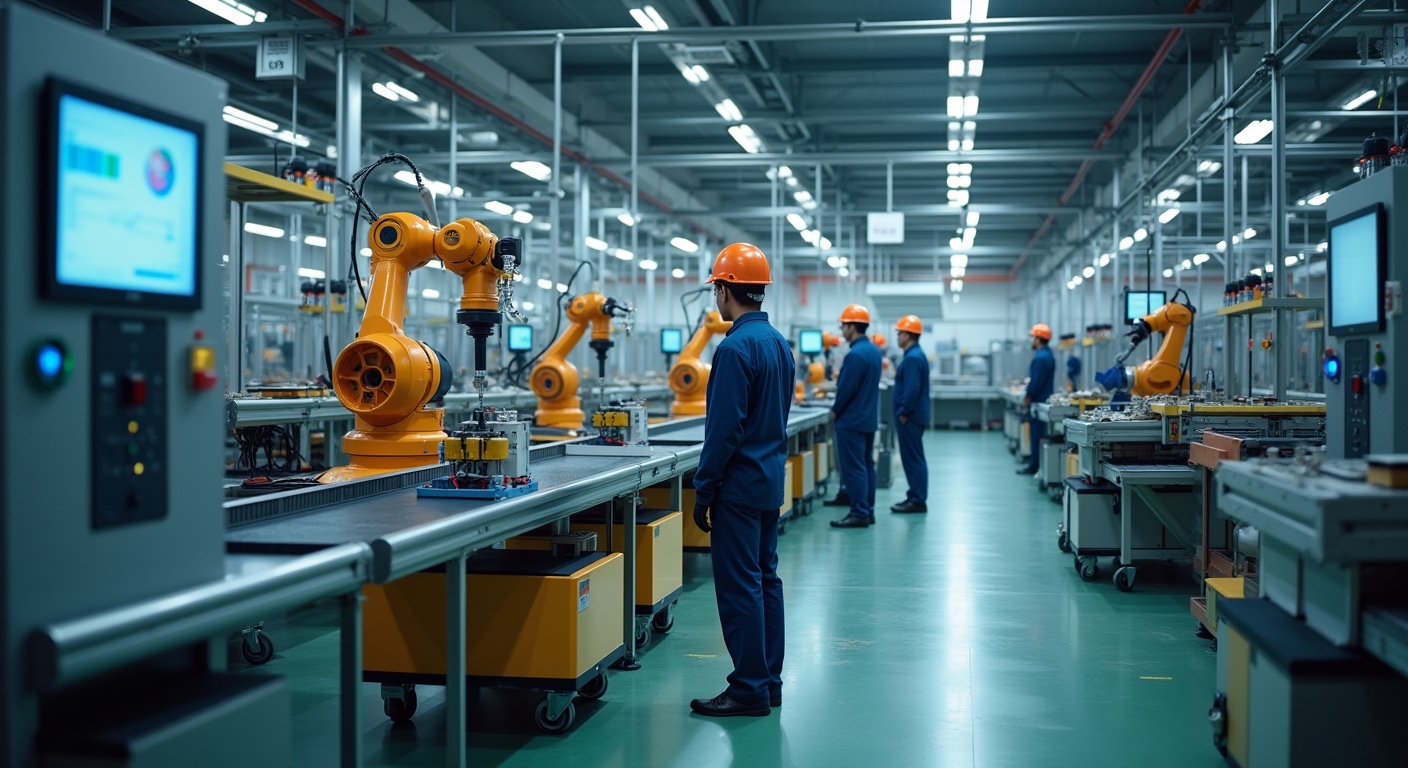

Factory automation Malaysia refers to the use of control systems, software, sensors and industrial equipment to reduce manual intervention in manufacturing processes. In practice, this can mean anything from a single automated machine to a connected production environment that links robots, PLC and SCADA systems, quality inspection and production data.
For manufacturers, automation is not only about replacing manual tasks. It is also about improving consistency, reducing avoidable errors, handling repetitive work more effectively and building a production system that can be monitored and improved over time. This guide explains how factory automation works, the main technology involved, common applications, cost drivers, implementation steps and what Malaysian manufacturers should evaluate before investing.
What is factory automation?
Factory automation is the use of sensors, control systems, software and machinery to operate manufacturing processes with less manual input. It can range from simple machine controls to fully integrated production lines that monitor performance, coordinate material flow and support real-time decision-making.
The term covers a wide range of technologies. A basic example is a packaging machine that runs through pre-set logic using sensors and actuators. A more advanced example is an automated production line where conveyors, robots, machine vision systems and supervisory software work together to maintain output and quality.
Automation does not always mean a factory becomes fully unmanned. Many automated systems still depend on operators, technicians, engineers and supervisors. The difference is that people focus more on control, exception handling, setup, maintenance and analysis rather than repeating the same manual task all day.
Why factory automation matters in Malaysia
Factory automation in Malaysia matters because manufacturers are under pressure to improve output, quality and responsiveness while managing labour availability, operating complexity and customer expectations. Many production environments need to deliver consistent results across multiple shifts, tighter quality requirements and shorter lead times.
In sectors such as electronics, food processing, packaging, automotive components and medical manufacturing, even small process variation can create scrap, rework or delays. Automation helps standardise work steps and improve repeatability. It can also support traceability when production data needs to be recorded and reviewed.
For some manufacturers, the main driver is throughput. For others, it is quality control, reduced handling, better hygiene, safer operation or more efficient use of skilled labour. A company that struggles to staff repetitive manual work may automate end-of-line packing or palletising. Another company may automate inspection because visual quality checks are inconsistent between operators or shifts.
Malaysia’s manufacturing base includes both large multinational operations and local SME manufacturers. Their automation priorities can be very different. A high-volume plant may focus on integrated controls and data systems, while an SME may begin with one machine, one workstation or one material handling problem. In both cases, the value of automation depends on whether the selected process is suitable and whether implementation is managed well.
How factory automation works
At a practical level, an automated factory works through a repeating cycle of sensing, decision-making, action and feedback.
First, the system receives inputs. These may include raw materials, workpieces, machine status signals, operator commands or recipe settings. Sensors then detect conditions such as position, presence, temperature, pressure, speed, level or dimensions.
The data collected by sensors is sent to a control system, often a programmable logic controller (PLC) or another industrial controller. The controller compares the input against programmed logic. Based on that logic, it decides what should happen next. It may start a motor, stop a machine, trigger an alarm, divert a product, adjust a process parameter or send information to a supervisory system.
Actuators carry out the physical response. These can include motors, pneumatic cylinders, valves, servo drives or robotic arms. Monitoring systems such as human-machine interfaces (HMI) and SCADA help operators and engineers see what the process is doing, change settings where permitted and respond to abnormalities.
Feedback is what makes automation useful over time. The system checks whether the intended result actually happened. If a bottle was not detected on a packaging line, the filler may pause or reject the product. If a vision system identifies a missing component, the part may be separated automatically for review.
In a more connected smart factory Malaysia environment, data from machines may also feed into production reporting, maintenance planning, quality systems or higher-level software such as MES. That broader connectivity is what turns individual automated machines into a more coordinated manufacturing automation Malaysia strategy.
Core components of a factory automation system
A factory automation system is usually made up of several layers of hardware and software. Each component has a specific role, but the real value comes from how they work together.
Sensors and actuators
Sensors detect conditions in the process. Common examples include photoelectric sensors for object detection, proximity sensors for position sensing, temperature sensors for thermal control and pressure sensors for pneumatic or fluid systems. Industrial sensors and control systems provide the raw information that automated equipment needs in order to respond correctly.
Actuators convert control commands into physical movement or mechanical action. Motors drive conveyors and rotating equipment. Cylinders push, lift or clamp parts. Valves open and close flow paths. Servo systems can position components more precisely than simpler on-off motion devices.
Without accurate sensing, the controller is effectively operating blind. Without reliable actuation, the logic may be correct but the process still fails in execution. That is why both sensing quality and actuator reliability matter.
PLCs, HMIs and SCADA
A programmable logic controller, or PLC, is a rugged industrial computer designed to control machinery and processes. It reads input signals, executes programmed logic and sends output commands in real time. PLCs are widely used because they are well suited to manufacturing environments and can handle repetitive logic consistently.
An HMI, or human-machine interface, gives operators a screen-based view of the equipment. It may show machine status, alarms, counters, recipes or settings. HMIs help operators run equipment more consistently because the process is presented in a structured way.
SCADA stands for supervisory control and data acquisition. It is used to monitor and supervise processes across machines, lines or facilities. A SCADA system can collect data, display trends, record events and give managers or engineers a broader view than a single machine HMI. In industrial automation Malaysia projects, PLC and SCADA systems are often part of the same overall architecture, even if they serve different levels of control and visibility.
Robots, conveyors and material handling
Industrial robots are used where a machine needs controlled motion to pick, place, assemble, weld, dispense, palletise or handle parts in a repeatable way. Robots are especially useful when the motion path is complex, the task is repetitive or the work area presents safety or ergonomic concerns.
Conveyors move products or materials through defined routes and are a common foundation of automated production line design. They can support assembly, packaging, sorting and transfer between process steps.
Material handling automation may also include lifts, feeders, indexing systems, automated guided vehicles (AGV) or autonomous mobile robots (AMR). AGVs generally follow defined routes or guidance methods, while AMRs can make more dynamic movement decisions within set operating parameters. Both can reduce manual transport work, but suitability depends on layout, traffic, safety planning and workflow stability.
These systems matter because many inefficiencies in factories are caused not by the core machine process itself, but by how parts are moved, queued, orientated or presented to the next step.
Machine vision and quality inspection
Machine vision systems use cameras, optics, lighting and software to inspect products or guide machine actions. They can be used to check presence or absence, orientation, label position, surface defects, dimensions or code readability, depending on the application design.
Machine vision is valuable when manual inspection is slow, subjective or difficult to keep consistent across shifts. It is also useful when inspection data needs to be recorded for traceability or process improvement.
However, vision systems are only as good as the application engineering behind them. Lighting, part presentation, acceptable tolerance logic and environmental conditions all affect reliability. Vision is not a magic solution; it needs disciplined setup and validation.
Software and data integration
Software connects machine-level automation to production management and decision-making. This can include recipe management, production monitoring, downtime tracking, quality records, maintenance alerts or MES functions.
The Industrial Internet of Things (IIoT) extends this visibility by allowing equipment and sensors to exchange data in more connected ways. Predictive maintenance applications may use condition data such as vibration, temperature or cycle counts to help maintenance teams intervene before failures become disruptive.
Software and integration matter because automation is not only about moving parts. It is also about creating useful information that helps a factory improve planning, traceability and operational control.
Types of factory automation
Factory automation is usually grouped into four broad types: fixed automation, programmable automation, flexible automation and integrated automation. The right choice depends mainly on production volume, product variety and how often the process changes.
| Type | Best fit | Strengths | Limitations | Typical use cases |
|---|---|---|---|---|
| Fixed automation | High-volume, repetitive production | High consistency, efficient cycle times, strong repeatability | Less adaptable to frequent product changes | Dedicated assembly or packaging lines |
| Programmable automation | Batch production with periodic changeovers | Can be reprogrammed for different products or sequences | Changeovers may require time, setup and technical support | CNC operations, batch processing, multi-product equipment |
| Flexible automation | Moderate volume with higher product variation | Handles change more easily, supports mixed production | Higher system complexity and integration demands | Robotic cells, flexible assembly, adaptable packaging lines |
| Integrated automation | Factories seeking connected control and data flow across processes | Better coordination, traceability and visibility across systems | More engineering effort, software integration and change management | Smart factory systems linking machines, data and production management |
Fixed automation is common where the process rarely changes and volume justifies dedicated equipment. Programmable automation is useful when different product variants are made in batches. Flexible automation suits manufacturers that need quicker adjustment between products. Integrated automation goes beyond one machine or cell and focuses on how multiple systems communicate and support broader factory performance.
Common factory automation applications
Automation systems for factories are used in many different production and support activities. The most effective applications are usually tasks that are repetitive, clearly defined, quality-sensitive or difficult to staff consistently.
Assembly
Assembly automation can include part feeding, screwdriving, pressing, joining, dispensing and handling between stations. It is common where the sequence is stable and component variation is controlled. Electronics manufacturing and automotive component assembly are typical environments where repeatability matters.
Packaging and palletising
Packaging lines often use sensors, PLCs, conveyors and robotic or mechanical handling to fill, seal, label, cartone and palletise products. End-of-line automation is frequently one of the first areas manufacturers consider because it involves repetitive movement and often creates labour bottlenecks.
Inspection and quality control
Automated inspection may use machine vision, test stations, barcode reading or in-process sensors. These systems help detect variation earlier and support more consistent quality decisions than purely manual checks in some applications.
Labelling and traceability
Automation can apply labels, print codes, verify identification and capture batch or production data. This is useful where customers require traceability or where internal control depends on tracking lots, jobs or serialised items.
Material handling
Material handling automation covers conveying, sorting, buffering, lifting, feeding and movement between production steps. In some factories, productivity gains come less from the core process machine and more from improving the way materials arrive, queue and exit.
Process control
In process industries or utilities within a plant, automation may be used to control temperature, flow, pressure, mixing, dosing or timing sequences. Controlled process conditions can improve consistency and reduce operator-dependent variation.
Warehousing interface
Some manufacturers automate the handoff between production and storage through barcode scanning, transfer systems, pallet handling or digital production records. Even when the warehouse is not fully automated, improving the interface between factory and inventory flow can reduce delays and errors.
Production data collection
Automated data capture supports performance monitoring, downtime analysis, traceability and maintenance planning. This is an important step for companies moving toward smart factory Malaysia initiatives because better decisions depend on reliable data, not manual reconstruction after the fact.
Benefits of factory automation
Factory automation benefits can be significant when the process is stable, the system is well designed and the organisation is prepared to support it. Common benefits include:
- Higher productivity: automated systems can keep work moving more consistently and reduce avoidable idle time.
- Better repeatability: the same programmed logic is applied every cycle, which can reduce variation.
- Fewer manual errors: automation can lower the risk of missed steps, incorrect handling or inconsistent setup.
- Improved traceability: digital control and data capture make it easier to track process events and production records.
- Safer handling of certain tasks: automation can reduce direct exposure to repetitive, awkward or hazardous operations.
- Lower waste and rework: more consistent control can help catch problems earlier or prevent them entirely.
- Faster changeovers in some systems: recipe-driven or programmable setups may reduce adjustment time between products.
- Better use of labour: people can be moved from repetitive manual work to supervision, setup, maintenance or quality tasks.
These benefits are not automatic. A poor process can remain a poor process even after automation. If the workflow is unstable, product variation is unmanaged or maintenance support is weak, the expected returns may not appear.
Challenges and limitations to consider
Automation also brings real constraints, and manufacturers should evaluate them honestly before committing capital.
Upfront investment is often the first concern. Even relatively modest systems may require spending on equipment, electrical work, controls, safety measures, installation and training. More integrated projects add engineering and software costs.
Integration complexity is another common issue. New systems may need to communicate with older machines, existing utilities, production software or facility layouts that were never designed for automation.
Maintenance capability matters more after automation, not less. When a manual process stops, people may improvise a workaround. When an automated line stops, specialised troubleshooting may be needed before production can resume.
Training needs affect operators, technicians, engineers and supervisors. A system may work technically but still underperform if staff do not understand normal operating conditions, alarm response, changeover procedures or fault escalation.
Transition downtime should be expected. Installing, testing and tuning a system can interrupt normal production. For this reason, many companies phase implementation rather than change everything at once.
Cybersecurity and data integrity become more important as machines and software become more connected. The more information that moves between systems, the more important access control, network design and backup planning become.
Spare parts and support availability also affect long-term reliability. A technically impressive solution may create problems if replacement parts are difficult to obtain or if local support is limited.
Process variability can be the biggest hidden limitation. Automation works best when inputs are controlled. If incoming parts vary too much, manual operators may adapt instinctively while machines struggle. In such cases, upstream process improvement may be needed before automation makes sense.
How much does factory automation cost in Malaysia?
Factory automation costs in Malaysia vary too widely to state a reliable universal price without verified project-specific market data. The cost depends on what is being automated, how much engineering is needed, how many machines are involved and how deeply the system must integrate with existing operations.
Instead of focusing on generic price claims, buyers should understand the main cost drivers.
Main cost drivers
- Project scope: a single workstation costs very differently from a multi-machine line or plant-wide integration project.
- Equipment type: robots, conveyors, machine vision systems, feeders and specialised handling devices affect system complexity.
- Controls architecture: PLCs, HMIs, SCADA, networking and software integration add hardware and engineering requirements.
- Safety systems: guarding, interlocks, emergency stops and safe operating design must be built into the solution.
- Mechanical and electrical design: custom fabrication, panel building, wiring and installation can be significant cost elements.
- Integration with existing machines: retrofitting older equipment may require additional interface work or redesign.
- Commissioning and testing: tuning a system to achieve stable production often takes time and specialist support.
- Training: operators and maintenance personnel need training to run and support the new system properly.
- After-sales support: service response, spare parts planning and long-term maintenance support affect total ownership cost.
- Customisation level: highly tailored systems usually require more engineering than standard modular solutions.
What buyers should ask for in quotations
When comparing proposals for industrial automation Malaysia projects, ask suppliers to break quotations into clear sections. A useful quotation checklist includes:
- Scope of supply and scope exclusions
- Process assumptions used in the proposal
- Equipment list and system architecture
- Safety provisions included in the design
- Software, licensing or data integration scope
- Installation responsibility and site preparation needs
- Commissioning and acceptance criteria
- Training included for operators and maintenance personnel
- Warranty terms and limits
- Recommended spare parts
- After-sales support model
- Estimated project schedule and key milestones
Comparing quotations only on headline price can be misleading. One proposal may exclude integration, programming changes, training or commissioning support that another supplier includes.
How to plan a factory automation project
Most successful automation implementation in manufacturing follows a structured process rather than starting with a machine purchase. A practical planning sequence is:
- Identify the bottleneck. Focus on the process that limits output, creates recurring quality issues, causes labour strain or introduces repeated handling problems.
- Define the objective. Decide whether the project is meant to improve throughput, consistency, traceability, safety, labour utilisation or a combination of these.
- Map the current process. Document material flow, cycle steps, variation points, manual interventions, downtime causes and quality risks.
- Assess technical feasibility. Confirm whether the product, process stability, part presentation and operating conditions are suitable for automation.
- Build the business case. Compare expected benefits against project cost, support requirements, production impact and operational risk.
- Select vendors carefully. Evaluate technical capability, relevant application experience, support model and clarity of proposal scope.
- Run pilot testing where useful. For higher-risk applications, prototypes or proof-of-concept trials can reduce uncertainty before full rollout.
- Implement in phases. Phased deployment lowers disruption and allows the team to learn before scaling across more lines or processes.
- Train teams thoroughly. Operators, maintenance staff and supervisors need clear procedures, ownership and escalation paths.
- Measure results after startup. Track output, downtime, scrap, response time and actual process stability against the original objectives.
This step-by-step approach helps manufacturers avoid automating the wrong problem. It also improves alignment between management goals, engineering reality and shopfloor execution.
What to evaluate before choosing an automation solution
Before committing to a specific system, buyers should assess whether the proposed solution fits the process, the facility and the organisation that will operate it.
| Evaluation area | Why it matters | Questions to ask |
|---|---|---|
| Production volume | Volume affects payback logic and equipment design | Is output high enough to justify automation? |
| Product variation | Frequent changes may require more flexible systems | How many variants, changeovers or recipe adjustments are needed? |
| Cycle time | The automation must keep up with line speed expectations | Can the proposed system reliably meet required takt or cycle performance? |
| Part consistency | Variable inputs can reduce automation reliability | Are incoming materials and components stable enough for automated handling? |
| Floor space | Layout constraints can limit system design | Is there enough room for equipment, guarding, access and maintenance? |
| Utilities and infrastructure | Power, air, networking and support services affect implementation | What site preparation is required before installation? |
| Integration needs | Existing machines and software may need interfaces | Can the new system communicate with current equipment and data systems? |
| Maintenance support | Long-term uptime depends on internal and external support capability | Who will maintain the system, and what skills are needed? |
| Operator skill level | Ease of use affects adoption and performance | Can the production team run the system confidently after training? |
| Safety considerations | Machine interaction must be controlled and documented properly | How will access, guarding, stop functions and intervention points be managed? |
| Data requirements | Some projects require only control, others need reporting and traceability | What information needs to be captured, displayed or shared? |
| Expected return | Financial logic should match business priorities | What outcome justifies the investment for this factory? |
This type of review is especially useful for SME manufacturers, which often need a solution that is manageable, serviceable and scalable rather than overly complex.
Factory automation, robotics and Industry 4.0: what is the difference?
These terms are related but not interchangeable. Automation is the broad concept. Robotics is one part of automation. Industry 4.0 refers to connected, data-driven manufacturing systems that use digital integration to improve visibility and decision-making.
| Term | What it means | Main focus | Example |
|---|---|---|---|
| Factory automation | Use of controls, sensors, software and machinery to reduce manual intervention | Process execution and consistency | An automated filling, inspection and packing line |
| Robotics | Use of programmable machines to perform physical tasks | Motion, handling and repeatable actions | A robot palletising cartons at end of line |
| Industry 4.0 | Use of connected systems and data to improve manufacturing visibility and decisions | Integration, analytics and digital connectivity | Production machines feeding performance data into dashboards and maintenance alerts |
A factory can be automated without using robots. For example, a PLC-controlled conveyor and packaging machine is automated even if no robot is present. A factory can also use robots without being fully connected in an Industry 4.0 sense. Likewise, Industry 4.0 initiatives often build on a foundation of existing automation but add more data sharing, monitoring and system integration.
Implementation and compliance considerations in Malaysia
When planning factory automation in Malaysia, manufacturers should review implementation and compliance issues early rather than after equipment arrives on site. Exact obligations can vary depending on the machinery involved, the manufacturing activity, the facility setup and how the system will be operated.
At a general level, companies should assess:
- machine safety during normal operation, cleaning, setup and maintenance
- electrical design and installation quality
- operator and technician training requirements
- documentation for operation, maintenance and fault response
- access control, guarding and intervention points
- change management when integrating automated systems with existing processes
- maintenance procedures and spare parts planning before commissioning
If a project involves significant machinery changes, electrical work or specialised operating conditions, requirements should be confirmed with qualified professionals and the relevant official authorities or current standards sources before startup. It is also important not to assume that one safety or certification approach applies to every factory, as obligations can differ by process and industry.
Is factory automation right for your business?
Factory automation is most effective when it addresses a real production problem in a process that is stable enough to automate. It is usually a strong fit when a manufacturer faces recurring bottlenecks, quality inconsistency, repetitive handling, traceability demands or difficulty staffing certain tasks reliably.
For SMEs, the right answer is often not full-scale transformation at once. A focused project such as automated inspection, packaging support or material handling may deliver clearer results with lower organisational strain. For larger manufacturers, automation may be part of a broader strategy involving digital integration, standardisation across lines and deeper process visibility.
A practical decision framework is to ask:
- Is the process repetitive and clearly defined?
- Are current labour or quality issues persistent enough to justify change?
- Is product variation controlled well enough for automation to run reliably?
- Can the business support maintenance, training and troubleshooting after startup?
- Will the solution still fit future production plans?
If the answer to most of these questions is yes, automation may be worth serious evaluation. If the process itself is unstable, it is often better to fix the process first and automate second.
Ultimately, factory automation in Malaysia should be approached as an operational improvement decision, not just a technology purchase. The best projects solve a clear business problem, fit the actual production environment and can be supported long after installation is complete.
Frequently Asked Questions
What is the difference between factory automation and industrial automation?
Factory automation usually refers specifically to automation within manufacturing and production environments, such as assembly, packaging, inspection or material handling. Industrial automation is broader and can also include utilities, processing plants, warehouses and other industrial operations beyond the factory floor.
How do manufacturers decide which processes to automate first?
Most manufacturers start with the process that creates the biggest operational constraint. This may be a bottleneck, a repetitive labour-heavy task, a quality risk, an ergonomics issue or a step where manual variation causes frequent downtime or waste.
Can SMEs in Malaysia adopt factory automation without fully replacing workers?
Yes. Many SME automation projects are designed to support workers rather than replace them entirely. Automation can take over repetitive or physically demanding tasks while staff move into machine operation, quality control, setup, troubleshooting or production coordination roles.
What are the main cost factors in a factory automation project?
The main cost factors usually include project scope, equipment type, controls and software, safety systems, engineering design, integration with existing machines, installation, commissioning, training and after-sales support. Customisation level also has a major effect on total cost.
Which industries in Malaysia commonly use factory automation?
Automation is commonly relevant in industries such as electronics manufacturing, food processing, packaging, automotive components, medical manufacturing and other sectors where consistency, throughput, inspection or traceability matter. The exact level of automation varies widely by process and factory size.
How long does it usually take to implement a factory automation system?
Implementation time depends on the complexity of the system, site readiness, engineering scope, integration requirements and testing needs. A simple standalone solution may move faster than a multi-machine or software-integrated project. Timelines should be confirmed with the selected supplier based on actual project scope.