A hydraulic press machine is widely used in manufacturing to apply controlled compressive force for shaping, forming, assembling, straightening or testing materials. For factory managers, engineers and buyers, understanding how it works and where it fits into production is essential before selecting equipment, tooling and safety controls.
This guide explains the basic working principle, main components, common machine types, typical applications, the difference between hydraulic and mechanical presses, and the practical factors manufacturers should review before making a purchase decision.
What is a hydraulic press machine?
A hydraulic press machine is an industrial press that uses fluid pressure to generate controlled force through a cylinder and ram. Manufacturers use it to compress, form, shape, assemble, straighten or test materials and components across metalworking, fabrication, maintenance and general production environments.
How a hydraulic press machine works
At a basic level, a hydraulic press works by transferring force through pressurized hydraulic fluid. A pump moves the fluid through the system, and that pressure acts on a hydraulic cylinder. The cylinder then drives the ram downward to apply force to the workpiece.
This operating principle is commonly explained through Pascal’s law: pressure applied to a confined fluid is transmitted throughout the fluid. In practical terms, that means the machine can convert input power into a controlled pressing action suitable for forming, joining or testing tasks.
Unlike simpler hand-operated workshop equipment, industrial hydraulic press systems are designed to control force and stroke more precisely. That makes them useful when the process requires steady pressure, controlled movement or flexibility across different jobs.
Step-by-step: how a hydraulic press works
- Power is supplied to the machine, typically to drive the hydraulic pump and control system.
- The pump moves hydraulic fluid from the reservoir into the hydraulic circuit.
- Pressure builds in the system as valves direct the fluid toward the cylinder.
- The hydraulic cylinder extends, moving the ram toward the material or tooling.
- The ram applies force to perform the pressing operation, such as bending, forming, punching, assembling or straightening.
- The operator or control system manages the stroke, pressure and holding time according to the process.
- The fluid is redirected for the return stroke, retracting the ram and resetting the press for the next cycle.
In production, the exact sequence depends on the press design, tooling setup and control method. Some applications need a simple down-and-up motion, while others may require dwell time, gradual force build-up or closer process control.
Main components of a hydraulic press
The easiest way to understand a hydraulic press is to break it down into its working parts. Each component supports force generation, machine stability, process control or operator protection.
| Component | Purpose |
|---|---|
| Frame | Provides the machine’s structural support and resists the pressing load. |
| Bed or table | Supports the workpiece, fixture or die during the pressing operation. |
| Ram | Moves downward or along the working axis to apply force to the material or tooling. |
| Hydraulic cylinder | Converts hydraulic pressure into mechanical movement that drives the ram. |
| Hydraulic pump | Moves hydraulic fluid through the system to create usable pressure. |
| Reservoir | Stores hydraulic fluid and supports circulation within the system. |
| Valves | Control fluid direction, pressure regulation and movement of the cylinder. |
| Control system | Allows the operator or automation system to manage stroke, pressure and operating sequence. |
| Safety features | Help reduce risk through guarding, emergency stops, interlocks or other protection measures depending on machine design. |
Why these components matter
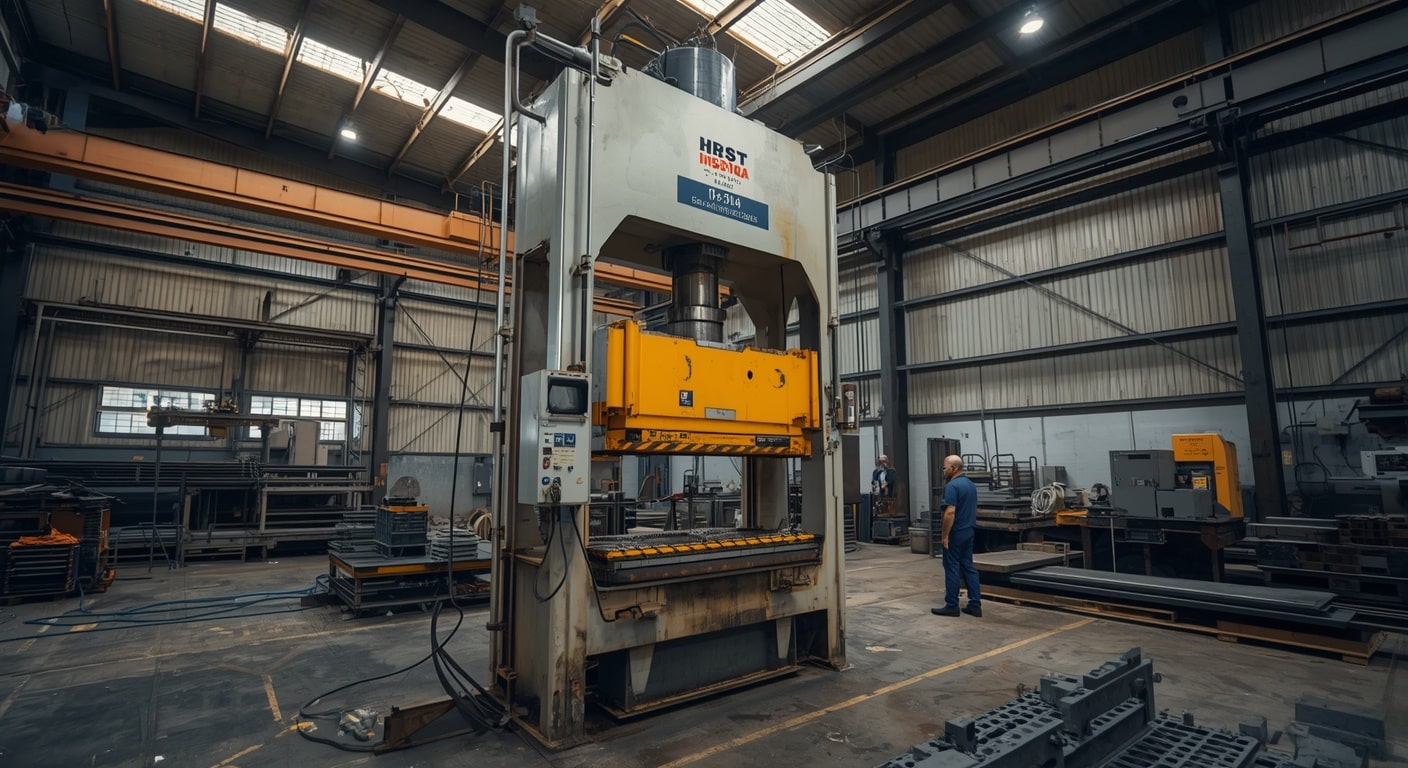
The frame affects rigidity and overall machine configuration. The bed influences how parts and tooling are supported. The cylinder, pump and valves determine how force is delivered and controlled. The control system affects repeatability, operator convenience and potential integration with broader factory operations.
For manufacturers comparing machines, it is often more useful to understand component function than to focus only on headline force ratings. A press that fits the process, tooling and workflow will usually deliver better practical results than one chosen only on size or advertised power.
Common types of hydraulic press machines
There is no single press layout that suits every manufacturing task. Hydraulic press machines come in several common configurations, each designed around access, stability, part size, tooling arrangement and workshop or production needs.
H-frame hydraulic press
An H-frame press has a frame shape resembling the letter H. It is commonly used for general pressing, assembly, straightening and maintenance work. This layout is often chosen where strength and a straightforward working arrangement are priorities.
Manufacturers may use H-frame machines in repair workshops, fabrication environments or low-to-medium volume production where flexibility matters.
C-frame hydraulic press
A C-frame press has an open-front design that improves access to the working area. This can make loading, unloading and tool access easier, especially for smaller parts or simpler operations.
Because of the open layout, it is often associated with jobs where operator access and workflow convenience are important, such as light forming, punching or assembly tasks.
Four-column hydraulic press
A four-column press uses four vertical columns to guide the moving structure and support the working area. This design is often selected for applications that benefit from a broad working zone, stable alignment or larger tooling arrangements.
It is commonly seen in forming processes, deep drawing and applications involving larger parts or more specialized tooling systems.
Hydraulic workshop press
A hydraulic workshop press is typically used for repair, maintenance and general-purpose pressing rather than dedicated high-volume production. Typical tasks include removing bearings, fitting bushings, straightening parts and performing service operations.
While simpler than many production presses, workshop models are still industrial equipment and should be selected with the same care for safety, access and application fit.
Application-specific press configurations
Some hydraulic press machines are configured around a particular process, such as molding, compaction, assembly or a specific forming method. Others are integrated into production cells with custom fixtures, dies, sensors or automated handling systems.
For that reason, the broad machine category is only the starting point. Buyers still need to evaluate tooling, process control, part geometry and production flow before deciding on a press design.
What hydraulic press machines are used for
Hydraulic press applications span both production and maintenance work. The key advantage is controllable force, which makes the technology suitable for material shaping, assembly and test operations across many industries.
Metal forming
Many manufacturers use a hydraulic forming machine for shaping metal parts through controlled pressure. Depending on tooling and process design, this can include forming, bending and reshaping work in fabrication and component manufacturing.
This is relevant to sheet metal shops, automotive supply chains, industrial fabrication and general metalworking operations where part geometry and repeatability matter.
Punching and stamping
A hydraulic stamping press can be used for punching, blanking or similar die-based operations where controlled force is important. Compared with other press types, hydraulic systems may offer more flexible control over the pressing cycle for certain jobs.
Actual suitability depends on the part design, tooling arrangement and production volume, not simply on whether the press is hydraulic.
Deep drawing
Deep drawing is a metal forming process in which sheet material is drawn into a die to create a deeper shape. Hydraulic presses are often associated with this process because they can apply force in a steady and controlled manner.
Manufacturers producing formed housings, covers or other drawn components may consider this type of press where process control and tooling behavior are important.
Assembly and press fitting
Hydraulic presses are also used to assemble components by pressing one part into another. Common examples include fitting bearings, bushings, sleeves and similar parts where alignment and controlled force matter.
In some factories, this supports sub-assembly work for machinery, automotive components or industrial products.
Straightening and correction work
A press machine for manufacturing may also be used to correct distortion, straighten shafts or align fabricated parts. This is common in maintenance, repair and rework environments where damaged or misaligned parts need controlled correction.
Compaction and testing
Some presses are used for compaction tasks or for testing how a component behaves under load. The same basic hydraulic principle can support very different end uses, which is why the intended process should always guide selection.
Across these applications, the press itself is only part of the system. Tooling, fixtures, controls, operator method and maintenance discipline are equally important to consistent results.
Hydraulic press vs mechanical press: what is the difference?
The main difference between a hydraulic press and a mechanical press is how force is generated and delivered. A hydraulic press uses fluid pressure through a cylinder, while a mechanical press uses a mechanical drive system to convert motion into pressing force.
Neither is universally better. The right choice depends on the forming method, tooling, production rate, force control needs and the type of parts being made.
| Factor | Hydraulic press | Mechanical press |
|---|---|---|
| Force generation | Uses hydraulic fluid pressure acting through a cylinder and ram. | Uses a mechanical drive system to transmit force through the press stroke. |
| Force control | Often preferred where controlled pressure and stroke flexibility are important. | Often selected where a fixed mechanical motion suits the process. |
| Stroke characteristics | Can support more adjustable movement and pressing behavior depending on controls. | Typically operates with a more defined mechanical stroke pattern. |
| Typical applications | Common in forming, deep drawing, assembly, straightening and general-purpose pressing. | Common in repetitive press operations where the mechanical setup matches the job. |
| Flexibility | Usually more adaptable across varied jobs and tooling requirements. | Often efficient when dedicated to a consistent, repeatable operation. |
| Maintenance focus | Requires attention to hydraulic fluid, seals, valves and leaks. | Requires attention to mechanical drive components, wear points and alignment. |
When a hydraulic press may be preferred
A hydraulic press may be the better fit when the application needs controlled force, process flexibility or a pressing profile that is not well suited to a purely mechanical motion. It is also commonly considered for assembly, repair, deep drawing and varied production work.
When a mechanical press may be preferred
A mechanical press may suit operations built around a more consistent, repetitive cycle with tooling and production flow designed specifically for that machine type. In many factories, the question is not which technology is best overall, but which one best matches the product and process.
Advantages and limitations of hydraulic press machines
Advantages
- Controllable force: useful for processes that need pressure to be applied in a steady and managed way.
- Versatility: one hydraulic press may support different tools, parts or operations depending on setup.
- Process flexibility: suitable for tasks such as forming, assembly, straightening and testing.
- Useful across production and maintenance: applicable in both manufacturing lines and workshop environments.
- Potentially better fit for complex pressing tasks: especially where stroke behavior or forming control matters.
Limitations
- Hydraulic system care is essential: fluid condition, seals, valves and leaks need ongoing attention.
- Cycle behavior may differ from mechanical systems: this can affect suitability for some high-repetition operations.
- Cleanliness matters: contamination in the hydraulic system can affect reliability and control.
- Setup still depends on tooling and process design: the press alone does not guarantee part quality.
- Maintenance capability should not be overlooked: support availability can be as important as the machine itself.
In short, hydraulic presses are best evaluated as process tools rather than generic force machines. Their real value depends on how well the press, tooling, controls and operating method align with the production requirement.
How to choose the right hydraulic press machine
Hydraulic press machine selection should start with the application, not the catalogue. Manufacturers in Malaysia often compare machines based on footprint or headline power alone, but the more important question is whether the equipment fits the material, tooling, workflow and maintenance environment.
A useful next step is to review broader equipment categories in the Industrial Machinery & Equipment Guide, especially if the press is part of a larger machinery investment plan.
Practical selection checklist
- Material type: What material is being formed, assembled, straightened or tested?
- Part size and geometry: How much working space, access and support does the part require?
- Process type: Is the press needed for bending, deep drawing, punching, compaction, press fitting or general workshop use?
- Production volume: Is the machine for occasional tasks, batch work or regular production?
- Tooling requirements: What dies, fixtures or special tooling will be used, and how will they be mounted?
- Control level: Does the process need simple manual operation or more advanced control over stroke and pressure?
- Floor space and layout: Will the machine fit the available production area and material flow?
- Loading and unloading method: Will parts be handled manually or integrated with lifting, conveyors or automation?
- Operator safety: What guarding, access control and emergency stop provisions are appropriate for the task?
- Maintenance support: Can the factory support hydraulic system care, troubleshooting and spare parts planning?
- Integration with existing operations: Will the press work smoothly with upstream and downstream processes?
Questions buyers should ask suppliers
Even when detailed specifications are under review, buyers should keep the conversation practical. Useful questions include:
- What applications is this press configuration commonly used for?
- How is the machine controlled during pressing and return?
- What tooling arrangements are supported?
- What routine maintenance does the hydraulic system require?
- What safety features are included as standard, and what depends on the final configuration?
- What local service, training or technical support is available?
These questions help move the discussion away from marketing claims and toward actual manufacturing suitability.
Practical operation and maintenance considerations
Good press performance depends as much on upkeep and operation as on machine design. Many hydraulic press problems begin with overlooked basics rather than major component failure.
Routine checks that matter
- Hydraulic fluid condition: fluid quality affects system performance and reliability.
- Leaks: visible leakage can signal seal wear, fitting problems or other hydraulic issues.
- Seal condition: worn seals can reduce control and create contamination or pressure loss problems.
- Alignment: ram, tooling and workpiece alignment affect part quality and equipment wear.
- Cleanliness: dirt and contamination can damage hydraulic components and reduce system consistency.
- Fasteners, hoses and connections: these should be checked as part of normal machine care.
Operator and process discipline
Operators should understand not only how to run the press, but also why setup, tooling placement and loading method affect results. Poor positioning, inconsistent workholding or incorrect tool installation can cause quality problems and unnecessary wear.
For manufacturers running varied jobs, documented setup procedures can help reduce mistakes between batches. Preventive maintenance planning is also important, especially where the press supports a critical operation and downtime could disrupt production.
Maintenance intervals, fluid types and inspection methods should follow the machine builder’s documentation and the factory’s maintenance system. Where the application is demanding, manufacturers may need more detailed service planning and closer monitoring.
Safety considerations before using a hydraulic press machine
Hydraulic presses can create serious crushing and pinch hazards if they are poorly guarded, incorrectly set up or used by untrained personnel. Safe use depends on both machine design and operating discipline.
Core safety points
- Guarding: the work area should be protected in a way that suits the machine layout and process.
- Emergency stops: operators should know where they are and how they function.
- Pinch point awareness: hands and body position must be kept clear of the pressing zone.
- Tooling setup: dies, fixtures and supports should be correctly installed and secured.
- Workpiece stability: parts should be positioned so that they do not shift unexpectedly during pressing.
- Lockout and isolation procedures: maintenance and setup tasks should follow the factory’s established energy isolation process.
- Training: only trained personnel should operate, set up or maintain the machine.
Specific workplace safety obligations, guarding requirements or machinery compliance expectations can vary by machine type, application and current regulatory guidance. Manufacturers should verify any Malaysia-specific safety requirements with the relevant authority and qualified safety personnel before commissioning or modifying a press installation.
Key takeaways for manufacturers
A hydraulic press machine is best understood as a controllable force system used for forming, assembly, straightening, compaction and testing. Its suitability depends on the job: material, part design, tooling, production volume, control needs and maintenance capability all matter.
For many manufacturers, the right decision is not simply choosing a hydraulic press over another machine type, but choosing the right press configuration for the intended process. Careful selection, proper setup, routine maintenance and practical safety controls are what turn a press into a reliable production asset.
If you are comparing this equipment with other factory machines, the broader Industrial Machinery & Equipment Guide is the best next reference point.
Frequently Asked Questions
What does a hydraulic press machine do?
A hydraulic press machine applies controlled compressive force to shape, form, assemble, straighten or test materials and components. In manufacturing, it is commonly used for metal forming, press fitting, deep drawing, correction work and other operations that require managed pressure.
How does a hydraulic press machine generate force?
It generates force by using a pump to move hydraulic fluid through a closed system. The fluid pressure acts on a hydraulic cylinder, which drives the ram and transfers controlled force to the workpiece or tooling.
What industries use hydraulic press machines?
Hydraulic presses are used in metalworking, fabrication, automotive-related manufacturing, industrial maintenance, component assembly and general production environments. The exact use depends on the process, tooling and product being made.
What is the difference between a hydraulic press and a mechanical press?
A hydraulic press uses fluid pressure to move a cylinder and ram, while a mechanical press uses a mechanical drive system. Hydraulic presses are often chosen for controllable force and flexibility, while mechanical presses may suit more dedicated repetitive operations.
What should manufacturers consider before buying a hydraulic press machine?
They should review the intended process, material, part size, tooling, production volume, control requirements, floor space, operator safety, maintenance support and how the press will fit into the existing production flow. The best choice depends on process fit, not only machine size.