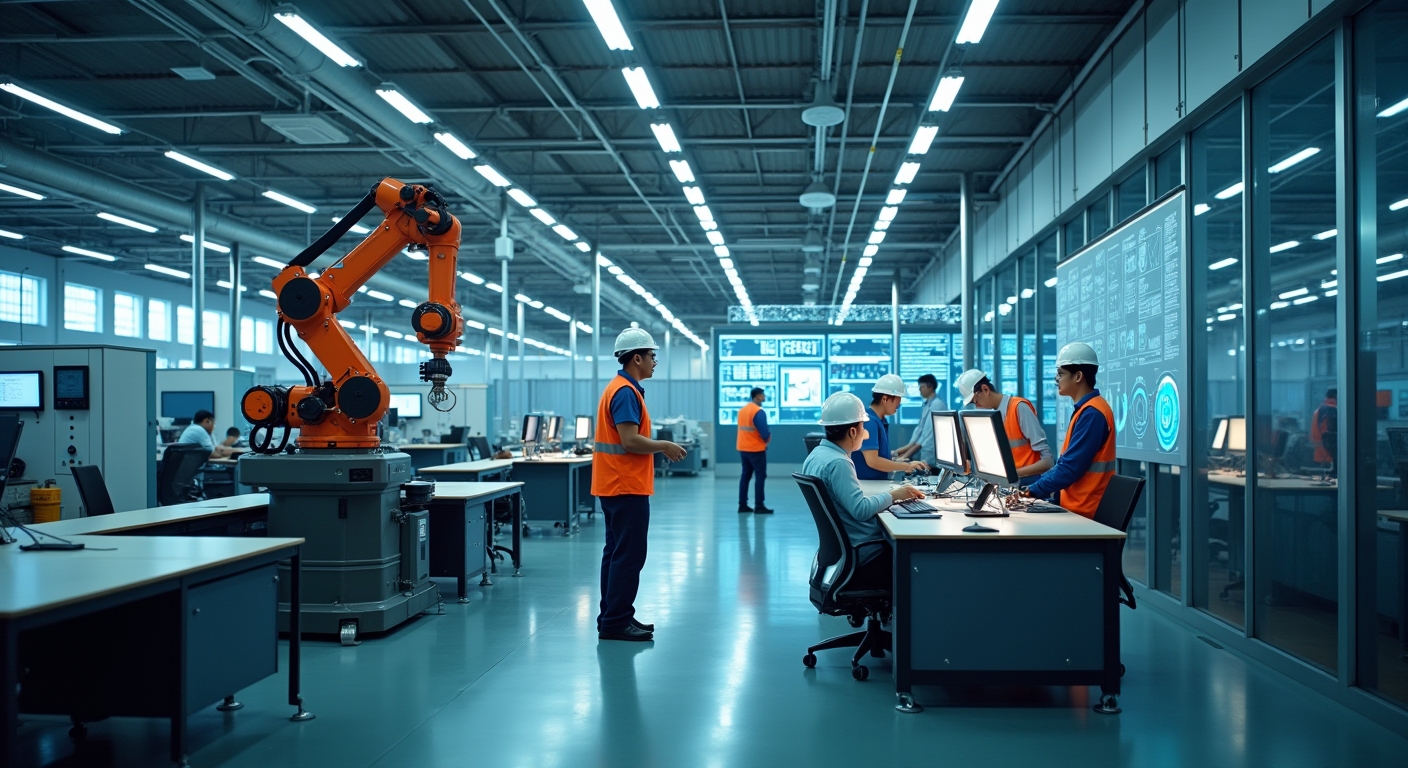

Industry 4.0 Malaysia refers to the use of connected digital technologies in manufacturing to improve visibility, control and decision-making across factory operations. In practice, it combines automation with data, software and machine connectivity so manufacturers can monitor production in real time, respond faster to problems and improve performance more systematically.
For Malaysian manufacturers, smart manufacturing is not limited to large multinational plants or fully automated high-volume lines. It can also apply to SMEs that want better machine monitoring, more reliable maintenance, clearer production dashboards or stronger traceability. The core idea is simple: connect what happens on the shop floor to the people and systems that need to act on it.
This guide explains what Industry 4.0 means in the manufacturing context, how a smart factory works, which technologies matter most, where the practical benefits come from, and how manufacturers can start with a realistic roadmap.
What is Industry 4.0 in Malaysia?
Industry 4.0 in manufacturing is the integration of machines, sensors, software, data and people so factory operations can be monitored, analysed and improved in a connected way. In Malaysia, the concept is relevant to factories that want more than standalone automation and need better coordination between production equipment, maintenance, quality and management systems.
The term is often used alongside smart manufacturing and smart factory. In practical terms, it means production assets do not operate in isolation. Machines generate data, systems share information, and teams use that information to make faster and better decisions.
A factory can be automated without being truly connected. For example, a packaging line may run with programmable controls and minimal manual intervention, but if production status, downtime reasons and quality alerts are recorded separately on paper or spreadsheets, the factory is not yet operating as a full Industry 4.0 environment. The shift happens when machine data, operational workflows and business systems begin to work together.
In the Malaysian manufacturing sector, this approach is relevant across many production environments, including electronics assembly, food processing, metal fabrication, plastics, packaging and automotive components. The level of implementation can vary widely. Some factories build integrated, multi-system environments. Others begin with simple shop-floor visibility projects that connect a few critical machines and create live dashboards.
How smart manufacturing works
A smart manufacturing system works by capturing information from production processes, moving that data into usable systems, analysing it and turning it into action. The goal is not just to collect data, but to improve how the factory responds to normal operations and operational problems.
A typical connected factory flow looks like this:
- Machines and sensors collect data from equipment, utilities, operators or inspection points.
- Connectivity tools transfer the data from the machine or device to a local or central system.
- Software platforms organise the information into production, quality, maintenance or planning views.
- Dashboards, alerts and analytics highlight issues such as downtime, scrap trends, cycle interruptions or maintenance risks.
- Supervisors, engineers and managers act on the information by adjusting schedules, fixing bottlenecks, planning maintenance or improving processes.
In a traditional factory, information often moves slowly. Operators may write shift data manually, technicians may troubleshoot after a machine has already failed, and managers may only see yesterday’s results after the shift has ended. In a data-driven manufacturing environment, the same information can be visible much earlier, which supports faster operational decisions.
For example, if a critical machine begins stopping repeatedly, connected monitoring can show the frequency of stops, the time of each event and the effect on output. Maintenance can investigate earlier, production can reallocate work if needed, and management can see the operational impact without waiting for manual reports.
This is why Industry 4.0 in manufacturing is not just about digitising reports. It changes how information flows from the shop floor to decision-makers and how quickly factories can respond.
Core technologies behind Industry 4.0
Industry 4.0 is built from several technologies that work together. Not every factory needs every technology at the same time, but most smart manufacturing projects involve some combination of connectivity, automation, software integration and analytics.
Industrial Internet of Things (IIoT)
The Industrial Internet of Things, or IIoT, refers to connected industrial devices that collect and share operational data. In manufacturing, this commonly includes machine signals, counters, sensors, meters and equipment status data.
IIoT in manufacturing makes it possible to see what equipment is doing while production is running. Depending on the application, manufacturers may capture data such as run status, stop events, cycle counts, temperatures, vibration, energy use, reject counts or environmental conditions. The exact data points depend on the process, machine type and monitoring objective.
The value of IIoT comes from visibility. Instead of relying only on manual records, teams can monitor production conditions in closer to real time. This is useful for understanding actual machine utilisation, identifying recurring stoppages, tracking line performance and improving maintenance response.
For example, a factory with several older machines may not replace all of them immediately. It may instead add sensors or connectivity modules to selected equipment so supervisors can monitor availability and downtime patterns through a central dashboard. This is a common first step in factory digitalisation because it improves information quality without requiring a full plant redesign.
Automation, robotics and machine integration
Automation uses control systems and programmed equipment to perform manufacturing tasks with reduced manual intervention. Robotics adds configurable mechanical systems that can handle actions such as picking, placing, loading, unloading, transferring or inspection support. Machine integration connects these automated assets so they can share status, sequencing or performance information.
In an Industry 4.0 setting, automation is an important component, but it is not the whole system. A robot cell or automated production line becomes more valuable when its operating data can be viewed alongside upstream and downstream processes, quality records and maintenance history.
For instance, an automated assembly station may be efficient on its own, but if its faults are not integrated into plant reporting, managers may still struggle to understand why throughput is inconsistent. Once the station is connected to monitoring and reporting systems, engineering teams can identify repeat issues, compare shift performance and coordinate improvements across departments.
Integration also matters where factories use a mix of new and legacy equipment. The objective is not always to create a perfectly uniform environment. Often, the practical goal is simply to make different machines visible within one operational framework.
Data analytics, AI and predictive maintenance
Data analytics turns raw production data into usable insight. That can include trend analysis, performance comparisons, exception reporting, quality correlation or maintenance planning. Analytics can be relatively simple, such as identifying the top causes of downtime, or more advanced, such as forecasting when equipment behaviour is starting to drift.
Artificial intelligence and machine learning are typically used where large data sets or pattern recognition can support better decisions. In manufacturing, examples may include anomaly detection, visual inspection support, process correlation or predictive maintenance models. The value depends heavily on data quality, process stability and the clarity of the use case.
Predictive maintenance means using equipment data and historical patterns to estimate when maintenance may be needed before a serious failure happens. This is different from purely reactive maintenance, where action is taken only after breakdown, and different from fixed-interval preventive maintenance, where service is scheduled by time rather than equipment condition.
Used correctly, analytics and AI in manufacturing can help factories:
- spot recurring downtime patterns
- prioritise maintenance work on critical assets
- identify process conditions linked to defects
- compare actual versus expected production performance
- improve planning with more reliable operational data
However, these tools do not automatically create value. If machine tags are inconsistent, quality data is incomplete or production events are not classified properly, the analysis may not support useful decisions. Smart manufacturing depends as much on data discipline as on advanced software.
Cloud, edge computing and software platforms
A connected factory usually needs several software layers, each serving a different role.
SCADA systems typically focus on supervisory control and operational visibility. They help operators and engineers view process status, alarms and equipment conditions.
MES, or manufacturing execution systems, usually support production management functions such as work order tracking, traceability, workflow control, production reporting and performance monitoring.
ERP systems generally manage wider business processes such as purchasing, inventory, finance, sales and planning. In a more integrated environment, ERP and manufacturing systems exchange information so shop-floor activity connects better with business decisions.
Cloud computing allows selected production information to be stored or visualised through centralised platforms and dashboards, which can make multi-site reporting and broader access easier. Edge computing processes data closer to the machine or production line, which can help where quick local response, filtering or reduced network dependency is important.
In practice, a smart factory may use a combination such as:
- edge devices to collect machine signals locally
- SCADA for operational visibility and alarms
- MES for production execution and traceability
- ERP for business planning and inventory coordination
- cloud dashboards for management reporting across departments or sites
The right architecture depends on the production process, existing systems, internal capabilities and integration priorities.
Industry 4.0 vs traditional automation
Traditional automation focuses on making machines or processes run with less manual intervention. Industry 4.0 goes further by connecting automation, data, software and decision-making across the factory.
| Area | Traditional automation | Industry 4.0 |
|---|---|---|
| Primary focus | Automating individual tasks or machines | Connecting operations, data and systems across the factory |
| Connectivity | Often limited to local machine control | Machine, software and business system connectivity |
| Data use | Basic local data or manual reporting | Continuous data collection, analysis and reporting |
| Operational visibility | Usually confined to the machine or line | Wider visibility across production, maintenance and management |
| Decision speed | Slower if information must be collected manually | Faster when alerts, dashboards and integrated data are available |
| Scalability | Can be difficult to compare or coordinate across assets | Better suited to multi-machine, multi-line or multi-site visibility |
| Maintenance approach | Often reactive or schedule-based | Can include condition monitoring and predictive analysis |
| Business integration | Limited link to planning or enterprise systems | Stronger integration with MES, ERP and reporting platforms |
This distinction matters because some manufacturers believe they have already completed digital transformation once a process is automated. In reality, a factory may be highly automated but still lack plant-wide data visibility, performance traceability or coordinated decision support.
Benefits of Industry 4.0 for manufacturers
When implemented well, smart manufacturing can improve both operational control and management visibility. The exact outcome depends on the process, data quality, workforce readiness and how clearly the project is linked to business goals.
- Better productivity visibility: teams can track output, downtime and utilisation more consistently.
- Faster problem detection: real-time alerts can highlight machine stops, quality deviations or process changes earlier.
- Reduced unplanned downtime: condition monitoring and better maintenance information can support earlier intervention.
- Improved quality control: production and inspection data can be linked more closely to find defect patterns and process drift.
- Stronger traceability: manufacturers can record batches, work orders, process events or equipment history more reliably.
- Better planning visibility: production status can be shared more clearly with supervisors, planners and management.
- More effective maintenance management: maintenance teams can prioritise assets based on actual behaviour and criticality.
- Energy and utility awareness: monitored consumption data may help identify unusual patterns or waste.
- Faster decision-making: managers do not need to wait for delayed manual reports to understand plant conditions.
- Cross-functional alignment: production, quality, maintenance and management can work from a more consistent set of data.
These benefits are not automatic. A dashboard alone does not improve a factory unless people use it to manage operations differently. Likewise, data capture without clear action rules can create noise rather than improvement. The strongest results usually come when technology supports a defined operational discipline.
Common use cases in Malaysian manufacturing
Smart manufacturing projects often begin with practical use cases rather than a large all-at-once transformation plan. In Malaysia, this approach is relevant to both established industrial operations and smaller factories that need focused operational improvements.
Machine monitoring and OEE dashboards
Many manufacturers start by tracking machine run status, stops and output counts. This creates a clearer view of equipment utilisation and production losses. In environments with multiple lines or several shifts, dashboards can help supervisors compare actual versus planned performance and prioritise follow-up.
Quality alerts and process traceability
In electronics, packaging, food processing and precision manufacturing, production quality often depends on consistent process conditions and reliable records. Connected data capture can support faster detection of abnormalities, more structured defect tracking and better linkage between production events and inspection outcomes.
Predictive and condition-based maintenance
Where unplanned downtime is costly or disruptive, factories may monitor selected critical assets for signs of abnormal behaviour. Maintenance teams can then investigate recurring issues earlier instead of relying only on emergency repair or fixed service intervals.
Warehouse and material visibility
Some smart factory projects focus less on machines and more on internal flow. Barcode, scanning or system-linked inventory movements can improve visibility over raw materials, work-in-progress and finished goods. This helps when production delays are caused by information gaps rather than equipment limitations alone.
Production reporting for SME factories
General SME manufacturing businesses often depend on manual whiteboard updates, spreadsheets or shift-end reporting. A practical smart manufacturing step is to digitise core production data first: output, rejects, downtime reasons and machine availability. Even a modest improvement in reporting accuracy can make planning and troubleshooting more consistent.
Challenges and barriers to implementation
Industry 4.0 projects often look straightforward at concept level but become more complex during implementation. The main challenge is rarely the technology alone. It is usually the gap between what the factory wants to improve and what its existing processes, systems and teams are ready to support.
Cost concerns and unclear return on investment
Manufacturers may hesitate because they associate smart factory initiatives with major capital spending. In reality, project cost depends on scope, integration requirements, equipment condition, software choices and internal resources. The bigger problem is often unclear ROI. If a project starts without a defined operational target, it becomes harder to justify the investment.
Legacy equipment and integration difficulty
Many factories operate a mix of old and new machinery. Some assets provide accessible digital signals while others do not. Integration can therefore involve additional hardware, custom interfaces or manual workarounds. That does not make transformation impossible, but it does affect project design and rollout speed.
Weak data quality
Connected systems only work well when the data is meaningful. If downtime reasons are inconsistent, machine names differ across systems, quality records are incomplete or operators bypass procedures, the resulting dashboards may not support reliable decisions.
Cybersecurity exposure
As factories connect more machines and software platforms, the attack surface becomes broader. Operational technology and business systems need controlled access, disciplined user management, secure network design and a clear response approach for incidents. Cybersecurity is not just an IT issue; it is an operational risk issue.
Workforce skills and change management
Smart manufacturing changes how people work. Operators may need to enter data differently, technicians may need to interpret condition signals, engineers may need stronger data analysis capability, and managers may need to rely less on informal reporting. Without training and clear ownership, new systems may be underused.
Too much ambition too early
Some projects fail because the initial scope is too broad. Factories try to connect every machine, every process and every department at once. A better approach is usually to start with a defined bottleneck, critical asset group or reporting problem, then scale once the factory has proven the operating model.
How to start an Industry 4.0 roadmap
A practical Industry 4.0 roadmap starts with operational priorities, not technology shopping. Manufacturers usually get better results when they focus on a specific problem, prove value in a pilot and expand in stages.
- Assess current operations. Review how production, maintenance, quality and planning information is collected today. Identify manual reporting gaps, repeated delays and weak visibility areas.
- Identify bottlenecks and business pain points. Focus on issues such as unplanned downtime, quality losses, low utilisation, poor traceability or delayed reporting.
- Define measurable goals. Decide what the project should improve, such as faster downtime response, better production accuracy, more reliable maintenance planning or clearer line-level visibility.
- Choose a pilot area. Start with one line, one cell, one process or one group of critical machines rather than the full plant.
- Select the right data points. Capture only the information needed to answer the business problem, such as machine status, stop events, output counts, defect logs or maintenance alerts.
- Decide the integration approach. Determine whether data should flow through sensors, controllers, gateways, SCADA, MES or other software layers based on the factory’s existing setup.
- Prepare people and workflows. Clarify who will use the data, who will respond to alerts and how the information will change daily operating routines.
- Train the relevant teams. Include operators, supervisors, maintenance personnel, engineers and managers where their input is needed.
- Measure outcomes and adjust. Compare results against the defined target, fix data or workflow issues, and refine the model before scaling.
- Scale in phases. Expand to more machines, lines or processes only after the pilot has established useful data, practical response routines and stable reporting.
This step-by-step approach helps manufacturers avoid building a connected system that looks advanced but does not solve a clear factory problem.
Key systems and data foundations to get right
Many smart manufacturing projects underperform because the data foundation is weak. Connected technology creates value only when the underlying structure is disciplined enough to support accurate analysis and repeatable action.
Machine and asset naming standards
If one system calls a machine by one name and another system uses a different label, reporting becomes harder to trust. Standardised naming conventions help align maintenance records, production data, spare parts history and dashboards.
Clear event definitions
Factories should define key events consistently. For example, the difference between planned stop, breakdown, waiting for material and quality hold should be clear enough that operators and systems classify them the same way.
Useful dashboard design
Dashboards should support action, not just display numbers. A supervisor may need shift output and current stops. Maintenance may need alarm history and repeat faults. Management may need trend visibility across lines or weeks. One dashboard rarely serves everyone equally well.
Interoperability between systems
MES, SCADA, ERP and machine-level systems are more valuable when information flows sensibly between them. Interoperability does not always mean full deep integration, but basic consistency between production status, work orders, inventory movement and performance reporting usually matters.
Maintenance discipline
Condition monitoring does not replace maintenance process discipline. Equipment records, work order follow-up, spare part control and root-cause analysis still matter. Without that discipline, predictive maintenance manufacturing projects may identify problems without ensuring reliable closure.
Cybersecurity policies and access control
Connected factories need clear control over who can access systems, change settings or retrieve data. Requirements vary by plant architecture and risk profile, but role-based access, backup discipline, patch management planning and network segmentation are common areas to review. Manufacturers should verify any formal standards or requirements that may apply to their own environment before implementation.
What SMEs should prioritise first
SMEs do not need to begin with a fully integrated smart factory programme. In many cases, the best first move is to improve visibility around a limited number of operational problems.
Good starting points for smaller manufacturers often include:
- Machine monitoring on critical assets: understand which machines stop most often and when production losses happen.
- Simple production dashboards: replace delayed manual reporting with clearer shift and daily visibility.
- Maintenance tracking: record breakdowns, response times and repeat faults more consistently.
- Quality data capture: digitise defect categories, inspection outcomes or process exceptions.
- Traceability for key products or batches: improve record quality where customer or operational demands require it.
These smaller projects are often more realistic than attempting a full connected factory architecture in the first phase. They help SMEs learn what data is actually useful, how teams respond to digital workflows and where the next investment should go.
For SME manufacturers, the priorities should usually be:
- solve a specific operational pain point
- keep the pilot scope narrow
- use data that teams will actually act on
- avoid buying software capabilities that the factory is not ready to use
- build internal understanding before expanding
This approach reduces risk and creates a stronger base for later digital transformation manufacturing projects.
Industry 4.0 implementation checklist
- Define the business objective before selecting technology.
- Identify the machines, lines or processes included in the first phase.
- Check what data is already available from existing equipment.
- Confirm what additional sensors, gateways or interfaces may be needed.
- Decide which systems will receive and display the data.
- Set clear KPI definitions for output, downtime, quality or maintenance performance.
- Standardise machine names, event categories and reporting rules.
- Assign ownership for alerts, dashboard review and corrective action.
- Review cybersecurity access, network structure and backup practices.
- Train operators, supervisors, engineers and maintenance teams on the new workflow.
- Run a pilot long enough to test data accuracy and operational response.
- Review the pilot results before scaling to more assets or departments.
Conclusion: building a practical smart manufacturing strategy
Industry 4.0 is not just about buying advanced equipment or adding more automation. The real value comes from connecting machines, software, data and people in a way that improves how the factory sees problems, makes decisions and manages performance.
For manufacturers in Malaysia, the most effective strategy is usually practical rather than ambitious for its own sake. Start with a real operational need, build a reliable data foundation, choose a manageable pilot and expand only when the factory can use the information consistently. That is what turns smart manufacturing from a concept into operational value.
Frequently Asked Questions
What does Industry 4.0 mean for manufacturers in Malaysia?
It means using connected digital tools to link machines, production data, software and decision-making across factory operations. For manufacturers, the practical goal is better visibility, faster response to problems, improved traceability and more informed planning rather than automation alone.
What is the difference between smart manufacturing and automation?
Automation focuses on making equipment or processes run with less manual intervention. Smart manufacturing includes automation but also adds connectivity, data sharing, monitoring, analytics and integration with wider factory or business systems.
Which technologies are most important in Industry 4.0?
The most common building blocks are IIoT connectivity, industrial sensors, machine integration, SCADA, MES, ERP integration, data analytics, cloud or edge computing, predictive maintenance tools and selected AI applications where the use case is clear.
How can SMEs adopt Industry 4.0 without a large budget?
SMEs can start with focused projects such as machine monitoring, production dashboards, maintenance tracking or digital quality records. A small pilot on a critical line or asset is often more effective than trying to digitise the whole plant at once.
What are the main risks or challenges of smart manufacturing?
Common challenges include unclear ROI, legacy equipment limitations, poor data quality, integration complexity, cybersecurity exposure, workforce skill gaps and weak change management. Many problems come from process readiness rather than the technology itself.
How do manufacturers measure success in an Industry 4.0 project?
Success should be measured against the original business objective. Depending on the project, relevant indicators may include better downtime visibility, improved reporting accuracy, faster maintenance response, stronger traceability, reduced recurring faults or more reliable production planning.