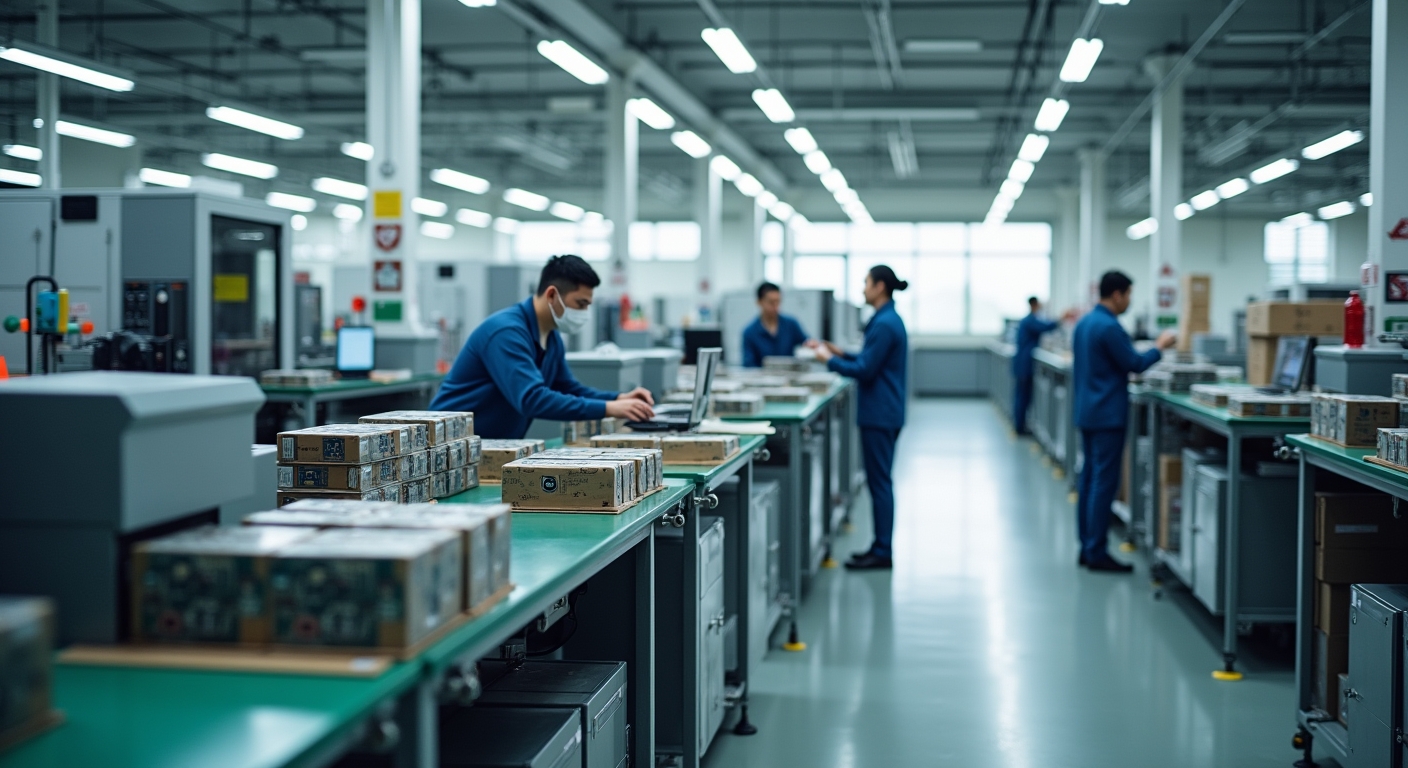
Contract manufacturing Malaysia refers to outsourcing product manufacturing to a third-party factory based in Malaysia. Depending on the arrangement, the hiring company may provide the product design, formula, specifications, bill of materials, packaging requirements or branding, while the contract manufacturer handles some or all production activities.
For Malaysian SMEs, established brands, importers and regional businesses, this model can reduce the need to build an in-house factory while still giving access to manufacturing capability. It can also support faster product launches, supplier diversification and scalable output. At the same time, success depends on choosing the right partner, setting clear quality standards and managing commercial risk properly.
This guide explains how contract manufacturing works, where it is commonly used, how it differs from OEM and related models, and what to review before selecting a supplier. For broader industry context, see our guide to manufacturing in Malaysia.
What is contract manufacturing in Malaysia?
Contract manufacturing in Malaysia is a business arrangement where a company hires a Malaysia-based manufacturer to produce goods on its behalf. The customer usually controls the product requirements and brand, while the manufacturer provides production capability, labour, equipment, process control and sometimes sourcing, packaging or logistics support.
In practice, the scope can vary widely. Some companies engage a Malaysia contract manufacturer only for production, while others require a more complete service that includes procurement, assembly, testing, filling, packing or export preparation. The exact setup depends on the product category, technical complexity and regulatory needs.
How contract manufacturing works
At a practical level, contract manufacturing starts with a clear product requirement and ends with approved goods being delivered according to agreed quality, quantity and timing.
- Define the product brief including specifications, drawings, formulations, materials, packaging and quality expectations.
- Identify and screen suppliers based on capability, sector experience, capacity, location and commercial fit.
- Request quotation and feasibility review to confirm production scope, assumptions and commercial terms.
- Develop samples or prototypes so both parties can verify the product standard before scaling.
- Run pilot production to test tooling, process stability, output consistency and inspection methods.
- Approve quality controls such as acceptance criteria, test methods, checkpoints and defect handling.
- Start full production once the sample, process and commercial terms are approved.
- Package and deliver the goods according to the agreed labelling, shipping and documentation requirements.
- Monitor ongoing performance through inspections, delivery tracking, corrective actions and supplier reviews.
Typical workflow in more detail
The process usually begins with a product brief. This may include technical drawings, a formula, a reference sample, expected tolerances, finishing requirements, packaging format, branding elements and target order volume. The clearer the input, the easier it is for a third-party manufacturing Malaysia partner to quote accurately and identify production risks early.
Next comes supplier sourcing and evaluation. Buyers often compare several manufacturers, especially when the product involves specialised processes such as electronics assembly, food processing, precision fabrication or regulated production. At this stage, it is important to check whether the manufacturer is genuinely experienced in the relevant product type rather than assuming general factory capability is enough.
After initial discussions, the manufacturer typically provides a quotation and comments on manufacturability. This is where issues such as material availability, tooling needs, minimum order quantities, packaging constraints or process limitations may surface. Early feasibility feedback can prevent expensive changes later.
Sampling or pilot production is a critical step. Approved samples help align both parties on quality expectations. Without this stage, commercial misunderstandings often appear only after full production begins. Once a pilot run is accepted, the parties can move into ongoing production with clearer process controls and inspection criteria.
Why businesses use contract manufacturing in Malaysia
Businesses use contract manufacturing in Malaysia for practical operational reasons rather than for one universal advantage. Whether it makes sense depends on the product, internal capabilities, forecast volume and degree of control required.
One major driver is lower capital commitment. Building and operating a factory requires spending on premises, machinery, utilities, labour, maintenance, process engineering and quality systems. Contract manufacturing allows a business to access production capacity without taking on all of that fixed infrastructure directly.
Another reason is speed to market. If a company already has a product concept, formulation or design, working with an established manufacturer may reduce the time needed to start supply compared with setting up in-house operations from scratch. This is especially relevant when a firm wants to test a market or expand its product line without a full plant investment.
Specialisation also matters. A contract manufacturer may already have the equipment, people and process knowledge needed for a specific product category. This can be useful in sectors where production requires controlled handling, repeatable batch processes, precision assembly, dedicated packaging lines or experienced quality assurance teams.
Scalability is another common benefit. Outsourced manufacturing Malaysia arrangements can help companies increase or reduce production more flexibly than a fully owned facility, particularly when demand is seasonal or uncertain. The hiring company can then focus more of its resources on product development, procurement, marketing, sales or customer support.
Some businesses also choose local or regional manufacturing partners for supply chain reasons. A capable Malaysian manufacturer may support shorter communication cycles, easier site visits, better coordination with local packaging or component suppliers, and smoother oversight compared with a more distant production base. However, the best fit still depends on the product, target market and service expectations.
Common contract manufacturing models
Terms such as contract manufacturing, OEM, ODM and private label are often used interchangeably, but they do not mean the same thing. The difference usually comes down to who owns the design, who controls the brand and how responsibilities are divided.
| Model | Who owns the product design? | Who controls the branding? | Manufacturer’s role | Typical use case |
|---|---|---|---|---|
| Contract manufacturing | Usually the hiring company | Usually the hiring company | Produces goods to the customer’s specification; may also support sourcing, testing or packaging | Brands with their own product requirements that need external production capacity |
| OEM | Usually the hiring company or brand owner, though the term is used differently across industries | Usually the hiring company | Manufactures products or components to the buyer’s design or specification | Industrial, electronics or component-based supply relationships |
| ODM | Usually the manufacturer | Buyer sells under its own brand or agreed brand arrangement | Designs and manufactures a ready-developed product that customers can customise to some extent | Faster product launch where the buyer does not want to develop a product from zero |
| Private label | Usually based on the manufacturer’s existing product platform or formula | Buyer controls the retail brand | Produces standard or semi-custom goods that are branded for the buyer | Retail, cosmetics, food, supplements, household or consumer products |
Contract manufacturer vs OEM
The phrase contract manufacturer vs OEM can be confusing because OEM is used differently in different industries. In many manufacturing contexts, OEM manufacturing Malaysia refers to a factory producing goods or components to a customer’s specification. That overlaps strongly with contract manufacturing.
In general use, contract manufacturing is the broader concept. It focuses on outsourcing production to a third party. OEM is often used when the buyer owns the product design or technical requirements and the factory produces to that specification. In some sectors, companies use both terms almost interchangeably, while in others OEM has a narrower meaning tied to component supply or original equipment production.
ODM and private label are different because the manufacturer usually contributes more of the product development base. That can reduce development time, but it may also reduce exclusivity and control.
Industries that commonly use contract manufacturing
Contract manufacturing in Malaysia appears across many sectors because not every company wants to own a factory. The model is especially common where products can be standardised, where output needs may fluctuate, or where specialist process capability is expensive to build internally.
Electronics
Electronics contract manufacturing Malaysia is often used for assembly, sub-assembly, testing and related production support. Electronics brands and industrial buyers may outsource because production can require specialised equipment, controlled processes, component handling discipline and repeatable inspection methods.
Food and beverage
Food contract manufacturing Malaysia is widely used by brands that have a product concept, recipe direction or packaging strategy but do not operate their own plant. These arrangements may cover blending, filling, packing or other production steps. Exact requirements can vary depending on the product category, process and target market, so businesses should verify sector-specific compliance obligations before launch.
Cosmetics and personal care
Private label manufacturing Malaysia is common in cosmetics, toiletries and personal care products. A manufacturer may provide a base formula or standard product format, while the buyer controls branding, packaging and market positioning. This can be attractive for companies that want a faster route to market with less product development from scratch.
Medical devices and healthcare-related products
Medical device contract manufacturing Malaysia may involve assembly, packaging or production support for healthcare-related products. Because this is a higher-risk area, businesses need to confirm the applicable product and market requirements directly with the relevant authorities and professional advisers rather than relying on general assumptions.
Consumer goods and household products
Many consumer brands use third-party manufacturing Malaysia arrangements for plastic goods, household items, packaged products and accessories. In these categories, outsourcing can help businesses focus on branding, distribution and retail relationships instead of factory operations.
Industrial components and packaging
Industrial firms may outsource fabrication, sub-assemblies, machining, molding, finishing or packaging where a supplier already has the right equipment and process controls. Contract manufacturing can also support procurement by reducing the need to manage multiple small in-house processes.
Key benefits and trade-offs to consider
Contract manufacturing can create real advantages, but it also introduces dependencies. A balanced assessment is more useful than assuming outsourcing is always cheaper or easier.
Potential benefits
- Lower upfront investment: The buyer may avoid major spending on production facilities, equipment and staffing.
- Faster launch potential: An experienced supplier may already have established processes and equipment.
- Access to specialised capability: This can include process knowledge, quality control routines or sector-specific production methods.
- Scalability: Production can often be adjusted more easily than in a fully owned facility.
- Operational focus: The buyer can concentrate on sales, branding, product management or distribution.
- Supply chain support: Some manufacturers can assist with sourcing, packaging or coordination of related suppliers.
Trade-offs and limitations
- Less direct control: The buyer is not managing every machine, operator or production decision on the shop floor.
- Quality variation risk: Output consistency depends on process discipline, inspection systems and clear standards.
- Lead-time dependency: Delays at the supplier can affect inventory, launches and customer commitments.
- Intellectual property concerns: Product knowledge, formulas, tooling or design information may need stronger protection.
- Supplier concentration risk: Relying too heavily on one plant can create continuity problems if capacity or business conditions change.
- Hidden coordination effort: Outsourcing does not remove management work; it shifts it into supplier management, communication and oversight.
The best decision usually depends on product maturity, margin structure, order volume and the level of quality control the business needs to retain.
How to choose the right contract manufacturer
Knowing how to choose a contract manufacturer is often the difference between a scalable supply relationship and a costly sourcing problem. The right supplier is not just the lowest quoted option. It is the one that can repeatedly make the product to the required standard under practical commercial terms.
Core evaluation checklist
- Production capability: Can the factory actually make this product using the required process, materials and finish?
- Quality systems: Are there documented checks, sample controls, inspection records and corrective action routines?
- Sector experience: Has the supplier handled similar products, customers or production requirements before?
- Minimum order quantities: Do the supplier’s batch sizes fit your demand pattern and working capital limits?
- Engineering and technical support: Can the team provide manufacturability feedback, troubleshooting or process improvement input?
- Tooling arrangements: If molds, dies, fixtures or custom tooling are needed, who pays, who owns them and who controls access?
- Lead times and planning discipline: How does the supplier schedule production, procurement and delivery?
- Communication quality: Are responses clear, timely and technically competent?
- Location and logistics: Is the plant location practical for site visits, transport and market access?
- Export capability: If products will be shipped abroad, can the supplier handle the required documentation and shipping coordination?
- Financial stability: Is the manufacturer likely to remain a reliable operating partner over the life of the relationship?
Ask for samples and evidence, not only promises
Before committing to ongoing production, request samples, trial runs or pilot output where practical. Reviewing an actual product is often more useful than relying on brochures or verbal assurances. A sample can reveal issues in fit, finish, packaging, material consistency or process repeatability that are not obvious during early discussions.
It also helps to request documented information such as inspection forms, standard operating procedures, process flow summaries or example quality records where appropriate. The goal is not to create unnecessary paperwork, but to understand whether the factory manages production systematically.
Use factory audits for higher-risk products
Factory audits are especially helpful when the product is technically demanding, brand-sensitive or difficult to inspect only at final delivery. A buyer audit may review process flow, housekeeping, material handling, traceability, inspection points, maintenance discipline, training practices and change control. The purpose is to confirm whether the factory’s real operating condition matches its sales presentation.
For some products, a desktop review may be sufficient at the early stage. For higher-risk categories, an on-site audit by the buyer or a qualified representative is often a more reliable way to assess the supplier.
What to check before signing an agreement
A contract manufacturing agreement should translate product expectations into clear commercial and operating terms. It is not enough to agree on unit price and delivery dates. Many disputes arise because specifications, quality standards and ownership issues were not defined clearly at the start.
Key points to review include:
- Product specifications: Drawings, formulas, materials, dimensions, packaging requirements and revision control.
- Quality acceptance criteria: What counts as acceptable output, what defects are critical and how inspections will be conducted.
- Commercial structure: Pricing method, payment terms, order commitments and any assumptions that affect cost.
- Tooling ownership: Who owns molds, dies, jigs, fixtures or custom equipment, and what happens if the relationship ends.
- Confidentiality: How product information, formulations, drawings and customer data must be protected.
- Intellectual property: Who owns the design, branding, packaging artwork and any process-related improvements.
- Change control: How material substitutions, specification updates or process changes are approved.
- Delivery terms: Production schedules, shipment responsibilities, packaging standards and documentation expectations.
- Defect handling: What happens when goods fail inspection, including reporting, segregation, replacement or corrective action.
- Termination and exit terms: How either party can end the agreement and what happens to inventory, work in progress and tooling.
Legal drafting needs vary by product, industry and transaction structure. Businesses should seek professional legal review where needed, especially when intellectual property, product liability or cross-border supply obligations are significant.
Quality control and risk management in contract manufacturing
Quality control contract manufacturing should not begin only at final inspection. Effective supplier management uses controls throughout the production cycle, from approved sample to shipped goods.
Practical quality controls
One of the most important tools is the approved sample or master reference. This gives both parties a physical or documented baseline for what acceptable output looks like. It helps reduce subjective arguments later.
Incoming material checks also matter, especially where product performance depends heavily on raw materials, components or packaging. If the manufacturer is sourcing on the buyer’s behalf, there should be clarity about approved suppliers, substitute materials and verification steps.
In-process inspection helps catch defects before they are repeated across an entire batch. Depending on the product, this may involve dimensional checks, visual inspection, functional tests, line clearance routines or batch record review. Final inspection then verifies whether the finished goods meet the agreed acceptance criteria before release.
Traceability is another useful control, particularly for products where batch history, component origin or process recordkeeping matters. A corrective action process is equally important. When a defect occurs, the question is not only whether the batch can be sorted or replaced, but whether the underlying cause is identified and prevented from happening again.
Many buyers also use supplier scorecards to review delivery reliability, defect trends, responsiveness and general performance over time. This turns supplier management into an ongoing process rather than a one-time sourcing decision.
Risk control checklist
- Approve a final sample, specification set or golden sample before mass production.
- Document inspection points for incoming materials, in-process checks and final release.
- Define defect categories and acceptance criteria in writing.
- Control material or process changes through formal approval.
- Maintain batch, lot or production traceability where relevant.
- Set up a clear non-conformance and corrective action process.
- Review supplier performance regularly using quality and delivery metrics.
- Avoid overdependence on one supplier where business continuity is critical.
Is contract manufacturing the right fit for your business?
Contract manufacturing is not automatically the right model for every company. It tends to work best when the product is already reasonably defined, expected demand is sufficient to support outsourced production, and the business is comfortable managing suppliers rather than owning every production step internally.
If your business has a mature product design, stable specifications and limited appetite for factory investment, outsourcing may be a practical way to scale. It can also make sense when production requires specialist equipment or know-how that would be inefficient to develop in-house.
On the other hand, the fit may be weaker if the product changes constantly, production volumes are too low to satisfy supplier economics, or the business requires unusually tight control over every process detail. The same applies if compliance obligations are highly specific and the manufacturer cannot clearly demonstrate relevant capability.
A simple evaluation framework is:
- Product maturity: Is the product definition stable enough for an external factory to run consistently?
- Forecast stability: Can you provide realistic volume expectations and ordering patterns?
- Internal capability: Do you want to build manufacturing capability, or focus on brand, sales and market development?
- Compliance complexity: Does the product require specialised controls that only some factories can support?
- Margin expectations: Will outsourced production still leave enough margin after quality, logistics and coordination costs?
- Desired control level: Are you comfortable managing through specifications, audits and agreements rather than direct daily supervision?
If most answers support external production, contract manufacturing may be a good fit. If not, a hybrid model or more in-house production control may be safer.
Frequently Asked Questions
What is contract manufacturing in Malaysia?
It is an arrangement where a company hires a Malaysia-based factory to produce goods on its behalf. The hiring company usually controls the product requirements or branding, while the manufacturer handles production and may also support sourcing, packaging or logistics.
What is the difference between contract manufacturing and OEM?
Contract manufacturing is the broader concept of outsourcing production to a third party. OEM often refers to manufacturing based on the buyer’s design or technical specification. In many industries the terms overlap, but OEM usually places more emphasis on the customer’s product specification.
How do I choose a contract manufacturer in Malaysia?
Assess production capability, quality systems, relevant sector experience, communication, minimum order quantities, tooling arrangements, delivery discipline and financial stability. Samples, pilot runs and factory audits are often the best way to verify that a supplier can meet your real product requirements.
What are the main risks of contract manufacturing?
Main risks include inconsistent quality, delayed delivery, weak communication, excessive dependence on one supplier, intellectual property exposure and unclear ownership of tooling or process changes. These risks can be reduced through better supplier selection, tighter specifications and stronger quality controls.
What should a contract manufacturing agreement include?
It should clearly cover product specifications, quality acceptance criteria, pricing structure, tooling ownership, confidentiality, intellectual property, change control, delivery terms, defect handling and termination terms. The exact structure depends on the product and commercial arrangement, so legal review may be appropriate.
Conclusion
Contract manufacturing in Malaysia can be a practical solution for businesses that want production capability without building and operating a factory themselves. The model is most effective when the product is well defined, the manufacturer has proven capability, and both parties align on specifications, quality control and commercial terms.
Before scaling, focus on supplier fit, approved samples, agreement clarity and ongoing performance monitoring. Done properly, contract manufacturing can support growth, flexibility and better use of internal resources without removing the need for disciplined supplier management.