Air compressor sizing for a factory means matching compressed air supply to the real needs of the plant, including airflow, pressure, duty cycle, air quality and system losses. In practice, air compressor sizing factory decisions should be based on the full compressed air system, not just compressor horsepower or a rough estimate from past installations.
For factory managers, engineers and procurement teams, the main goal is simple: supply enough stable air for production without paying for unnecessary capacity or creating reliability problems elsewhere in the plant. This guide explains what affects factory air compressor sizing, how to calculate compressed air demand, how storage and piping influence performance, and what to check before making a purchase decision.
If you are reviewing compressor options as part of a wider equipment planning exercise, it also helps to understand where compressed air fits within your broader industrial machinery and equipment guide considerations.
What air compressor sizing for factories means
Air compressor sizing for factories is the process of selecting a compressed air system that can deliver the required flow rate at the required pressure, for the required operating pattern, while accounting for air treatment, storage, piping losses and future operating conditions. Correct sizing is a system design task, not only a question of motor size or compressor type.
Why correct sizing matters in a manufacturing environment
Compressed air is often treated as a basic utility, but poor sizing can affect production quality, maintenance workload and operating cost. In many plants, pneumatic tools, actuators, packaging equipment, automation components and blow-off points all depend on consistent compressed air performance. When the compressor system is poorly matched to demand, the problem tends to appear across the factory rather than at a single machine.
What happens when the system is undersized
An undersized compressor or system may struggle to maintain pressure when several users operate at the same time. The result can include slow actuator movement, machine faults, unstable process performance and lost output during peak production periods. In some cases, operators try to compensate by increasing set pressure, which may create extra stress on the system without solving the real airflow shortfall.
Undersizing can also increase wear if the compressor runs heavily loaded for long periods without enough recovery time. Where moisture control depends on stable operating conditions, poor sizing may also make downstream air quality harder to manage.
What happens when the system is oversized
Oversizing is also a problem. A compressor that is too large for actual demand may cycle inefficiently, operate far from its most suitable load range or consume more energy than necessary. It can also increase capital cost if buyers choose a larger unit, larger accessories or more space than the application really needs.
Oversizing is sometimes justified for planned expansion, but only when the expansion case is credible and the system design supports it. Buying excess capacity “just in case” often locks a factory into poor part-load operation and unnecessary maintenance complexity.
Why factory managers should treat sizing as a business decision
Correct factory air compressor sizing is not only an engineering calculation. It affects uptime, process consistency, maintenance planning and utility efficiency. A well-sized compressed air system supports production with fewer pressure complaints, fewer workarounds on the shop floor and a clearer basis for future upgrades.
The main inputs used to size a factory air compressor
Before any equipment selection begins, the factory needs a clear picture of demand. The most useful starting point is not the existing compressor nameplate, but the actual end uses of compressed air throughout the plant.
Required airflow
Airflow is the volume of compressed air the system must deliver to all connected uses. In practical terms, this means identifying demand from production machines, pneumatic cylinders, process tools, packaging lines, robotic end effectors, blow guns, air knives, instrumentation and any other air-consuming devices.
The key point is to total actual demand, not to guess based on the size of the current compressor. Existing systems may already be oversized, undersized or compensating for leaks. For that reason, compressed air demand calculation should begin with equipment data from machine documentation, supplier information or measured operating conditions where available.
Required pressure
Pressure is different from airflow. Pressure describes the force level needed at the point of use for equipment to function correctly. A machine might need a certain minimum pressure at its inlet, but the compressor may need to produce a higher system pressure to overcome losses through filters, dryers, valves and distribution piping before the air reaches that machine.
This is why compressor selection should consider both end-use pressure and system pressure. If pressure drop is ignored, a factory may choose a compressor that appears suitable on paper but cannot maintain the required pressure at the far end of the line during production.
Duty cycle and operating pattern
Duty cycle describes how heavily and how often the compressor is expected to operate. Some factories have relatively steady demand across full shifts. Others have intermittent peaks driven by batch processing, changeovers, packaging cycles or pneumatic cleaning activities.
Operating pattern matters because average demand alone can be misleading. A plant with low average use may still need strong short-term delivery during simultaneous machine cycles. Shift structure also matters. Day shift, night shift, weekend use and maintenance shut periods can all influence the most appropriate compressor arrangement.
Air quality needs
Not every application needs the same air quality. Some processes can tolerate basic treated compressed air, while others require drier or cleaner air to protect product quality, instrumentation or surface finish. Painting, sensitive assembly work, food-related processing, electronics handling and control air applications often need more attention to air treatment.
Air quality affects sizing because dryers, filters and other treatment components create system resistance and need to be selected as part of the overall compressed air system planning process. Compressor output alone is only one part of the solution.
How to calculate compressed air demand step by step
To size an air compressor for a factory, first list every air-consuming machine or process, record each item’s required airflow and pressure from manufacturer documentation, identify which users operate at the same time, account for system losses and a reasonable reserve, then match the result to the compressor, receiver, dryer, filters and distribution system.
- List all air users. Include production machines, pneumatic tools, automation devices, air blow-off points, packaging equipment, instrumentation and maintenance connections.
- Record the requirement for each item. Use manufacturer documentation or verified supplier data for airflow and pressure. Avoid guessing from pipe size or compressor motor size.
- Group equipment by operating pattern. Separate continuous users from intermittent users. Note which machines run every shift and which operate only during certain batches or product types.
- Identify simultaneous use. Determine which equipment can demand air at the same time. This step is critical because total installed demand is often higher than actual operating demand.
- Account for system losses. Review filters, dryers, control valves and distribution piping for pressure drop or restrictions that affect the pressure required from the compressor side.
- Consider leakage and operational reserve. If the plant has known leakage or expected process variation, include that in planning rather than relying on ideal conditions.
- Match demand to the full system. Select compressor capacity together with receiver tank, dryer, filters and piping layout so the system can support real plant conditions.
- Validate before purchase. Confirm assumptions with equipment suppliers, internal maintenance teams and actual production usage patterns before final approval.
This step-by-step approach is usually more reliable than selecting by compressor type alone or copying another site’s installation.
How to account for peak demand instead of average demand
Peak demand is often where compressed air systems succeed or fail. A factory may look acceptable when average use is calculated across a shift, yet still experience pressure problems because several high-use events happen at the same moment.
Examples of peak contributors include packaging equipment cycling together, multiple pneumatic actuators operating during line startup, blow-off stations used simultaneously, maintenance air use during production and process areas that demand short bursts of high flow. Pneumatic conveying or rapid motion applications can also create short but significant peaks.
The practical way to account for this is to build a simple demand profile by process area, machine group or shift. Instead of asking only, “How much air does the factory use in total?” ask:
- Which users run continuously?
- Which users cycle on and off?
- Which users can demand air at the same time?
- When do the largest peaks happen?
- Do those peaks happen daily, occasionally or only during certain products?
A simple example illustrates the issue. Imagine a plant with a modest average air load overall, but with a packaging section where several cylinders, vacuum generators and blow-off nozzles operate together at product transfer points. The average consumption across the shift may appear manageable, yet the short peak at those transfer moments can cause pressure dip if the compressor, receiver or piping cannot respond fast enough.
That is why industrial air compressor selection should be based on a realistic operating profile, not only an average number from a monthly utility review.
Pressure, flow and storage: how the system works together
Compressed air performance depends on several connected components. The compressor creates the supply, but storage, treatment and distribution determine whether the plant receives stable and usable air where it matters.
| System component | Main role | How it affects sizing |
|---|---|---|
| Compressor | Generates compressed air at the required system conditions | Must match the factory’s actual airflow demand, pressure requirement and operating pattern |
| Receiver tank | Provides air storage and helps buffer short-term demand swings | Can smooth fluctuations and reduce cycling, but does not replace proper compressor capacity sizing |
| Dryer | Removes moisture to support required air quality | Needs to be considered in system design because treatment equipment affects pressure loss and operating performance |
| Filters | Remove particles, oil or contaminants depending on application | Improve air quality but can add restriction if undersized, poorly maintained or not suited to the application |
| Distribution piping | Delivers air from the compressor room to points of use | Piping layout, distance and restrictions influence pressure drop and the pressure required upstream |
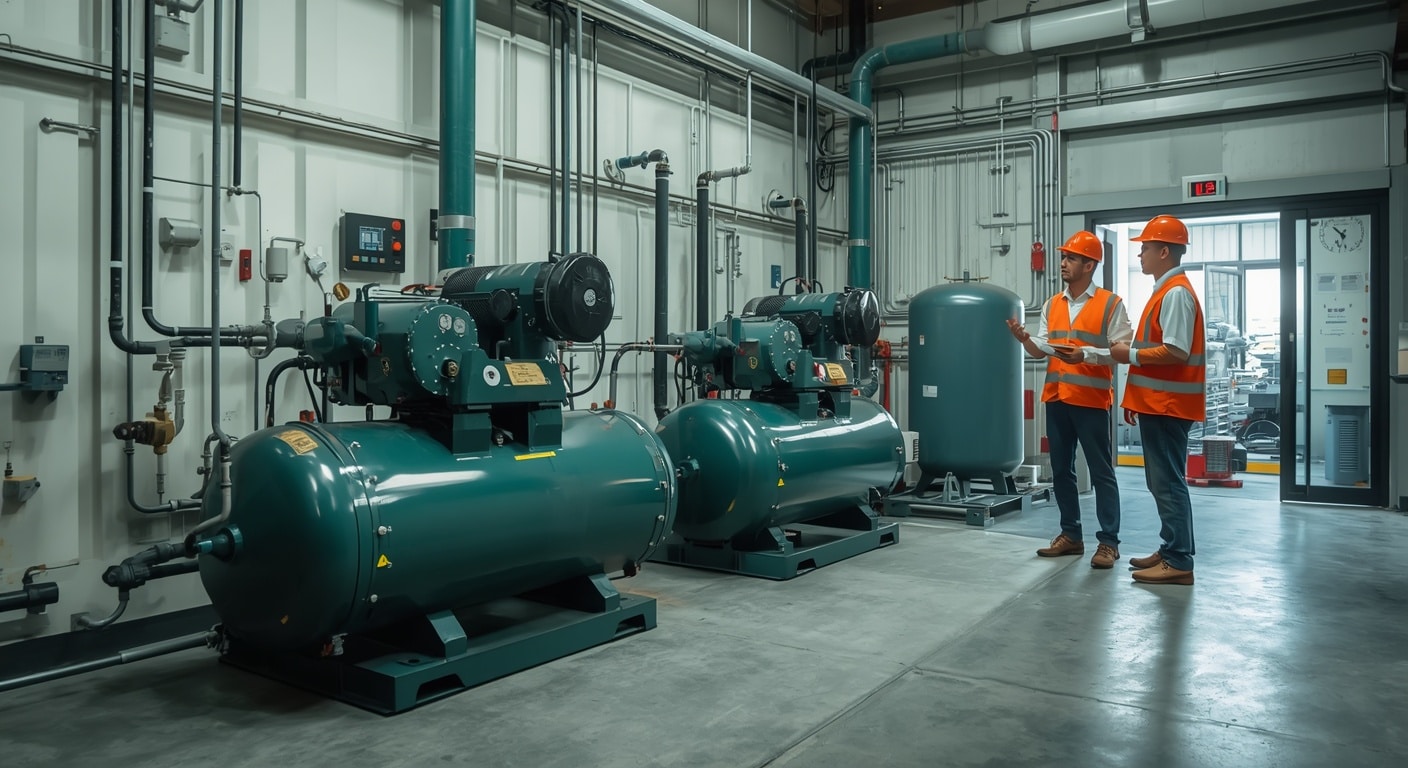
This relationship matters because compressor capacity sizing is only one part of the real system. A factory can have a compressor that appears large enough, but still suffer poor end-use performance due to weak storage strategy, excessive pressure drop or poorly planned distribution piping.
Receiver tanks are especially useful for buffering short-term events, but they should not be used as a substitute for a badly undersized compressor. Storage helps the system respond to temporary swings. It does not create airflow that the compressor cannot ultimately supply.
Common factory mistakes when sizing an air compressor
- Sizing only by horsepower. Motor size alone does not define whether the system can deliver the required airflow and pressure for the application.
- Ignoring simultaneous demand. Adding all machine names together without checking who runs at the same time can give the wrong picture in either direction.
- Using average demand as the main basis. Short production peaks often matter more than average shift consumption.
- Overlooking leaks. Leaks increase background demand and can distort compressor selection if they are not identified.
- Neglecting pressure drop. Filters, dryers, valves and long piping runs affect delivered pressure at the machine.
- Assuming future expansion without a clear plan. Expansion allowance should be deliberate, not speculative.
- Copying another factory’s setup. Even similar plants can have very different duty cycles, process risks and air quality needs.
- Separating compressor purchase from system review. Buying the compressor first and reviewing distribution later often leads to avoidable performance issues.
When one compressor may not be enough
Some factories are better served by more than one compressor rather than a single larger unit. This can make sense when demand varies significantly by shift, when separate process areas operate differently, or when production continuity requires some level of redundancy.
A lead-lag arrangement may help a plant handle changing loads more flexibly, with one unit covering base demand and another supporting higher-load periods when needed. Multiple compressors may also be useful where maintenance access is important and a complete shutdown of compressed air supply would disrupt operations.
The right configuration depends on the load profile, control approach, maintenance strategy and criticality of the process. The main point is that air compressor sizing for a factory should consider system architecture, not only the size of an individual machine.
Practical selection considerations for Malaysian factories
For Malaysian factories, sizing decisions should also reflect local operating conditions and practical plant realities. Humid conditions can make moisture management more important in everyday operation, especially where downstream equipment or product quality is sensitive to water carryover. That does not automatically mean every site needs the same treatment setup, but it does mean air quality planning should be taken seriously.
Production continuity is another practical issue. In facilities with tight delivery schedules or continuous processes, compressed air interruptions can affect more than one machine at a time. That makes maintainability, service access and equipment layout important selection considerations alongside nominal compressor capacity.
Space constraints also matter. Compressor room layout, ventilation, pipe routing and access for maintenance can influence which system arrangement is realistic. A technically suitable compressor may still be a poor choice if the site cannot support proper servicing or distribution piping design.
Power quality and plant utility stability may also affect how comfortably a system operates, especially in facilities with variable loading patterns. Rather than assuming a standard solution, engineering and procurement teams should review the plant’s actual operating environment before finalizing the specification.
A useful Malaysia factory air compressor guide should therefore stay practical: verify demand, understand site conditions, and avoid one-size-fits-all assumptions.
A simple checklist before choosing a compressor
Before requesting quotations or approving a purchase, align operations, maintenance, engineering and procurement around a common checklist.
- Machine list completed: All air-consuming equipment has been identified, including non-production uses.
- Pressure requirements verified: End-use pressure needs are confirmed from machine documentation, not memory or assumption.
- Usage pattern mapped: Continuous loads, intermittent loads, batch production and peak demand periods are understood.
- Air quality reviewed: Sensitive applications have been identified so dryer and filter needs are included early.
- Piping system reviewed: Current distribution layout, restrictions and likely pressure drop points have been considered.
- Leak inspection considered: Known leakage has been checked so it does not distort compressor sizing.
- Expansion assumptions documented: Future growth is included only if there is a real production plan behind it.
- Maintenance plan discussed: Service access, downtime planning and spare support have been considered.
- Supplier data validated: Proposed compressor and accessory selections are checked against your actual demand profile and system conditions.
This checklist helps prevent a common problem in compressed air system planning: one team focuses on purchase price, another on machine reliability, and neither fully validates the operating assumptions behind the final selection.
Frequently Asked Questions
How do you size an air compressor for a factory?
Start by listing every air-consuming machine and process, then verify each item’s airflow and pressure requirement from manufacturer documentation. Next, identify simultaneous usage, review duty cycle and peak demand, consider pressure losses through the system, and match the result to the compressor, receiver, dryer, filters and piping.
What is the most important factor in factory air compressor sizing?
The most important factor is verified real demand at the point of use. That includes actual airflow, required pressure and when different users operate at the same time. A compressor that looks adequate in theory can still perform poorly if the demand profile or system losses are misunderstood.
Why is airflow different from pressure when selecting a compressor?
Airflow is the volume of compressed air the factory needs, while pressure is the force level required for equipment to operate correctly. A system may have enough pressure but not enough airflow during peak use, or enough airflow but poor delivered pressure because of losses in piping, filters or dryers. Both must be considered together.
What happens if a factory air compressor is oversized?
An oversized compressor may cost more to buy, use more energy than necessary and operate inefficiently at low load or frequent cycling conditions. It can also encourage poor system design decisions if buyers assume excess capacity will solve pressure or distribution issues that are actually caused by storage, piping or control problems.
Do you need a receiver tank when sizing a factory compressor?
In many factory systems, a receiver tank is useful because it helps buffer short-term demand changes and can reduce unstable cycling. However, it should be treated as part of the total compressed air system, not as a substitute for proper compressor sizing. The right storage approach depends on how the factory uses air and how variable the demand is.
Conclusion
Proper air compressor sizing for a factory depends on more than choosing a machine with enough nominal capacity. The decision should be based on verified airflow demand, required pressure at the point of use, operating pattern, air quality needs and the supporting system around the compressor. When factories take time to validate these conditions before purchase, they are far more likely to get stable performance, manageable maintenance and a system that supports production instead of limiting it.