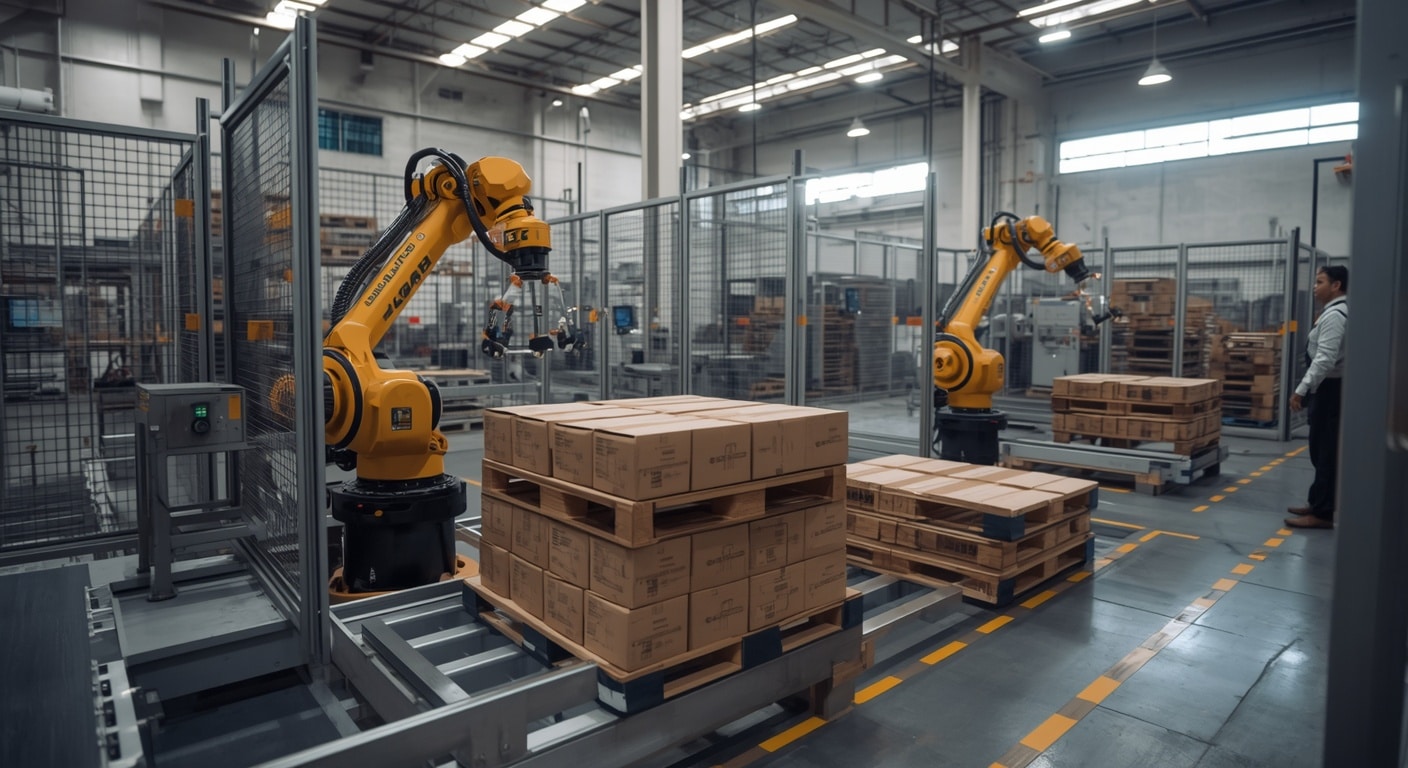
Robotic palletizing systems are used at the end of a production or packaging line to automatically stack products onto pallets in a planned pattern. For manufacturers, they sit at the intersection of end-of-line automation, material handling, and warehouse flow. Understanding how these systems work helps factory teams decide whether robotic palletizing is a practical fit for their product mix, layout, and broader automation plans.
This guide explains the basic operating principle, main components, common applications, expected advantages, limitations, and the key points manufacturers in Malaysia should review before discussing a solution with suppliers or integrators.
What are robotic palletizing systems?
Robotic palletizing systems are automated end-of-line systems that use industrial robots to pick products such as cartons, bags, cases, or bundled items and place them onto pallets according to a programmed stacking pattern. Their purpose is to reduce manual pallet loading and create more consistent pallet builds for storage, transport, or further warehouse handling.
In practical terms, a robot palletizer is usually installed after packaging, sealing, labeling, or case packing. Products arrive on a conveyor, the robot identifies or receives the pick position, grips the product with a suitable end effector, and places it onto a pallet layer by layer. The system may be configured for one product type or adapted for multiple SKUs, depending on the cell design and controls.
Because palletizing is part of the wider end-of-line process, it is often evaluated within a broader plan for factory automation in Malaysia, especially when manufacturers want to improve consistency between packaging, internal handling, and warehouse operations.
How a robotic palletizing system works
A robotic palletizing system usually follows a repeatable sequence from product infeed to full pallet discharge.
- Products arrive at the infeed. Cartons, bags, pails, trays, or other packaged items are transferred from the upstream line onto a conveyor or staging area.
- The system detects product position and flow. Sensors, conveyor controls, and sometimes machine vision help confirm that products are in the correct location and orientation for picking.
- The robot picks the product. The robot arm moves to the pick point and uses its gripper or end effector to lift one item or multiple items, depending on the application.
- The product is oriented if needed. Some applications require the item to be rotated or aligned before placement so that the pallet pattern is stable and repeatable.
- The robot places the product on the pallet. The programmed pattern determines where each item is placed to build a layer with the required arrangement.
- Layers are built until the pallet is complete. The system continues stacking until the target pallet height or pattern is finished.
- The completed pallet is discharged. The full pallet is moved out for wrapping, storage, or warehouse transfer, and an empty pallet is introduced for the next cycle.
Although the sequence looks simple, reliable operation depends on coordination between several parts of the system. The robot provides motion, the end effector secures the load, the conveyor presents products consistently, and the control system synchronizes signals from sensors and upstream equipment. Safety systems also play an essential role by controlling access and helping prevent unsafe interaction between personnel and moving machinery.
In more advanced installations, palletizing automation may also connect to upstream packaging equipment, pallet dispensers, label verification steps, or downstream stretch wrapping. The exact level of integration varies by application and does not need to be identical across every factory.
Main components in a robotic palletizing cell
A robotic palletizing cell is more than a robot arm. It is a coordinated system made up of mechanical, electrical, and control elements that support stable product handling.
Industrial robot
The industrial robot provides the motion needed to pick and place products. In palletizing applications, the robot is programmed to follow a defined path between the infeed position and the pallet build location. The right robot depends on the product type, required reach, payload needs, cell layout, and how the product must be handled.
Gripper or end effector
The gripper for palletizing is the part that actually holds the product. Different end effectors suit different packages:
- Vacuum grippers for cartons, cases, or flat stable surfaces
- Clamp grippers for items that can be held from the sides
- Fork-style tools for certain trays or bundles
- Bag handling tools designed for sacks or flexible packaging
End effector selection matters because poor product grip can lead to unstable layers, damaged packaging, or product drops. The best gripper depends on packaging material, product rigidity, surface condition, and whether single or multiple picks are required.
Infeed conveyor
The infeed conveyor brings products from the packaging line into the palletizing cell. Consistent product spacing and orientation at this stage make the robot’s work more predictable. In some systems, conveyor and palletizing integration is a major part of the engineering effort, especially if products arrive from multiple lines or require merging before pick-up.
Pallet position or pallet dispenser
Every palletizing cell needs a defined place where the pallet is presented to the robot. Some systems use a simple pallet station loaded manually or by forklift. Others use a pallet dispenser that automatically feeds empty pallets into position. The right arrangement depends on throughput needs, layout, and how much end-of-line automation the factory wants to achieve.
Control system
The control system coordinates robot motion, conveyor logic, sensors, interlocks, and operator commands. This may include a PLC, robot controller, and communication with adjacent machines. Controls determine when the robot picks, where it places the product, when to change pallet patterns, and how to respond to faults or stoppages.
Operator interface
The operator interface allows production staff to start and stop the cell, select recipes, change pallet patterns, acknowledge alarms, and monitor status. In multi-SKU operations, this interface becomes especially important because changeovers must be clear and manageable for the team using the system daily.
Safety equipment
Safety fencing, access doors, light-based protection devices, emergency stops, and interlocked barriers are commonly used to manage interaction between people and moving equipment. Exact safety design depends on the machine layout, robot movement, access points, and the applicable requirements for the site and application, which should always be verified during engineering and installation.
Optional additions
Some palletizing cells include extra functions such as vision systems, slip sheet handling, pallet label confirmation, or integration with stretch wrapping. These additions can improve automation flow in certain applications, but they are not automatically part of every robotic palletizing system.
Common applications in manufacturing and warehousing
Robotic palletizing systems are used wherever products need to be stacked repeatedly and consistently for storage, transport, or dispatch. They are common in both manufacturing and warehouse operations because pallet formation is a standard final step in many material flows.
Typical industries
- Food and beverage for cartons, shrink-wrapped packs, trays, and cases
- Consumer goods for boxed and packaged retail products
- Chemicals for bags, pails, and selected closed containers
- Packaging operations where finished cases need consistent pallet patterns
- Logistics and distribution where outbound handling benefits from repeatable pallet loads
- General manufacturing for finished goods, components in shipping cartons, or bundled items
Typical product types
A palletizing robot may be used for:
- Carton palletizing for regular boxes or cases
- Case palletizing for packed consumer or industrial goods
- Bag palletizing for flexible sacks containing powders, pellets, or granules
- Pail or container handling where the packaging form is stable and suited to the gripper
- Bundled items such as wrapped multipacks or grouped products
In Malaysian factories, these systems are often most relevant where end-of-line manual handling is repetitive, where multiple product types share the same line, or where companies are trying to improve consistency before goods move into storage or shipment. However, the suitability of robotic palletizing depends less on industry name and more on product stability, packaging format, and line layout.
Benefits of robotic palletizing systems
Robotic palletizing systems can offer practical advantages, but the results depend on how well the system fits the application. They should be evaluated as process tools rather than universal upgrades.
Reduced manual handling
Pallet loading is repetitive and can involve awkward lifting, twisting, and reaching. Automating this step can reduce the amount of direct manual handling required at the end of the line. That may help operators focus on monitoring, material flow, and exception handling instead of continuous stacking work.
More consistent pallet patterns
A programmed robot places products according to the defined pattern, which can improve layer consistency and pallet presentation. This can matter when downstream storage, transport, or wrapping depends on stable pallet builds.
Support for multiple SKUs
Compared with some fixed mechanical arrangements, robotic palletizing can be more adaptable when product sizes, carton formats, or pallet patterns change. This is especially useful in operations that handle frequent SKU variation, seasonal packaging updates, or mixed production runs.
Better end-of-line coordination
When integrated well, automated palletizing systems can help align packaging, discharge, and transfer steps. That does not automatically remove every bottleneck, but it can improve the flow between packaging output and warehouse preparation.
Scalability within automation plans
For companies developing wider automation roadmaps, robotic palletizing can be a practical entry point because it addresses a visible end-of-line activity with a clear interface to packaging and logistics. It can also fit into broader discussions about Industry 4.0 and smart manufacturing in Malaysia, especially when businesses are looking at connected production systems, recipe control, and improved visibility of end-of-line performance.
Potential layout flexibility
Some robot-based systems can be adapted to available plant layouts more easily than large fixed palletizing machinery. This is not true in every case, but in constrained facilities, layout flexibility can be a real selection advantage.
These benefits should be treated as potential outcomes, not guaranteed results. Product presentation, software logic, cell design, operator training, and upstream reliability all influence how much value the system delivers.
Limitations and implementation challenges
Robotic palletizing is not automatically the best choice for every factory. Understanding the constraints early helps avoid poor fit and unrealistic expectations.
Integration complexity
The robot itself is only one part of the solution. Reliable operation depends on how the cell connects to conveyors, sensors, packaging machines, pallet supply, and downstream handling. If the upstream line is inconsistent, the palletizing cell may inherit those problems.
Floor space and layout
Even where a robot offers layout flexibility, the total cell still needs room for safe access, pallet presentation, infeed flow, and completed pallet discharge. In smaller factories, available floor space can be a major limiting factor.
Product variability
Not every package is easy to palletize. Lightweight, unstable, deformable, or irregular products may require more engineering attention. Bag palletizing, for example, often needs careful consideration of product shape, grip method, and layer stability.
Changeover management
Multi-product environments can benefit from robotic palletizing, but they also demand clear recipe control, operator procedures, and practical changeover logic. A flexible robot does not eliminate the need for disciplined production setup.
Maintenance and support
Automated cells need planned maintenance, spare parts management, and staff who can respond to routine faults. A system that is technically suitable can still underperform if internal maintenance capability is weak or external support is not readily available.
Training requirements
Operators, technicians, and supervisors need to understand more than basic start-stop functions. They may need training on fault recovery, product changeovers, safe access procedures, and basic troubleshooting.
Safety design
Robot cells must be designed and installed with appropriate safeguarding and safe operating logic. The exact guarding approach and compliance requirements vary by machine design and site conditions, so these details should be confirmed during project engineering rather than assumed from a generic template.
For SMEs, these challenges do not mean robotic palletizing is unsuitable. They mean the project should begin with a clear understanding of product flow, staffing capability, and integration readiness.
Robotic palletizing systems vs conventional palletizers
Both robotic palletizing systems and conventional palletizers can automate end-of-line stacking. The better choice depends on product range, layout, and operating priorities.
| Criteria | Robotic palletizing systems | Conventional palletizers |
|---|---|---|
| Flexibility | Generally well suited to handling multiple product formats and pattern changes through programming and tooling selection | Often better suited to more fixed or predictable product flows, depending on machine design |
| Product handling range | Can handle cartons, cases, bags, pails, and bundled items when matched with the right gripper | May be more limited by the machine’s mechanical configuration and intended package type |
| Layout adaptability | Often easier to configure around existing line layouts or space constraints | May require a more defined mechanical layout and product infeed arrangement |
| Changeovers | Pattern and product changes can often be managed through recipes and tooling adjustments | Changeovers may be more mechanical in nature, depending on machine type |
| Throughput suitability | Application-dependent; best choice depends on required output, pick pattern, and product presentation | Application-dependent; some conventional systems may suit highly standardized operations |
| Integration considerations | Requires coordination between robot, controls, gripper, conveyors, and safety systems | Also requires integration, though the engineering emphasis may differ |
This is a general comparison, not a universal ranking. A conventional palletizer may still be the better option in some highly standardized applications, while a robot palletizer may be more attractive where flexibility and mixed-SKU handling matter most.
How to evaluate a robotic palletizing system for your factory
Before approaching suppliers or system integrators, define the application clearly. A good palletizing project starts with operational detail, not just interest in automation.
Evaluation checklist
- Product dimensions and stability: Are the products rigid, flexible, fragile, or inconsistent in shape?
- Packaging type: Are you palletizing cartons, bags, cases, pails, trays, or bundled items?
- Pallet pattern requirements: Do you need one fixed pattern or multiple stacking recipes?
- Line speed expectations: What does the end-of-line flow look like during normal and peak production?
- Available space: Is there enough room for the robot cell, safe access, pallet infeed, and completed pallet discharge?
- Upstream and downstream integration: How will the system connect to conveyors, packaging equipment, wrapping, labeling, or warehouse handling?
- Operator interaction: Who will change recipes, clear faults, replenish pallets, and supervise the cell?
- Maintenance support: Does your team have the ability to maintain the equipment, or will you depend mainly on external support?
- Future SKU changes: Are new product sizes, packaging formats, or line changes likely in the near future?
It is also useful to map the current process from packaging discharge to pallet removal. This often reveals hidden constraints such as unstable product presentation, uneven conveyor flow, lack of accumulation, or forklift interference near the end of the line.
When discussing solutions with suppliers, be ready to provide sample products, packaging details, pallet requirements, and an overview of how the line currently operates. This leads to better application matching than asking for a generic robotic palletizing quote without process context.
Integration considerations for Malaysian manufacturers
For Malaysian manufacturers, robotic palletizing is often considered as part of a wider move toward more stable and less labor-intensive end-of-line operations. The decision should still be grounded in plant reality rather than broad automation trends.
Labor-intensive end-of-line work
Where pallet loading is repetitive and heavily manual, robotic palletizing may be worth assessing. The key question is not simply whether labor is involved, but whether the task is repetitive enough, stable enough, and structured enough for automation to improve the process.
Multi-SKU production environments
Many factories run multiple packaging sizes, product variations, or customer-specific pallet requirements. In these environments, palletizing automation can be attractive if the system is designed for recipe management and practical changeovers.
Plant layout constraints
Existing factories often have limited free space near packaging lines. Evaluating access routes, forklift movement, pallet staging, and safe operator interaction is essential before assuming a palletizing cell will fit smoothly into the available area.
System integrator and service support
A robotic palletizing project depends on design, installation, commissioning, training, and after-sales support. Manufacturers should assess not only the robot brand or hardware, but also the capability of the integrator or supplier to support the full application over time.
Maintenance capability inside the factory
If the internal team is not yet familiar with industrial robots, controls, or end-of-line automation, that does not rule out adoption. It does mean maintenance planning, training, spare parts strategy, and escalation procedures should be discussed early.
Alignment with broader automation plans
Robotic palletizing works best when it fits a wider production strategy. For some factories, it may be a stand-alone improvement. For others, it is one step in a broader modernization effort that includes packaging automation, line monitoring, and warehouse flow improvements.
Safety, guarding, and machine design requirements should always be verified for the specific application and site before installation. The exact obligations can depend on the machine configuration and operating environment, so they should be addressed through proper project engineering rather than assumed from general guidance.
Conclusion: when robotic palletizing systems make sense
Robotic palletizing systems make the most sense when a factory has repeatable end-of-line stacking work, suitable product presentation, and a genuine need for more consistent pallet handling. They are especially worth evaluating when multiple SKUs, manual handling demands, and integration with packaging or warehouse flow are all part of the same challenge.
They are not automatically the right answer for every line. Suitability depends on product type, packaging stability, layout, changeover needs, maintenance readiness, and how well the system can be integrated into the wider operation. For manufacturers assessing palletizing as part of a bigger modernization effort, it helps to place the decision within a broader view of factory automation rather than treating the robot cell as an isolated purchase.
Frequently Asked Questions
What is a robotic palletizing system?
A robotic palletizing system is an automated end-of-line setup that uses an industrial robot to pick packaged products and place them onto pallets in a programmed stacking pattern. It is commonly used for cartons, cases, bags, and similar loads that need repeatable pallet formation.
How does a robotic palletizing system work?
Products move to a pick position by conveyor or staging equipment. Sensors and controls help confirm product location, the robot picks the item with a suitable gripper, and then places it onto the pallet according to the selected pattern. The process repeats until the pallet is complete and discharged.
What products can robotic palletizing systems handle?
They can handle many packaged products, including cartons, cases, bags, pails, trays, and bundled items, provided the system uses the right gripper and cell design. Actual suitability depends on packaging shape, product stability, surface condition, and pallet pattern requirements.
What is the difference between robotic palletizing and conventional palletizing?
Robotic palletizing usually offers more flexibility for mixed products, recipe changes, and adaptable layouts, while conventional palletizing may suit more fixed and standardized applications. The better choice depends on the product range, line design, and operating priorities of the factory.
What should manufacturers prepare before installing a robotic palletizing system?
Manufacturers should define product dimensions, packaging types, required pallet patterns, expected line flow, available floor space, upstream and downstream integration points, operator responsibilities, and maintenance support expectations. Clear application data leads to better solution design.