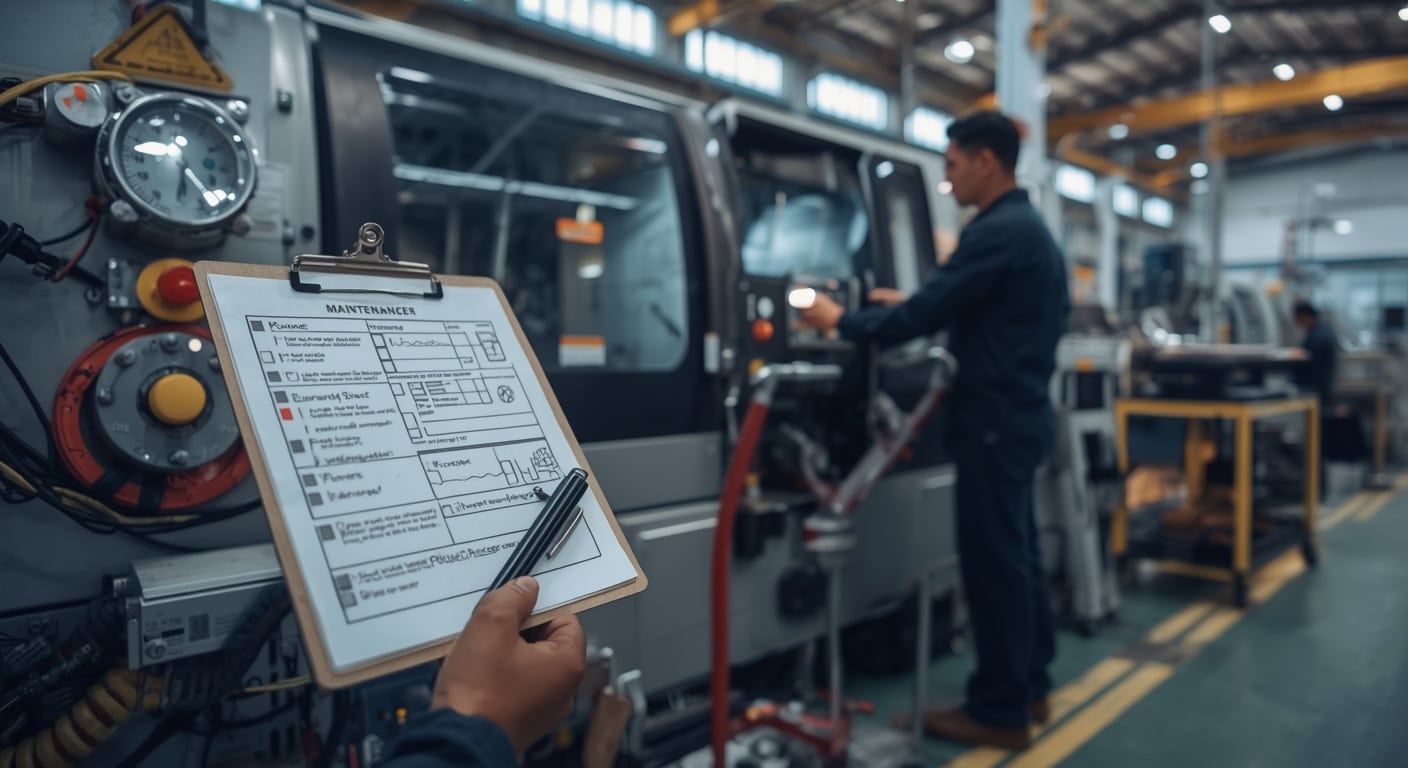
An industrial machine maintenance checklist helps factories inspect, clean, lubricate, test and document routine machine care in a consistent way. Instead of relying on memory or informal handovers, it gives operators and maintenance teams a clear structure for preventive maintenance, recordkeeping and early fault detection before a breakdown disrupts production.
For manufacturers, the value is practical: better maintenance discipline, clearer task ownership and more reliable equipment management. This guide explains what a machine maintenance checklist is, what it should include, how to organise it by frequency and how to create one that fits your equipment, operating conditions and OEM guidance.
What Is an Industrial Machine Maintenance Checklist?
An industrial machine maintenance checklist is a structured document used to inspect, clean, lubricate, test and record routine maintenance tasks for factory equipment. It supports preventive maintenance by standardising what must be checked, who performs it and when it is completed, helping reduce avoidable faults and unplanned downtime.
It can exist as a paper form, spreadsheet or digital workflow inside a maintenance system. In all cases, the checklist serves the same purpose: making sure routine care is not missed and that findings are recorded in a usable way.
A good checklist is not just a list of generic actions. It should reflect the actual machine, the type of work being done, normal operating conditions and the responsibilities of operators, supervisors and maintenance technicians.
Why Preventive Maintenance Matters in Manufacturing
Preventive maintenance is planned maintenance carried out before a machine fails. In manufacturing, this matters because many equipment problems start as small and visible issues: a loose fastener, contamination, unusual vibration, low fluid level, worn belt or abnormal sound. If those signs are noticed early, corrective action is usually simpler and less disruptive.
A preventive maintenance checklist supports this approach by turning maintenance into a routine process rather than a reactive one. When teams perform the same checks at the right intervals, they are more likely to catch developing problems before they stop production.
Practical benefits include:
- Fewer avoidable breakdowns: recurring inspections help identify wear, leakage, contamination and basic operating issues early.
- Improved reliability: machines that are cleaned, inspected and serviced consistently are generally easier to keep in stable operating condition.
- Better safety support: checklists help teams confirm guards, indicators and basic machine condition before operation, while more detailed safety procedures should follow the employer’s actual requirements and applicable rules.
- Clearer planning: maintenance work can be scheduled, assigned and tracked instead of being handled only after failure.
- Better documentation: a maintenance log creates traceability for recurring faults, replacement history and follow-up actions.
For a broader view of plant equipment categories and maintenance context, readers can refer to the Industrial Machinery & Equipment Guide.
What to Include in a Machine Maintenance Checklist
A preventive maintenance checklist for industrial machines should include the information needed to identify the equipment, perform the task correctly and record what happened. The exact format may vary, but most checklists should cover the following core fields.
- Machine name or asset ID: so the checklist clearly matches one specific machine.
- Location: useful for factories with similar equipment across multiple lines or departments.
- Date and time of inspection: to create a traceable maintenance history.
- Responsible person: operator, technician or supervisor who completed or verified the task.
- Task frequency: daily, weekly, monthly or another scheduled interval.
- Safety checks: for example machine guards, emergency stop accessibility, warning indicators and isolation status where relevant. Any prescriptive safety steps should be aligned with the employer’s actual procedures.
- Cleaning tasks: removal of dust, debris, residue or product buildup that may affect performance.
- Lubrication points: what needs lubrication, what was checked and whether servicing was completed according to the approved schedule.
- Wear components: belts, chains, seals, rollers, bearings or other consumable parts that should be inspected for damage or deterioration.
- Electrical or control checks: limited to appropriate personnel and safe procedures, such as checking indicators, displays, alarms or visible cable condition.
- Fluid levels or air system checks: depending on the machine, this may include coolant, hydraulic fluid, pneumatic condition or drainage checks.
- Calibration or testing steps: where applicable, especially for equipment that depends on alignment, sensing accuracy or process consistency.
- Findings and observations: abnormal noise, heat, vibration, leakage, irregular movement or repeated faults.
- Corrective action required: what follow-up work is needed, by whom and when.
- Sign-off or verification: to confirm completion and accountability.
The best machine maintenance checklist is usually organised by machine type, task criticality and risk. A conveyor checklist, for example, will not look the same as one for a compressor, CNC machine or packaging line. Trying to use one generic factory machine maintenance checklist for all equipment often leads to weak inspections and missed issues.
How to Structure the Checklist by Maintenance Frequency
A useful maintenance checklist is usually divided by frequency so that simple tasks happen often and more technical tasks happen on a planned schedule. This keeps operator checks practical while reserving specialised inspections for trained maintenance personnel.
Maintenance intervals should follow the OEM manual, actual operating conditions, machine age, duty cycle, environment and the factory’s internal maintenance policy. Equipment running in dusty, humid, high-load or multi-shift conditions may need more frequent attention than lightly used equipment.
Daily Checks
Daily checks are usually short operator-level inspections completed before startup, during shift handover or after operation. Their purpose is to confirm that the machine appears safe, clean and normal.
Typical daily checklist items include:
- General visual inspection for obvious damage or abnormal condition
- Unusual noise, vibration or smell during operation
- Leaks from hoses, fittings, seals or fluid systems
- Presence and condition of guards and covers
- Status lights, indicators or alarms
- Cleanliness around moving parts, sensors, vents or product contact areas where relevant
- Basic operating condition, including smooth starting and normal stopping response
These checks do not replace technical servicing, but they are often the first line of equipment downtime prevention because they identify visible issues early.
Weekly Checks
Weekly checks are often more detailed and may be handled by line leaders, maintenance support staff or technicians depending on the equipment. This is where many routine condition checks sit.
Typical weekly tasks may include:
- Review of lubrication condition and schedule status
- Inspection of belts, chains or couplings for wear or tension concerns
- Checking accessible fasteners, brackets and mountings for looseness
- Inspection of filters, strainers or intake points for contamination
- Review of hoses, tubing and air lines for wear, cracking or poor routing
- Basic functional tests of switches, sensors or repetitive machine motions where appropriate
This level of routine machine inspection checklist helps bridge the gap between simple observation and more technical maintenance work.
Monthly or Scheduled Checks
Monthly or scheduled checks are generally more technical and should be assigned according to skill level and safe work procedures. These tasks often require planned downtime or controlled access to the machine.
Typical monthly or periodic tasks may include:
- Alignment review for relevant mechanical components
- Inspection of wear parts that may not be visible during daily checks
- Review of electrical connections or control cabinet condition by qualified personnel where appropriate
- Sensor condition checks and response verification
- Calibration review or process accuracy checks where required by the equipment
- Documented servicing, replacement of routine consumables and inspection log updates
Some manufacturers also use quarterly, half-yearly or shutdown-based maintenance checklists for deeper inspections. The right structure depends on the machine’s criticality and how failure would affect production, quality or safety.
Step-by-Step: How to Create an Industrial Machine Maintenance Checklist
Creating a maintenance checklist for manufacturing equipment is usually easiest when the process is practical and machine-specific.
- Identify the machine clearly. Record the machine name, asset ID, model reference, location and operating department.
- Review the OEM documents. Use the manufacturer manual as the starting point for maintenance intervals, service points and known care requirements.
- List common failure points. Focus on the parts and conditions most likely to cause stoppages, wear or quality problems.
- Separate operator tasks from technician tasks. Keep simple visual and routine checks with operators, and assign technical work to trained maintenance personnel.
- Assign frequencies. Group tasks into daily, weekly, monthly and periodic actions based on usage, environment and internal maintenance planning for factories.
- Add safety steps. Include relevant pre-work precautions and referencing of actual isolation or lockout procedures where required by the employer.
- Create recording fields. Add spaces for dates, findings, corrective actions, pending issues and sign-off.
- Test the checklist on the shop floor. Ask the actual users whether the sequence is practical, clear and fast enough to complete properly.
- Refine and update it. Improve the checklist after recurring faults, process changes, upgrades or maintenance reviews.
This process helps turn a basic machine maintenance SOP into a usable document rather than a formality that teams ignore.
Example Checklist Categories for Common Industrial Machines
Exact maintenance checklist items vary by equipment type. The examples below show how checklist categories change depending on the machine’s function.
Conveyors
Conveyor checks often focus on belt or chain condition, tracking, drive components, rollers, guarding, unusual noise, debris buildup and stop-start response. Misalignment and contamination are common practical concerns.
Pumps
Pump checklist categories may include leakage, seal condition, unusual vibration, motor condition, suction and discharge line condition, lubrication where relevant and general operating sound. The aim is to identify signs of wear or process-related strain early.
Compressors
Compressor checklists often include pressure stability, visible leakage, drain condition, filters, cooling path cleanliness, hose connections and control indicators. Air quality and contamination concerns may also be important depending on use.
CNC Machines
CNC maintenance checklists commonly cover cleanliness, lubrication status, coolant-related checks where applicable, axis movement condition, alarms, guarding, tool area housekeeping and basic control response. More technical checks should remain with qualified personnel and OEM guidance.
Packaging Equipment
Packaging machine checklists may focus on sensors, feed paths, moving assemblies, sealing or cutting areas, guarding, product residue buildup and repeatability of operation. Small alignment or sensor issues can quickly affect consistency.
Forklifts and Mobile Equipment
For forklifts or similar internal handling equipment, checklist categories often include tyres, forks, visible damage, warning devices, fluid leaks, battery or fuel-related condition depending on type, steering feel and braking response. Any operator inspection programme should follow the employer’s actual procedures and applicable requirements.
These examples show why a routine machine inspection checklist should be tailored. The right categories depend on motion components, lubrication needs, cooling method, controls, guarding and the consequences of failure.
Preventive vs Corrective vs Predictive Maintenance
Factories often use more than one maintenance approach. The key difference is when action is taken and what triggers it.
| Maintenance approach | Purpose | When it happens | Typical tasks | Best use case |
|---|---|---|---|---|
| Preventive maintenance | Reduce the chance of failure through planned routine care | At scheduled intervals before breakdown | Inspection, cleaning, lubrication, replacement of routine wear items, scheduled testing | Most production equipment with repeatable service needs |
| Corrective maintenance | Fix a fault after a problem is found or a failure occurs | After breakdown or during fault response | Repair, replacement, troubleshooting, adjustment after malfunction | Unplanned faults or non-critical issues found during inspection |
| Predictive maintenance | Use condition data to detect developing problems and plan service at the right time | Based on machine condition rather than only calendar frequency | Condition monitoring, trend review, vibration analysis, temperature or performance checks where available | Critical assets where condition-based decisions add value |
In simple terms, preventive maintenance is planned in advance, corrective maintenance happens after a fault and predictive maintenance uses condition signals to decide when intervention is needed. Many factories start with preventive maintenance and add predictive methods later for critical equipment.
Common Mistakes When Using Maintenance Checklists
A checklist only works if it is specific, used consistently and reviewed when problems keep repeating. Common mistakes include:
- Using overly generic forms: a checklist that says only “inspect machine” gives little guidance and produces weak records.
- Unclear ownership: if nobody knows whether operators, technicians or supervisors are responsible, tasks are easily missed.
- No sign-off: without verification, it is difficult to confirm whether the work was actually completed.
- Poor recordkeeping: if forms are lost, unreadable or never reviewed, the maintenance history has little value.
- Ignoring recurring faults: repeated comments about leaks, misalignment or alarms should trigger investigation, not just repeated notation.
- Failing to update the checklist: machine modifications, layout changes or process changes should be reflected in the checklist.
- Not aligning with OEM instructions: unsupported assumptions about service tasks or intervals can lead to poor maintenance decisions.
- Separating maintenance from safety procedures: if the checklist refers to access or servicing tasks, it should link clearly to the site’s actual safety process.
A useful industrial equipment maintenance checklist is specific enough to guide action, but simple enough that teams will actually use it on the shop floor.
Best Practices for Malaysian Factories and SMEs
In many Malaysian factories and SMEs, maintenance systems need to work across mixed skill levels, multiple languages and fast production schedules. That makes clarity more important than complexity.
Useful implementation practices include:
- Use clear language and simple formatting: short tasks, tick boxes and straightforward terminology are easier to apply consistently.
- Support multilingual teams where needed: bilingual or multilingual instructions may reduce misunderstanding during daily checks and shift handovers.
- Separate operator care from technician work: this keeps routine tasks manageable while ensuring technical servicing is handled properly.
- Plan shift handover recording: if one shift detects abnormal noise, leakage or unstable operation, that information should reach the next shift and maintenance team quickly.
- Keep spare parts visibility practical: if common wear items are repeatedly unavailable, the checklist should feed into spare parts planning, not just fault reporting.
- Train users on what to look for: a form alone is not enough. Operators need to recognise what counts as abnormal sound, looseness, contamination or poor machine response.
- Retain records systematically: documented actions can be useful for internal reviews, troubleshooting and maintenance planning, while any formal compliance implications should be verified case by case.
For smaller manufacturers, a simple preventive maintenance checklist for industrial equipment can still be highly effective if it is used consistently and reviewed regularly.
When to Use a Digital Maintenance Checklist or CMMS
Paper forms, spreadsheets and CMMS tools can all work. The best choice depends on the number of assets, the complexity of maintenance planning and how important traceability is to the business.
When paper forms may be enough
Paper checklists can work well for small factories with limited equipment, stable processes and hands-on supervision. They are simple to introduce and easy for operators to complete during rounds. The limitation is that records can be lost, trends are harder to analyse and follow-up actions may not be tracked well.
When spreadsheets may be more practical
Spreadsheets suit businesses that want basic scheduling, central storage and a simple inspection log without adopting a full system. They are useful for maintenance planning for factories that are still formalising their process. However, spreadsheets still depend heavily on manual updating and discipline.
When a CMMS becomes useful
A CMMS, or computerised maintenance management system, becomes more valuable when a factory has many machines, multiple maintenance frequencies, recurring work orders or a stronger need for audit trails and accountability. A digital maintenance checklist inside a CMMS can help with:
- scheduling recurring tasks
- automatic reminders
- maintenance history tracking
- assignment of work to specific personnel
- recording of findings and corrective actions
- visibility of overdue tasks
Digital tools do not fix poor maintenance habits by themselves. If checklist content is weak or users are not trained, a digital system will only record inconsistent practice more efficiently. The checklist design still matters.
Frequently Asked Questions
What is an industrial machine maintenance checklist used for?
It is used to guide and document routine inspection, cleaning, lubrication, testing and servicing tasks for factory equipment. Its main purpose is to support preventive maintenance, improve consistency and help detect developing problems before they become larger breakdowns.
What should be included in a preventive maintenance checklist for industrial machines?
A checklist should normally include machine identification, inspection date, responsible person, task frequency, safety-related checks, cleaning tasks, lubrication points, wear item inspection, control or indicator checks, findings, corrective actions and sign-off. The exact items should be tailored to the machine type and OEM guidance.
How often should a machine maintenance checklist be completed?
That depends on the equipment, operating environment, duty cycle and OEM recommendations. Many factories divide tasks into daily, weekly, monthly and periodic checks so that simple operator observations happen often while technical inspections are scheduled less frequently.
Who is responsible for filling out machine maintenance checklists in a factory?
Responsibility is usually shared. Operators often complete basic daily checks, while maintenance technicians handle more technical inspections and servicing. Supervisors or maintenance managers may verify completion, review recurring issues and plan follow-up actions.
What is the difference between preventive and corrective maintenance?
Preventive maintenance is planned in advance to reduce the risk of failure, while corrective maintenance happens after a fault is found or a machine has already failed. Preventive work is scheduled; corrective work is reactive.
Can small factories use a simple maintenance checklist without a CMMS?
Yes. Small factories can start with a paper form or spreadsheet if the checklist is machine-specific, used consistently and reviewed properly. A CMMS becomes more useful as the number of assets, scheduled tasks and recordkeeping needs increase.
Conclusion
A good industrial machine maintenance checklist turns preventive maintenance into a repeatable process rather than an informal habit. It helps factories inspect equipment consistently, assign responsibility clearly and record issues before they become larger operational problems.
The most effective checklist is one that matches the actual machine, the way it is used and the guidance provided by the OEM. Whether a factory uses paper forms, spreadsheets or a CMMS, the goal remains the same: more systematic maintenance, clearer follow-up and fewer avoidable surprises on the shop floor.