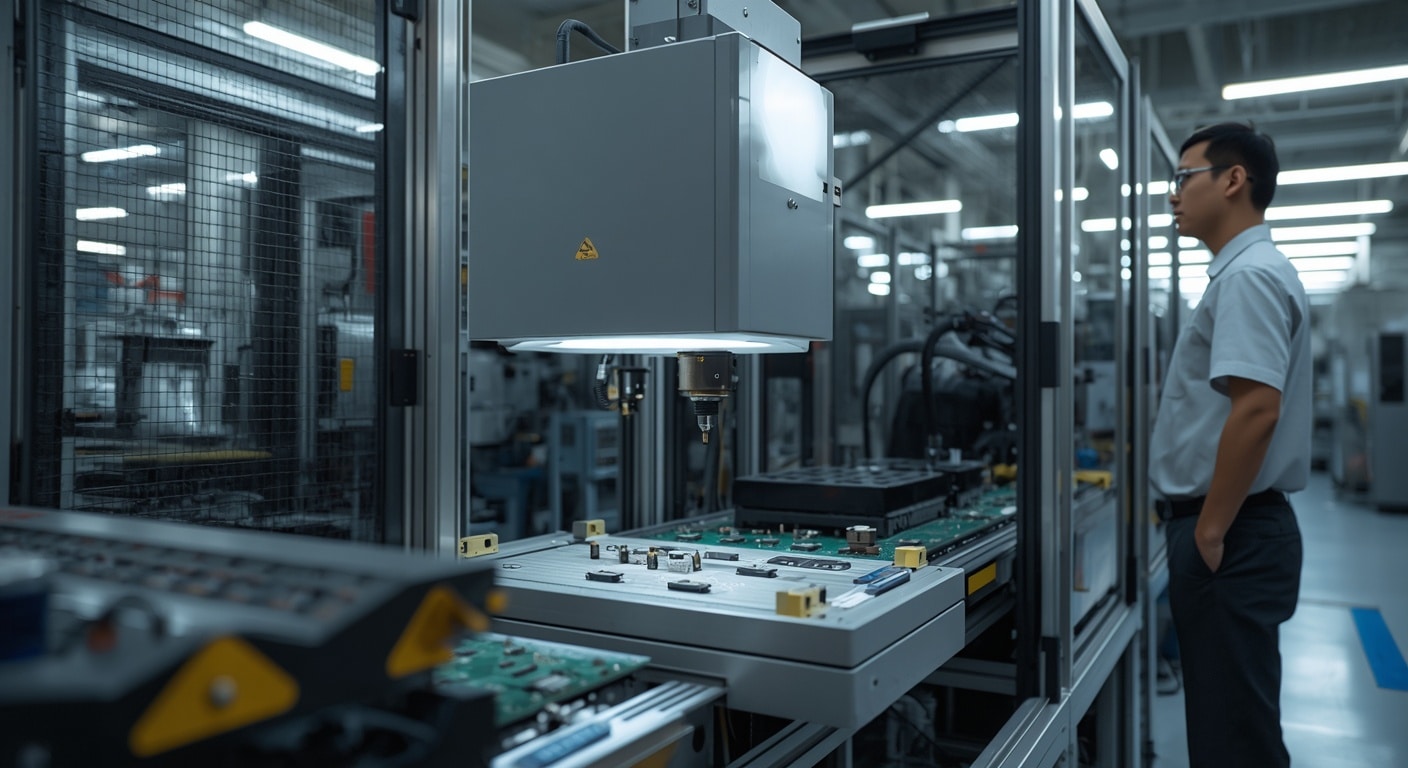
Machine vision manufacturing refers to the use of cameras, lighting, optics, software and automation controls to inspect, identify, measure or guide products and processes on the factory floor. In practice, it helps manufacturers perform visual tasks more consistently, whether the goal is defect detection, barcode reading, assembly verification or robot guidance.
For manufacturers, the value of machine vision is not just image capture. A well-designed system turns visual information into action: accept a part, reject a pack, stop a line, count an item, confirm a label or guide a robot to the correct position. This article explains how machine vision systems work, what components they need, where they are commonly used, and what manufacturers should evaluate before investing in one.
What is machine vision in manufacturing?
Machine vision in manufacturing is an industrial inspection and control approach that uses cameras, lighting, lenses, software and connected equipment to analyse images and make decisions automatically. It is used to check product quality, confirm assembly conditions, read codes, verify labels, measure features and support automated handling on production lines.
Unlike general-purpose photography, industrial machine vision is designed for repeatability. The system is set up to capture consistent images under controlled conditions so that software can evaluate the same features on every cycle. That matters in production environments, where even small changes in lighting, orientation or product presentation can affect inspection reliability.
In simple terms, a vision inspection system allows a machine to “see” a product in a structured way and respond according to predefined rules or learned inspection logic. The result may be as simple as a pass/fail signal or as advanced as sending position data to a robot.
How machine vision systems work on the factory floor
A machine vision system works by capturing an image, analysing it against inspection criteria, and triggering an output based on the result. Although system designs vary, the basic workflow usually follows the same sequence.
- Image capture: A camera takes an image when a product reaches the inspection point, often triggered by a sensor, conveyor position or machine cycle.
- Lighting control: Controlled lighting helps highlight the feature being inspected, such as an edge, surface, code or label.
- Image processing: Vision software analyses the image to find patterns, measurements, characters, defects or presence/absence conditions.
- Decision logic: The system compares results against defined criteria and decides whether the part or package passes or fails.
- Output action: The result is sent to connected equipment, such as a reject mechanism, PLC, HMI, robot or data logging system.
On a production line, that output can support several actions:
- pass/fail inspection
- part sorting or rejection
- counting and tracking
- positioning for robotics
- barcode and OCR inspection
- traceability data capture
The important point is that machine vision is part of an operating process, not an isolated camera. It only delivers value when image capture, inspection logic and automation response are aligned with the production task.
Core components of a machine vision system
Most machine vision systems use the same building blocks, even though the exact hardware and software vary by application. Each component affects inspection reliability, and weak performance in one area can limit the whole system.
Cameras and image sensors
The camera captures the image that the system will analyse. In industrial settings, cameras are selected for stable operation in production environments and for their ability to capture usable images of the target feature.
The image sensor inside the camera converts light into image data. If the sensor cannot capture enough detail or contrast for the task, the software will struggle no matter how advanced it is. That is why camera selection should always start with the inspection requirement rather than with headline hardware claims.
Some applications only need a compact camera inspection system to confirm presence or orientation. Others require more detailed imaging for surface inspection, fine assembly checks or multi-angle review. In some cases, 2D vision is enough. In others, 3D vision may be used when height, shape variation or spatial position matters.
Practical considerations include:
- the size of the inspection area
- how much detail must be visible
- whether the product is moving
- how consistent the product position is
- whether one view or multiple views are needed
For many manufacturers, the camera is the most visible part of the system, but it is rarely the only factor that determines success.
Lighting and optics
Lighting is often the most important factor in automated visual inspection. A high-quality camera cannot compensate for poor illumination if the feature of interest is not clearly visible. Good lighting makes the difference between a stable inspection and a system that gives frequent false rejects.
Lighting helps create contrast. For example, it can make a printed code easier to read, reveal a missing component, highlight the outline of a cap, or show a scratch on a surface. The right lighting approach depends on what the system must see and what it must ignore.
Lenses and optics determine how the camera views the product. They affect field of view, magnification and how clearly the target feature appears in the image. If the lens is poorly matched to the application, the image may distort, miss key detail or cover the wrong area.
In practical terms, manufacturers should think about:
- consistent illumination across the inspection area
- glare from reflective materials
- shadows caused by part geometry
- contrast between the target feature and background
- the distance between camera and product
- the area that must fit into one image
This is why machine vision applications in manufacturing are often solved through application engineering rather than by simply buying a camera.
Software and processing
Vision software turns images into decisions. It applies inspection logic to determine whether a product meets the required condition.
In a rule-based system, the software follows defined parameters. It may look for edges, measure distances, compare patterns, verify object presence, read text, detect shape differences or check whether a label is correctly placed. This approach is common in many structured factory tasks where product presentation is controlled.
Some systems use more advanced methods to classify patterns or handle more variable image conditions. These are often discussed under AI-enabled or learning-based inspection. At a high level, the distinction is straightforward: rule-based inspection follows explicit logic set by the engineer, while AI-oriented methods are typically used when defects or variations are harder to define with fixed rules alone.
Regardless of method, the software must support the production objective clearly. A system that produces images but does not generate stable decisions will not improve quality control.
Integration with automation controls
Machine vision is most useful when it is integrated with the rest of the production line. After inspection, the system usually sends a result or command to other equipment.
Common integration points include:
- PLCs: to receive triggers and send inspection results
- HMIs: to display status, images, errors or inspection counts
- Reject mechanisms: to remove failed items from the line
- Conveyor systems: to coordinate timing and product position
- Robotics: to guide picking, positioning or handling actions
- Data systems: to store images, results or traceability records
This integration is what turns vision sensors manufacturing setups into actual process control tools. A barcode read, for example, may trigger data logging. A missing part detection result may stop the station. A position calculation may guide a robot end effector to the correct pick point.
Common machine vision applications in manufacturing
Machine vision applications in manufacturing are diverse, but most fall into a few practical categories: inspection, identification, measurement and guidance.
Common uses include:
- Presence or absence checks: confirming whether a component, cap, fastener, seal or label is present
- Surface defect detection: identifying scratches, dents, contamination, print flaws or other visible defects
- Dimensional verification: checking whether a feature falls within the visual measurement criteria defined for the process
- Assembly verification: confirming that parts are installed in the correct orientation or sequence
- Label inspection: checking label placement, print quality or missing information
- Barcode reading: capturing 1D or 2D codes for tracking and data association
- OCR: reading printed characters such as date codes, batch numbers or serial markings
- Packaging checks: verifying fill presence, seal condition, cap placement or pack completeness
- Robot guidance: helping robots locate parts or adjust to varying positions
In electronics manufacturing, a machine vision system may check component presence, connector orientation or marking readability. In food packaging, it may support package verification, date code inspection or label checks. In automotive component production, it may help confirm assembly conditions or detect visible defects before downstream operations. In general industrial production, it is often used for sorting, counting and in-line quality inspection automation.
These applications vary widely, which is why no single vision setup fits every factory. A simple barcode and OCR inspection task is very different from a defect detection manufacturing application involving reflective surfaces or variable part appearance.
Benefits of machine vision for manufacturers
When applied correctly, machine vision can improve the consistency and responsiveness of production inspection. The benefits are practical rather than theoretical.
Key advantages typically include:
- More consistent inspection: the system applies the same criteria on every cycle without fatigue-related variation
- Reduced manual checking: operators can focus on exceptions, process control or higher-value tasks instead of repetitive visual inspection
- Faster in-line verification: inspection can happen during production flow rather than only at offline checkpoints
- Better traceability support: images, code reads and inspection results can be recorded for review
- Improved process feedback: recurring inspection failures can help identify upstream process issues
- Support for automation: machine vision allows other equipment to act on visual information automatically
That said, these benefits depend on proper application design. A poorly engineered vision inspection system can create false rejects, operator frustration and maintenance burden. Manufacturers should evaluate machine vision as a process solution, not just a piece of hardware.
Machine vision vs manual inspection
Machine vision and manual inspection both have a role in manufacturing. The right choice depends on product stability, inspection complexity, line speed, required consistency and how easy the task is to define visually.
| Factor | Machine Vision | Manual Inspection |
|---|---|---|
| Consistency | Applies the same inspection logic repeatedly when conditions are controlled | Can vary between operators, shifts and fatigue levels |
| Speed | Suitable for continuous in-line inspection and automated response | Often slower for repetitive high-volume tasks |
| Fatigue risk | Does not tire from repetitive visual checking | Performance can decline during long repetitive work |
| Documentation | Can store images, results and code data for traceability | Usually depends on manual recording unless supported by separate systems |
| Flexibility | Works best when inspection rules and product presentation are defined | Humans can adapt more easily to unusual or changing conditions |
| Setup demand | Requires engineering, lighting control, integration and validation | Requires training and supervision but less technical setup |
In practice, manual inspection may still suit low-volume, variable or subjective tasks. Machine vision is often more suitable when inspection is repetitive, high-throughput and rule-based. Some factories use a hybrid approach, where machine vision handles primary screening and operators review exceptions.
Machine vision vs computer vision: what is the difference?
Machine vision usually refers to industrial applications where cameras and software are used for inspection, measurement, identification or equipment guidance in a controlled process. Computer vision is the broader field of enabling machines to interpret images and visual data.
In other words, industrial machine vision is a practical subset of computer vision. A factory camera inspection system that checks label position is machine vision. The wider methods used to analyse images across many environments, including non-industrial ones, fall under computer vision.
For manufacturers, the distinction matters mainly because machine vision is tied to production reliability, integration and repeatable operation on the factory floor.
How to choose a machine vision system for a manufacturing process
Selecting a machine vision system starts with the inspection task, not with a camera catalogue. The best approach is to define what the system must detect, what decision it must make and how that decision will affect production.
A practical selection checklist includes:
- Define the inspection objective: Is the system checking presence, defect, measurement, code reading, assembly condition or robot position?
- Identify the critical feature: What specific defect, mark, dimension or condition must be visible?
- Assess product variation: How much do the product, packaging, orientation or surface finish change from one unit to another?
- Consider line speed and timing: How much time is available for image capture, analysis and output action?
- Review the operating environment: Are there issues such as dust, vibration, washdown exposure, temperature variation or limited access?
- Evaluate lighting conditions: Is the product reflective, transparent, dark, glossy or irregular?
- Define integration needs: Does the system need to connect with PLCs, conveyors, reject stations, robots or plant data systems?
- Clarify data requirements: Do you need image storage, code records, pass/fail logs or production traceability support?
- Consider changeovers and maintenance: How often will products change, and who will adjust or maintain the system?
- Request application validation: Suppliers should demonstrate performance using real samples and actual defect conditions where possible.
It is also important to ask how the system will be supported after installation. A smart manufacturing vision system is only useful if production teams can maintain lighting consistency, manage changeovers and troubleshoot basic issues without long downtime.
Where machine vision forms part of a broader automation roadmap, it helps to place the decision in the wider context of factory automation in Malaysia. Inspection technology has the most value when it supports the actual production strategy, not when it is treated as a stand-alone upgrade.
Implementation challenges and practical considerations
Many machine vision projects succeed or fail based on application details that are easy to underestimate during early planning. The challenge is rarely just buying the right camera. It is building a stable inspection condition around the process.
Common issues include:
- Inconsistent lighting: changes in ambient light, shadows or glare can affect image quality and decision stability
- Reflective or transparent surfaces: glossy materials, metal parts or clear packaging can be difficult to inspect reliably
- Product positioning variation: if parts arrive at different angles or locations, the same inspection can become much harder
- False rejects: an over-sensitive setup may reject acceptable products and disturb production flow
- Environmental contamination: dust, oil, moisture or residue on the lens or lighting can reduce image clarity
- Frequent changeovers: product variation can require recipe management, adjustment or retraining of inspection parameters
- Training needs: operators and maintenance teams need to understand basic setup, cleaning and fault response
- Integration complexity: timing with conveyors, reject devices and PLC logic must be coordinated carefully
For that reason, successful deployment often depends on testing real products under real conditions. Samples should include acceptable products, common variation and known defect cases if available. This helps establish whether the proposed automated visual inspection method is robust enough for daily operation.
Manufacturers should also consider long-term ownership. Even a good system can become unreliable if cleaning, calibration checks, recipe control or basic preventive maintenance are ignored.
Where machine vision fits into factory automation and smart manufacturing
Machine vision is a foundational technology for automated inspection and data-driven production. It allows a production line to convert visual information into digital decisions, which can then be used for process control, traceability and feedback.
Within a broader automation strategy, machine vision can support:
- in-line quality inspection without constant manual checking
- closed-loop control, where inspection results influence downstream actions
- traceability through code reading and inspection records
- robotic handling based on part position or orientation
- process monitoring that highlights recurring quality issues
This is one reason machine vision is often discussed alongside Industry 4.0 and smart manufacturing in Malaysia. In connected production environments, vision data can become part of a larger system of operational insight. However, the value still depends on disciplined implementation. Machine vision does not create a smart factory by itself; it contributes useful visual data and control capability when integrated properly.
For manufacturers planning automation, machine vision is often most effective where there is a repetitive visual decision that can be clearly defined and linked to a production action.
Frequently Asked Questions
What is machine vision in manufacturing used for?
It is used for inspection, identification, measurement and guidance tasks on the factory floor. Common examples include defect detection, presence or absence checks, label verification, barcode reading, OCR, packaging inspection and robot guidance.
How does a machine vision system work in a factory?
A machine vision system captures an image at the inspection point, uses controlled lighting to make the target feature visible, analyses the image with software, applies pass/fail or decision logic, and sends an output to connected equipment such as a PLC, reject device, conveyor or robot.
What components are needed for a machine vision system?
Most systems need a camera, image sensor, lighting, lens or optics, vision software or processing hardware, and integration with automation controls. Depending on the application, they may also include triggers, conveyors, reject mechanisms, HMIs, robots or data logging functions.
What is the difference between machine vision and computer vision?
Machine vision usually refers to industrial image-based inspection and control in production environments. Computer vision is the broader field of enabling machines to interpret visual data across many applications, including but not limited to manufacturing.
How do manufacturers choose the right machine vision system?
They should begin with the inspection objective, identify the exact feature or defect to detect, evaluate product variation and line conditions, consider integration requirements, and validate the proposed solution using real samples. The right system is the one that performs reliably in the actual process, not the one with the most impressive hardware description.
Conclusion
Machine vision manufacturing is best understood as a practical factory tool that uses controlled imaging and software-based decision-making to inspect, identify, measure or guide production tasks. It can add real value in quality inspection automation, traceability and process control, especially where visual checks are repetitive and time-sensitive.
The key decision is not which camera looks most advanced, but whether the system can reliably see the required feature under actual production conditions. For manufacturers evaluating adoption, the strongest starting point is a clear inspection objective, realistic sample testing and careful integration with the wider production process.