Industrial control panels are a core part of modern factory operations. They bring electrical and automation components into one organised enclosure so a machine, process line or utility system can be monitored, controlled and protected more reliably. For manufacturers, understanding how these panels work helps with equipment selection, automation planning, maintenance and procurement decisions.
This guide explains what industrial control panels are, how they work, the main components inside them, where they are used, and what to consider when choosing one for a factory application.
What are industrial control panels?
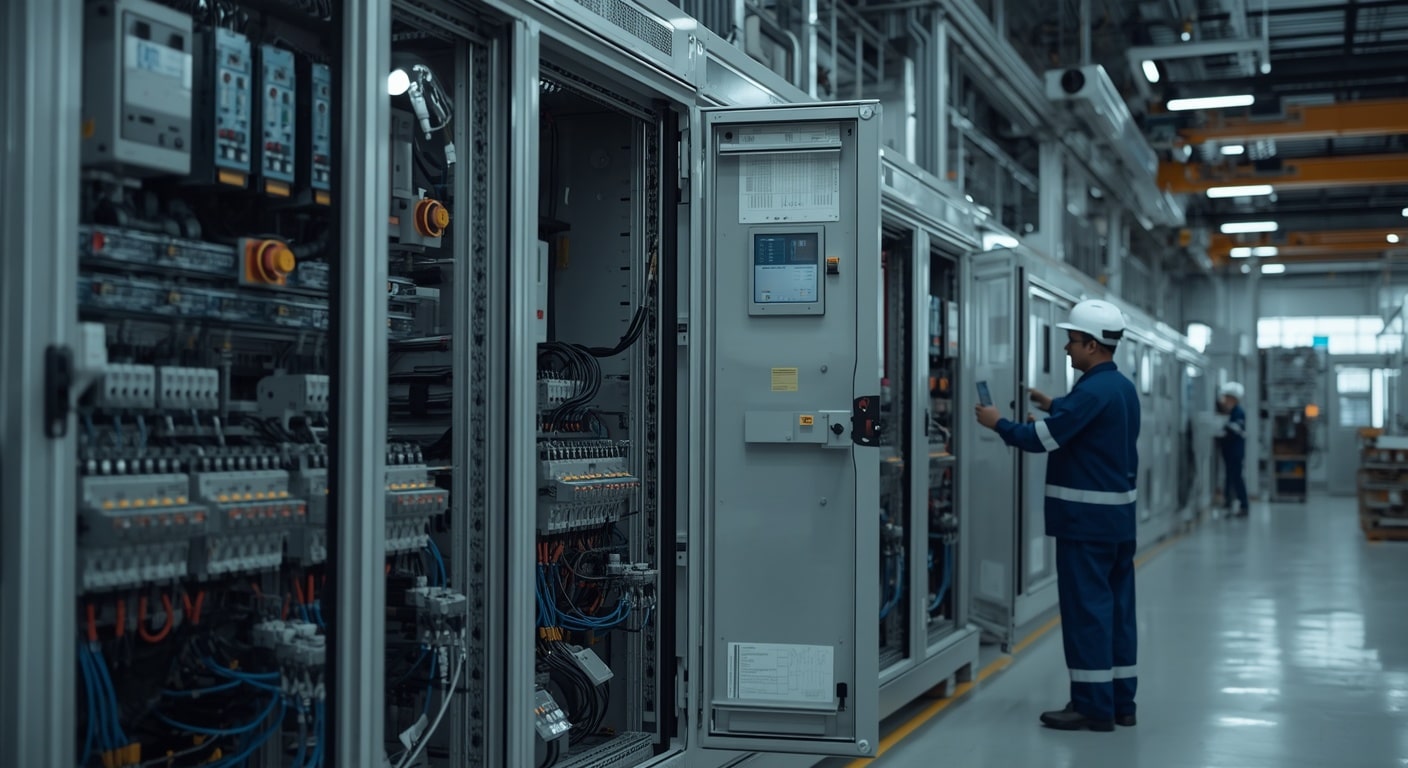
Industrial control panels are enclosed assemblies that house electrical and automation components used to control, monitor and protect industrial equipment and processes. They are commonly used on standalone machines, production lines and facility systems such as pumps, conveyors, compressors and process skids.
In simple terms, the panel acts as a central control hub. Instead of wiring every component separately across a machine or process area, key devices are brought together in a structured control cabinet. This makes operation more consistent and maintenance more manageable.
Depending on the application, a panel may be very simple, such as basic motor starting and stopping, or much more advanced, with PLC logic, HMI screens, alarms, communication modules and integration into wider factory automation systems.
Why industrial control panels matter in manufacturing
Industrial control panels matter because they help manufacturers run equipment in a controlled, repeatable and serviceable way. In most factories, the issue is not only whether a machine can run, but whether it can run safely, consistently and with minimal downtime.
A well-planned panel supports that by centralising the main control functions. Operators know where to start, stop and monitor equipment. Maintenance teams have a defined location for troubleshooting. Engineers can document the logic, wiring and component layout more clearly.
Practical benefits include:
- Centralised control: key electrical control functions are grouped in one place.
- Improved process consistency: the panel helps execute the same sequence or logic each cycle.
- Easier troubleshooting: faults can often be traced faster when wiring and control devices are organised.
- Better integration: panels can connect machines, sensors, drives and operator interfaces into one automation scheme.
- Support for safer operation: isolation, protection and controlled switching are easier to manage when designed correctly.
In manufacturing environments such as packaging, food processing, electronics assembly and general production, industrial automation panels often become the practical link between field devices and day-to-day operations.
How industrial control panels work
An industrial control panel works by receiving incoming electrical power, routing it through protective and control devices, processing input signals from the machine or process, and then sending output commands to motors, valves, actuators or other equipment.
The basic sequence usually looks like this:
- Power enters the panel from the electrical supply.
- Protective devices such as isolators, breakers or fuses help disconnect, distribute and protect circuits.
- Control devices such as a PLC, relay logic or timers process input signals.
- Inputs may come from push buttons, sensors, switches or measurement devices.
- Outputs trigger actions such as starting a motor, opening a valve, activating an alarm or changing drive behaviour.
- Operator devices such as indicator lights or an HMI panel allow people to monitor status and issue commands.
For example, on a conveyor system, a sensor may detect a product at a certain point. The controller inside the panel receives that signal, applies the programmed logic, and then energises an output to start, stop or slow a motor. If the system includes a variable frequency drive, the panel may also coordinate speed control instead of using only simple on-off switching.
This is why panel design matters. Even when two machines appear similar, their control requirements may differ based on sequence complexity, motor control needs, operator interaction and communication with higher-level systems.
Main components found inside an industrial control panel
The exact mix of industrial control panel components depends on the application, but most panels contain a combination of power distribution, protection, control, switching and operator interface devices. The goal is to create a structured system that can power equipment, execute logic and support operation and maintenance.
Power and protection components
These components manage incoming power and help protect the system from faults or unstable conditions.
- Main isolator: used to disconnect the panel from its power source for servicing or shutdown.
- Circuit breakers: help protect circuits from overcurrent and provide controlled disconnection.
- Fuses: often used for branch circuit protection or specific component protection.
- Power supply: converts incoming power to the voltage needed by control devices such as PLCs, sensors or communication modules.
- Surge protection devices: may be included where protection from electrical surges is important.
- Terminal blocks: provide organised connection points for field wiring entering and leaving the panel.
These items are essential because control logic is only useful when the panel receives stable power and can isolate faults in a controlled way.
Control and switching components
These are the devices that make decisions, switch loads and execute the intended machine or process sequence.
- PLC: a programmable logic controller is a compact industrial computer used to read inputs and control outputs according to programmed logic.
- Relays: electrically operated switches used for signal switching, isolation or simple logic tasks.
- Contactors: switching devices commonly used to control motors or other higher-power loads.
- Timers: used when actions must occur after a delay or for a fixed duration.
- VFD-related controls: where motors need speed control, a panel may include a variable frequency drive and associated control devices.
A PLC control panel is usually chosen when the process requires flexible logic, multiple inputs and outputs, sequencing, alarms or communication. A simpler motor control panel may focus more on starting, stopping and protecting motors with less complex logic.
This is also why not all electrical control panels are interchangeable. The right control strategy depends on what the equipment needs to do.
Operator interface and communication components
These components allow operators, technicians and other systems to interact with the panel.
- Push buttons: for commands such as start, stop or reset.
- Selector switches: used to choose operating modes such as manual or auto.
- Indicator lights: provide simple visual status information such as power on, run, fault or warning.
- HMI panel: a human-machine interface screen that displays machine status, alarms, trends or operating menus.
- Communication modules: support data exchange between the panel and other devices or supervisory systems.
- Networking interfaces: connect the panel into wider control or monitoring architecture.
For machine builders and system integrators, these communication functions are increasingly important because many manufacturers want panels that can feed data into line monitoring, production dashboards or supervisory software.
Common types of industrial control panels
Industrial control panels can be grouped by what they are designed to control. The most suitable type depends on the process, the number of devices involved and the level of automation required.
| Panel type | Typical function | Typical use case |
|---|---|---|
| PLC control panel | Runs programmed control logic using a PLC | Packaging machines, process skids, assembly systems, conveyor sequences |
| Motor control panel | Starts, stops and protects motors | Pumps, fans, compressors, mixers, conveyors |
| Automation control panel | Combines logic control, operator interface and device coordination | Integrated production lines and machine cells |
| Distribution and control panel | Distributes power while also supporting control functions | Utility systems, plant services, larger equipment packages |
| Machine-specific panel | Built around the needs of one machine or OEM design | Standalone machinery such as filling, cutting, labeling or handling equipment |
A useful distinction is the difference between a PLC panel and a motor control panel. A PLC panel is designed around logic and sequencing. A motor control panel is centred on managing motor loads. In practice, one panel can include both functions, especially in more advanced automation control panel designs.
Where industrial control panels are used in factories
Industrial control panels are used anywhere a factory needs structured control over machinery, movement, utilities or processes. They are common in both simple mechanisms and more complex production systems.
Typical control panel applications include:
- Conveyors: managing motor operation, interlocks, sensors and line coordination.
- Pumps and water systems: controlling pump sequencing, status indication and alarms.
- Compressors and air systems: supporting control, monitoring and equipment protection.
- Packaging lines: integrating sensors, actuators, drives and operator commands.
- HVAC and facility support systems: handling fans, dampers, temperature-related control and service equipment.
- Process lines: coordinating valves, motors, dosing equipment, temperature devices or other process steps.
- Standalone machinery: giving one machine its own localised electrical and automation control.
The design of the control cabinet will vary depending on several factors:
- how many inputs and outputs the process requires
- whether operators need a basic interface or a full HMI
- whether motor speed control is required
- whether the panel will communicate with a SCADA or factory system
- whether the environment includes dust, washdown exposure, heat or vibration
That is why industrial panel assembly is rarely just a matter of placing parts in an enclosure. The structure should reflect the actual operating context.
How to choose the right industrial control panel
Choosing the right industrial control panel starts with the application, not the enclosure. Buyers should first understand what the machine or process must do, then work backwards into the required control functions, interfaces and integration needs.
- Define the application clearly.
Identify whether the panel will control a single machine, multiple motors, a process skid, a conveyor line or a utility system. The use case determines the logic complexity and hardware needed. - Confirm the power and load requirements.
Understand the types of equipment being controlled, such as motors, heaters, valves or instrumentation. Exact electrical design should be validated by qualified professionals, but the procurement team still needs a clear load overview. - Decide how much control logic is required.
Simple start-stop control may need a different architecture from sequencing, recipe handling, alarms or interlocking. If flexibility is important, a PLC control panel is often more suitable than fixed relay-only logic. - Plan the operator interface.
Decide whether operators only need push buttons and indicator lights, or whether an HMI panel is needed for status displays, fault messages, parameter adjustment and diagnostics. - Consider future expansion.
Many panels become constrained because no space was left for additional I/O, communication modules or process changes. If expansion is likely, account for it during design. - Review the operating environment.
Dust, moisture, cleaning routines, ambient heat and plant layout all affect enclosure suitability and internal arrangement. The right control cabinet for a clean electronics assembly area may differ from one used near a wet process line. - Check integration needs.
If the panel must connect to SCADA, plant monitoring, MES-related tools or other factory automation systems, this should be specified early rather than added later as an afterthought. - Think about maintenance access.
A panel should not only function on day one. It should also be serviceable, with clear layout, labeling and documentation to support troubleshooting. - Assess supplier or integrator capability.
Experience with similar industrial control systems, documentation quality, support availability and commissioning capability can be as important as the hardware selection itself.
For readers comparing broader automation priorities, this sits within the larger topic of factory automation in Malaysia, where panel design is only one layer of the full control architecture.
Key design and installation considerations
Good control panel design is not only about component selection. Layout, serviceability and installation planning have a direct impact on reliability and long-term usability.
Important considerations include:
- Panel layout: components should be arranged logically so power distribution, control wiring and service access are easier to understand.
- Heat management: components that generate heat may need spacing, ventilation or thermal planning so the enclosure can operate reliably.
- Cable management: neat routing helps with troubleshooting, modifications and reducing wiring errors.
- Labeling: clear labels on devices, terminals and wires make maintenance much more efficient.
- Accessibility: technicians should be able to inspect, test and replace parts without unnecessary obstruction.
- Enclosure suitability: the cabinet should be appropriate for the operating environment and installation location.
- Documentation: wiring diagrams, panel drawings, I/O lists and operating notes are essential for maintenance and future changes.
- Maintenance planning: spare parts strategy, backup files and fault-response procedures should be considered early.
Electrical installation, machinery safety and compliance obligations can vary depending on the application, site conditions and equipment scope. Before procurement or implementation, manufacturers should verify the applicable technical and regulatory requirements with qualified professionals and the relevant authorities where necessary.
Industrial control panels and factory automation
Industrial control panels are not standalone technology in the wider sense of automation. They are a practical interface point between field devices, machine logic and higher-level monitoring systems.
In many automated environments, the panel gathers signals from sensors, processes them in a PLC, sends commands to actuators or drives, and presents status information through an HMI panel. From there, data may also be shared with supervisory systems, production dashboards or plant-level software.
This is why control panels sit at the centre of many industrial automation panels and machine control architectures. They connect the physical process to the decision logic.
As manufacturers explore digitisation, remote visibility and smarter production workflows, panels increasingly need to support communication, diagnostics and structured data handling. Readers looking at that bigger picture can also explore Industry 4.0 and smart manufacturing in Malaysia to understand how panels fit into connected operations.
Not every factory needs a highly connected system, but many do benefit from planning panel architecture with future integration in mind. Retrofitting communication or monitoring features later is often harder than allowing for them during initial control panel design.
Common mistakes to avoid when specifying a control panel
Several specification mistakes can create unnecessary cost, downtime or redesign work later. Common examples include:
- Underestimating future expansion needs: no spare space, no extra I/O and no allowance for process changes.
- Poor component access: maintenance becomes slow because devices are difficult to inspect or replace.
- Unclear operator interface: controls and status indicators do not match actual operator needs.
- Ignoring the environment: enclosure choice and internal arrangement do not suit dust, moisture or heat exposure.
- Weak documentation: wiring and logic become difficult to troubleshoot after installation.
- Treating all panels as interchangeable: a panel that works for one machine may be unsuitable for another process.
- Adding integration requirements too late: communication, reporting or remote monitoring is requested only after build or installation.
These issues are avoidable when operations, engineering, maintenance and procurement teams define the application clearly from the start.
Conclusion: what manufacturers should remember about industrial control panels
Industrial control panels are the control hub for many machines, production lines and utility systems. They bring power distribution, control logic, switching and operator interaction into one organised assembly that helps factories run more consistently and maintain equipment more effectively.
The right panel depends on the application, the level of control required, the operating environment and the need for future integration. Before final procurement or installation, manufacturers should confirm detailed technical and compliance requirements with qualified specialists so the panel fits both the process and the site.
Frequently Asked Questions
What is the purpose of an industrial control panel?
The purpose of an industrial control panel is to house the electrical and automation components needed to control, monitor and protect industrial equipment or processes. It gives operators and maintenance teams a central point for managing machine functions, status and fault response.
What components are usually inside an industrial control panel?
Common components include isolators, circuit breakers, fuses, power supplies, terminal blocks, relays, contactors, PLCs, timers, push buttons, selector switches, indicator lights, HMI devices and communication modules. The exact combination depends on the application.
What is the difference between a PLC control panel and a motor control panel?
A PLC control panel is built around programmable logic and is suited to sequencing, interlocks, alarms and more flexible automation tasks. A motor control panel focuses mainly on starting, stopping, switching and protecting motors, although some panels combine both functions.
How do you choose an industrial control panel for a factory application?
Start by defining the machine or process requirements, then review power needs, control logic, operator interface, expansion plans, environmental conditions, maintenance access and integration with other systems. Supplier capability and documentation quality should also be considered before purchase.
Can industrial control panels be integrated with Industry 4.0 systems?
Yes, many can be integrated with wider digital and automation systems if they include suitable controllers, communication hardware and network planning. Integration may support monitoring, alarms, production visibility and data exchange with higher-level factory systems.