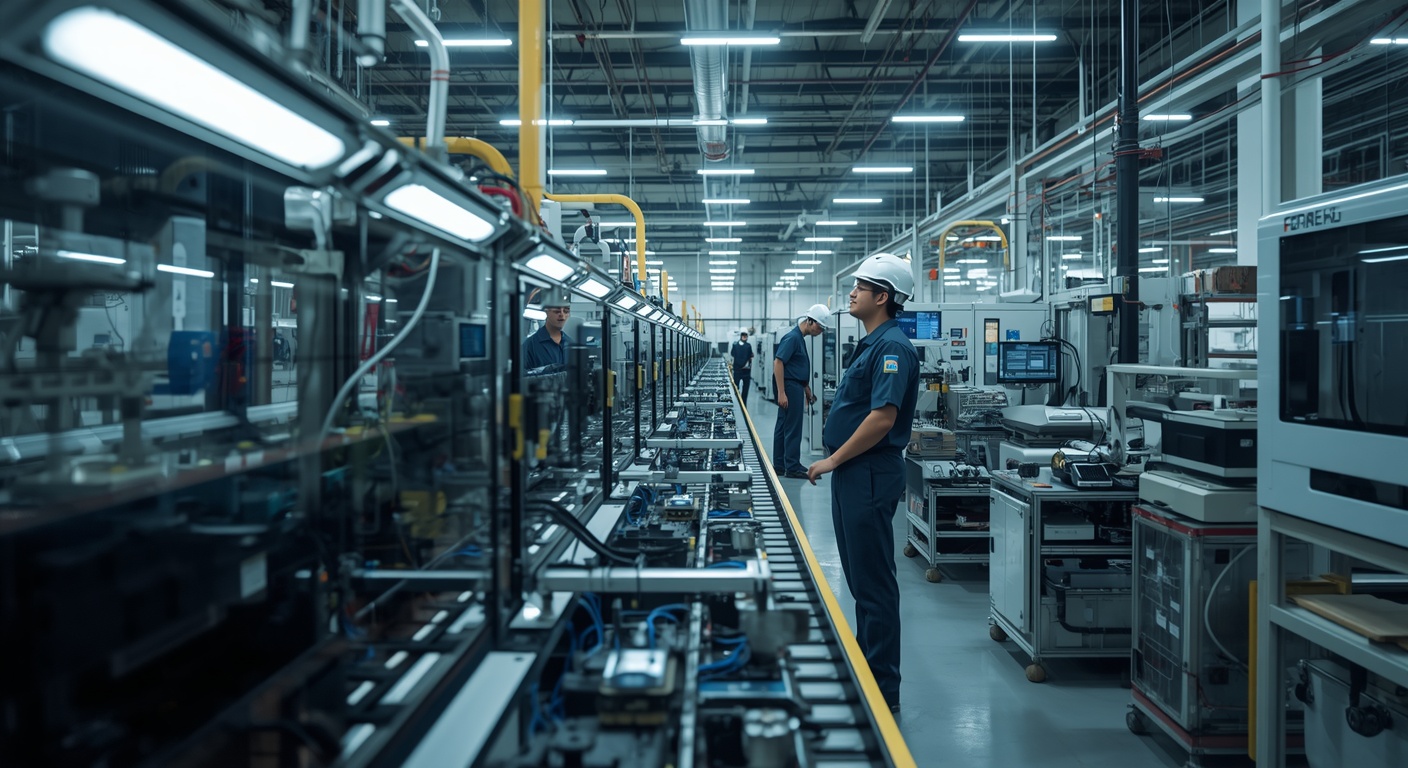
IIoT manufacturing uses connected machines, sensors and software systems to collect and use operational data inside a factory. In practice, it helps manufacturers monitor equipment, track production, detect problems earlier and make better decisions based on real conditions rather than assumptions.
For manufacturers, the value of industrial IoT in manufacturing is not just about putting sensors on equipment. It is about turning machine signals, process readings and production data into visibility that supports maintenance, quality, efficiency and planning. This article explains how IIoT works, the core components involved, common use cases, key benefits, major implementation challenges and how manufacturers can start in a practical way.
What is IIoT manufacturing?
IIoT manufacturing refers to the use of connected industrial machines, sensors and systems that collect, share and analyze data to improve production, maintenance and decision-making. Unlike consumer IoT, which often focuses on convenience devices, IIoT is built for factory operations where uptime, reliability, process control and system integration matter.
The term stands for Industrial Internet of Things. In a manufacturing setting, this can include machine monitoring, energy monitoring, production tracking, predictive maintenance and data connectivity between shopfloor equipment and business systems. IIoT is often discussed as part of smart manufacturing and broader digital transformation programmes.
How IIoT works in a manufacturing environment
At a practical level, IIoT works by moving data from equipment and processes to the people and systems that need it.
- Sensors and machine signals capture data. Equipment may provide information such as temperature, vibration, pressure, runtime, status, cycle counts or energy use.
- Devices transmit the data. The data moves through industrial networks, controllers, gateways or edge devices that collect and pass it onward.
- A platform processes the information. Software organizes the incoming data, displays it, stores it and may apply simple rules or analytics.
- Dashboards or alerts highlight issues. Supervisors, maintenance teams or engineers can see machine conditions, production performance or exceptions in near real time.
- Teams take action. They may inspect a machine, schedule maintenance, adjust a process, respond to downtime or investigate quality variation.
For example, a production line may have sensors that detect abnormal vibration on a motor. That signal is sent to a monitoring platform, which flags a maintenance alert before the motor fails completely. The maintenance team can then inspect the equipment during a planned stop instead of reacting to an unexpected breakdown.
In more advanced environments, IIoT data may also feed into SCADA, MES, ERP or maintenance systems so that equipment status is linked with production reporting, work orders or inventory planning.
Core components of an IIoT manufacturing system
An IIoT setup can be simple or highly integrated, but most systems are built from the same basic layers: data collection, connectivity, processing and operational use. Understanding those building blocks helps manufacturers evaluate what they already have and what may be missing.
Sensors and connected devices
Sensors are what allow connected factory systems to detect physical conditions and convert them into data. In manufacturing, common examples include sensors for temperature, vibration, pressure, humidity, flow, energy consumption, position and machine status.
These devices support several different purposes:
- Machine condition monitoring by tracking vibration, heat or current changes that may indicate wear or abnormal operation
- Process monitoring by checking pressure, temperature or flow during production
- Environmental monitoring in areas where ambient conditions affect product quality or equipment reliability
- Production visibility through machine status signals such as running, idle, stopped or faulted
- Energy monitoring to identify where utilities or equipment loads are unusually high
Not every IIoT project requires new sensors. Some machines already generate useful data through PLCs, controllers or built-in interfaces. In other cases, retrofit sensors are used to capture information from older equipment that was not originally designed for networked monitoring.
Connectivity, gateways and data platforms
Once data is generated, it needs a way to move from machines to users and software systems. That is where connectivity and data handling become important.
Machine connectivity can come from native machine controls, PLC outputs, industrial communication interfaces or additional sensing devices. In many factories, especially mixed-equipment environments, a gateway or edge device is used to collect signals from different sources and normalize the data before it is passed to a central platform.
Gateways act as intermediaries between shopfloor equipment and higher-level software. They may gather data from multiple machines, perform basic filtering or conversion, and send usable information to on-premise servers or cloud platforms.
Edge computing refers to processing some data closer to where it is generated, rather than sending everything directly to the cloud. This can help reduce unnecessary data traffic and support faster local responses for selected use cases.
Data platforms provide the environment where manufacturing data monitoring takes place. They store data, display trends, trigger alerts and support dashboards or reports. Depending on the manufacturer’s IT and operations strategy, this may be an on-premise system, a cloud platform or a hybrid setup.
The right architecture depends on the factory’s existing systems, cybersecurity expectations, network maturity and operational goals. There is no single model that fits every plant.
Software, dashboards and system integration
Data only becomes useful when it helps people make decisions. Software and dashboards translate raw machine and process data into practical visibility.
A supervisor might use a dashboard to monitor machine uptime, downtime events and output across several lines. A maintenance engineer might view trends in temperature or vibration to identify early signs of equipment deterioration. Quality teams may compare process conditions with inspection outcomes when looking for root causes.
IIoT platforms are often more valuable when they are connected with broader factory and business systems, such as:
- SCADA for supervisory monitoring and control visibility
- MES for production execution, tracking and shopfloor coordination
- ERP for planning, materials, costing and business reporting
- CMMS or maintenance software for work orders, maintenance scheduling and asset history
This integration helps prevent IIoT from becoming a standalone dashboard that operators rarely use. Instead, data can support real actions inside existing workflows.
Manufacturers looking at broader digital transformation should also understand how IIoT fits within Industry 4.0 and smart manufacturing in Malaysia, especially when planning connected systems across multiple departments.
Key benefits of IIoT manufacturing
The main benefits of IIoT manufacturing come from better visibility, faster response and more informed operational decisions. Outcomes vary by factory, process and implementation quality, but the following benefits are commonly targeted.
| Benefit | How IIoT helps | Why it matters |
|---|---|---|
| Better machine visibility | Collects machine status and condition data in near real time | Helps teams see what is running, stopped or underperforming |
| Reduced unplanned downtime | Highlights abnormal conditions earlier | Supports faster intervention before failures disrupt production |
| Predictive maintenance | Uses condition trends to guide maintenance timing | Improves maintenance planning compared with purely reactive work |
| Improved quality control | Tracks process variables and exception patterns | Supports earlier detection of process drift and quality issues |
| Energy monitoring | Measures equipment and utility usage | Helps identify waste, unusual loads or inefficient operating periods |
| Faster decision-making | Provides dashboards, alerts and data history | Reduces reliance on manual checks and delayed reporting |
| Stronger traceability | Connects events, machine states and production records | Improves investigation, accountability and reporting |
These benefits are closely linked to wider factory automation in Malaysia efforts, where machine connectivity and operational data help improve how automated systems are monitored and managed.
Common IIoT use cases in manufacturing
IIoT applications in manufacturing are most effective when they are tied to a clear operational need. Rather than deploying technology for its own sake, manufacturers usually start with a specific problem or improvement target.
Machine condition monitoring
One of the most common use cases is monitoring equipment condition through vibration, temperature, current or runtime data. This gives maintenance teams a better understanding of how critical assets are behaving between inspections.
For example, repeated temperature increases in a motor or abnormal vibration on a pump can signal mechanical issues that need attention before a full failure occurs.
Predictive maintenance
Predictive maintenance IIoT initiatives use condition data to support maintenance decisions based on actual equipment behavior. Instead of relying only on fixed schedules or waiting for breakdowns, teams can prioritize interventions where signs of deterioration appear.
This approach usually works best on assets where failure disrupts production, affects quality or creates difficult maintenance windows. It also requires disciplined follow-up. Data alone does not create value unless teams have processes for review, diagnosis and action.
Real-time production monitoring
Real-time production monitoring can show whether machines are running, idle, stopped or waiting for materials. It may also track cycle events, counts, scrap events or alarm states, depending on the data available.
This helps production managers identify bottlenecks, recurring stoppages and differences between planned and actual output. It can also support OEE analysis when combined with production context and reliable event definitions.
Quality monitoring
IIoT can help quality teams connect process conditions with product outcomes. When process variables are recorded continuously, manufacturers have better evidence when investigating defects, variation or inconsistent performance.
In some operations, this supports earlier detection of drift before nonconforming product accumulates. In others, it improves traceability after an issue has already been identified.
Energy management
Energy monitoring is a practical use case for facilities with large electrical loads, compressed air demand or utility-intensive processes. By tracking consumption patterns at machine, line or area level, manufacturers can identify unusual usage, idle energy draw or opportunities for scheduling improvement.
Even when a company is not pursuing a full smart factory strategy, energy data can still support straightforward operational improvements.
Remote equipment monitoring
Where a manufacturer operates multiple production areas, remote sites or difficult-to-access equipment, IIoT can make machine status and condition data available without requiring staff to be physically present at all times.
This is useful for central maintenance teams, group engineering functions or operations managers who need a consolidated view across facilities.
Inventory and asset tracking
Some IIoT deployments extend beyond machines to mobile assets, containers, tools or work-in-progress movement. The goal is usually to improve asset location visibility, reduce delays and strengthen material flow control.
This use case depends heavily on the production environment and the level of granularity the operation actually needs.
IIoT vs IoT: what is the difference?
IoT is a broad term for connected devices that collect and share data. IIoT is the industrial version of that concept, applied to factories, utilities, plants and other operational environments where reliability, safety, process continuity and system integration are more critical.
| Area | IoT | IIoT |
|---|---|---|
| Typical environment | Homes, offices, consumer settings | Factories, plants, warehouses and industrial operations |
| Main purpose | Convenience, comfort, personal monitoring | Operational performance, reliability, maintenance and process visibility |
| Reliability expectations | Usually moderate | Usually much higher because production impact can be significant |
| System integration | Often limited to apps or consumer platforms | Often connected with PLC, SCADA, MES, ERP or maintenance systems |
| Security considerations | Important, but often consumer-focused | Important at both IT and operational technology levels |
| Business impact | Usually individual or household level | Can affect uptime, quality, scheduling and operational decisions |
In short, consumer IoT may tell a user whether a room is too warm. IIoT may tell a factory team that a production asset is trending toward failure, that a line is losing availability or that a critical process parameter has moved outside its normal range.
Challenges and risks of IIoT implementation
Although the potential value is clear, IIoT implementation is not just a technology purchase. It requires operational alignment, practical integration and disciplined execution.
Cybersecurity
Connecting machines and operational systems creates more pathways that need to be managed securely. Risks can include unauthorized access, weak configurations, poor network segmentation, unmanaged devices or unclear responsibility between IT and operations teams.
Cybersecurity needs to be considered early, particularly when systems are remotely accessible or linked to wider enterprise networks. Specific technical or compliance requirements can vary depending on the site, industry and architecture, so they should be verified against the manufacturer’s own environment and relevant guidance.
Legacy machine integration
Many factories operate a mix of older and newer equipment. Some machines are data-ready, while others have limited interfaces or undocumented controls. This can make machine connectivity manufacturing projects more difficult than expected.
In some cases, retrofit sensors or gateways provide a workable route. In others, the available signals may be too limited for the intended use case. That is why early assessment of existing assets is important.
Data quality and context
More data does not automatically mean better decisions. If sensor data is inconsistent, machine states are poorly defined or time stamps are unreliable, dashboards can become misleading.
Operational context also matters. For example, a stopped machine may reflect a fault, a planned changeover, no material, no order or an operator break. Without correct interpretation, metrics may not support meaningful action.
Change management and staff adoption
IIoT affects how people work. Operators, technicians, supervisors and engineers may need to trust new dashboards, use alerts consistently and adapt to more data-driven decision-making. If the system is seen as extra reporting work rather than a practical tool, usage often drops.
Good implementation includes training, role clarity and clear ownership of what actions should follow from the data.
Interoperability
Different machines, software platforms and communication methods do not always connect smoothly. A pilot that works with one line or one vendor’s equipment may be harder to expand across the rest of the plant.
This is one reason why manufacturers should think beyond the pilot stage when evaluating platforms, data structures and integration methods.
Budget control and scaling
Initial pilots may appear manageable, but costs and complexity can increase when additional machines, sites, dashboards, support needs and integration requirements are added. The challenge is not only launching a proof of concept, but scaling it without losing clarity on business value.
A focused use case with defined outcomes is usually more effective than a broad rollout with unclear priorities.
How manufacturers can start with IIoT
Manufacturers usually get better results by starting with a controlled pilot tied to a real operational issue. A practical approach looks like this:
- Identify the business problem. Start with a specific pain point such as recurring downtime, poor visibility, maintenance inefficiency, energy waste or inconsistent process monitoring.
- Choose one pilot use case. Select a problem that is important enough to matter but narrow enough to manage. Predictive maintenance, machine monitoring or production tracking are common first projects.
- Assess machine connectivity. Review whether the target equipment already has useful signals through PLCs, controllers or software, or whether extra sensors and gateways may be needed.
- Define the data you actually need. Avoid collecting everything. Decide which parameters, time intervals, machine states and alerts are needed to support decisions.
- Select the platform or implementation partner carefully. Consider whether the solution fits existing systems, internal capabilities and future scaling plans.
- Set responsibilities and train users. Make sure operators, maintenance staff, engineers and managers know what they are expected to monitor and how to respond.
- Measure results against the original problem. Review whether the pilot improved visibility, response time, maintenance planning or another defined outcome.
- Scale carefully. Expand only after the use case, data quality and workflows are stable. Standardize what worked before rolling out more widely.
This step-by-step approach is often more practical for SMEs and mid-sized manufacturers than trying to build a fully connected smart factory all at once.
What to consider before investing in IIoT
Before committing budget, decision-makers should evaluate IIoT as an operational system, not just a software purchase. The following checklist can help structure that review.
- Business objective: What problem is the project solving, and how will success be judged?
- Existing equipment: Which machines can already provide data, and which may require retrofitting or manual workaround?
- System integration: Does the IIoT solution need to connect with SCADA, MES, ERP or maintenance systems?
- Cybersecurity responsibility: Who owns access control, device management, network design and ongoing monitoring?
- Internal capability: Does the team have the skills to interpret data, maintain the system and act on insights?
- Vendor or integrator support: Is support available for implementation, troubleshooting, expansion and user training?
- Maintenance ownership: Who will maintain sensors, gateways, tags, dashboards and data quality rules over time?
- ROI metrics: Which operational measures will be tracked, such as downtime events, maintenance response, energy patterns or reporting effort?
- Data governance: Who can access data, how long is it retained and how is data quality managed?
- Scalability: Can the chosen architecture support expansion to more machines, lines or plants without major redesign?
These questions help manufacturers avoid buying isolated technology that creates dashboards but does not improve daily operations.
Where IIoT fits into Industry 4.0 and smart manufacturing
IIoT is not the whole of Industry 4.0, but it is one of its most important enabling layers. In many factories, IIoT provides the data foundation that makes broader smart manufacturing initiatives possible.
Automation controls machines. Sensors and connectivity make machine behavior visible. Data platforms organize information. Analytics help identify patterns. Integration links the shopfloor with planning, quality, maintenance and business systems. Together, these elements support a more connected and responsive operation.
That is why IIoT is often part of broader programmes involving automation upgrades, digital monitoring, maintenance modernization and production transparency. Manufacturers exploring their long-term roadmap can use IIoT as a practical entry point into the wider strategy behind Industry 4.0.
Frequently Asked Questions
What does IIoT mean in manufacturing?
In manufacturing, IIoT means Industrial Internet of Things. It refers to connected machines, sensors and software systems that collect and use operational data to improve maintenance, production visibility, quality monitoring and decision-making.
How is IIoT different from regular IoT?
Regular IoT usually focuses on consumer or office devices, while IIoT is used in industrial environments such as factories and plants. IIoT typically places more emphasis on reliability, operational impact, machine integration and secure handling of production-related data.
What are the main benefits of IIoT manufacturing?
Main benefits include better machine visibility, stronger production monitoring, earlier detection of equipment issues, support for predictive maintenance, improved traceability, energy monitoring and faster operational decision-making.
Can older factory machines be connected to an IIoT system?
Sometimes yes, but it depends on the machine’s controls, available signals and condition. Some older machines can be connected through existing interfaces, gateways or retrofit sensors, while others may offer only limited data for practical use.
What is a good first IIoT use case for a manufacturer?
A good first use case is usually one with a clear operational problem and measurable value, such as monitoring critical machine downtime, tracking recurring equipment faults, or collecting condition data for maintenance planning on important assets.
Conclusion
IIoT manufacturing gives factories a way to connect machines, capture operational data and turn that information into better maintenance, production and process decisions. The most successful projects are usually not the most complex. They start with a defined problem, a practical pilot and a clear plan for acting on the data. For manufacturers building a broader digital roadmap, IIoT is often a useful foundation for smarter and more connected operations.