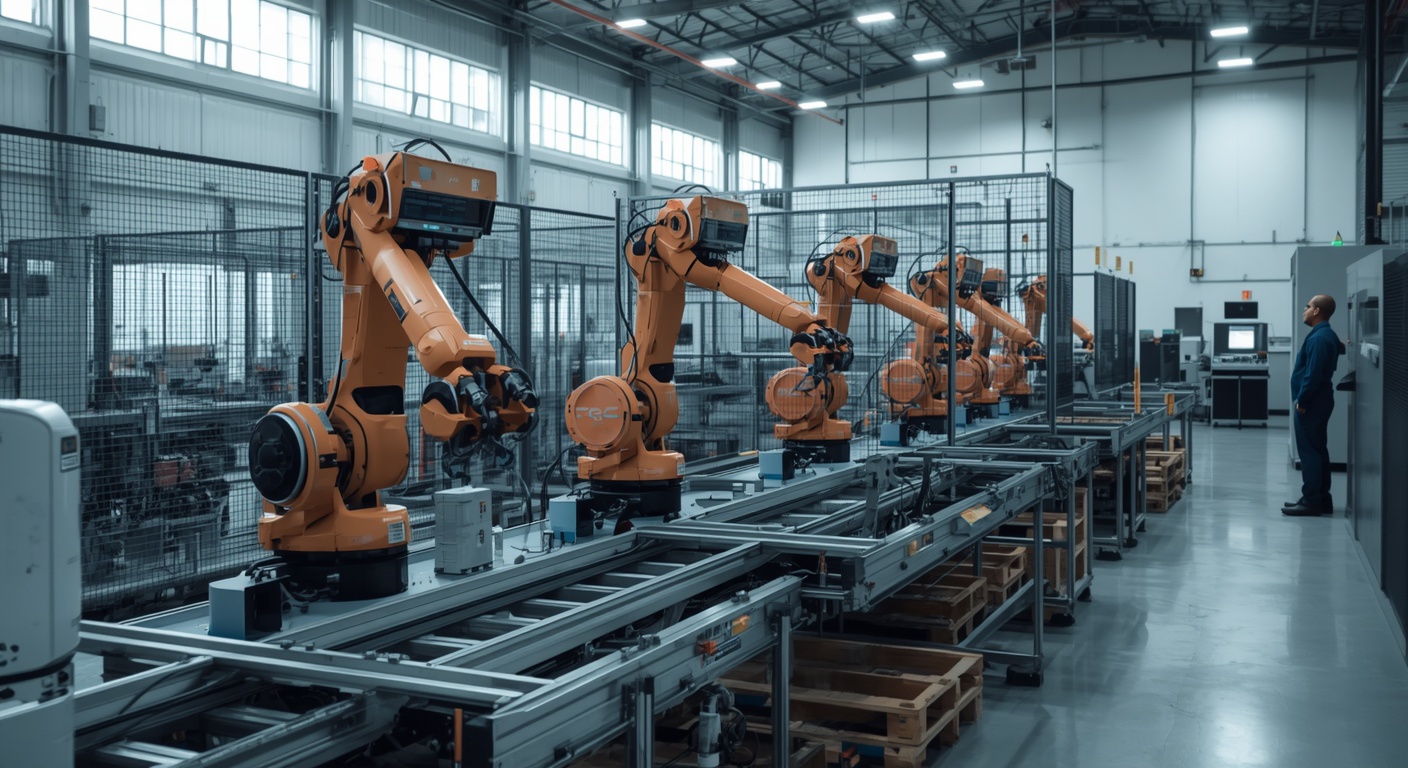
Factory automation is the use of control systems, software, sensors and production equipment to reduce manual intervention in manufacturing. It helps factories run machines, move materials, monitor processes and collect data more consistently across production, packaging, inspection and related operations.
For manufacturers, factory automation is not limited to robots on a large assembly line. It can include a simple conveyor with sensors, a programmable logic controller that manages machine sequences, an automated packaging cell or a production monitoring system that improves visibility. This guide explains how factory automation works, the main technologies involved, common examples, the benefits and limitations, and how manufacturers can assess where it makes sense to start.
What Is Factory Automation?
Factory automation is the use of machinery, control systems and software to perform manufacturing tasks with less manual intervention. It allows production equipment, material handling systems and monitoring tools to work in a coordinated way so factories can improve consistency, efficiency, quality and process control.
In practical terms, automation in manufacturing means that certain tasks are handled by programmed equipment instead of depending entirely on manual action. That can range from automatically stopping a machine when a sensor detects a fault to running a packaging line that counts, seals and labels products with limited operator input.
How Factory Automation Works in a Manufacturing Environment
Most factory automation systems follow a simple logic: detect, decide, act and verify.
A production process starts with inputs. Sensors detect position, temperature, pressure, speed, part presence, weight or other operating conditions. Those signals are sent to a control device, often a programmable logic controller, which applies predefined logic. Based on that logic, the system triggers an action such as starting a motor, moving a conveyor, opening a valve, rejecting a defective item or alerting an operator.
The process does not stop there. The system also monitors the result. If the expected condition is not achieved, it can adjust the process, stop equipment or prompt human intervention through a human-machine interface. In more advanced environments, data may also flow upward into SCADA or MES platforms for production monitoring, traceability and reporting.
For example, on an automated manufacturing line for packaged goods:
- a sensor detects that a product has reached the filling station
- the controller confirms the container is in the correct position
- the filling mechanism is activated
- another sensor checks whether the fill cycle was completed
- the conveyor moves the container to sealing and labelling
- the line status is displayed to operators and recorded for review
This interaction between equipment, controls and data is what makes factory automation systems useful. They reduce reliance on constant manual handling while making production more structured and measurable.
Main Components of a Factory Automation System
Although system design varies by industry and product, most automated manufacturing setups are built from a few core components.
Control systems and software
Control systems are the decision-making layer of industrial automation.
PLCs, or programmable logic controllers, are industrial computers designed to control machines and processes. They receive signals from sensors, apply programmed logic and send commands to motors, actuators, valves and other devices. In day-to-day factory operations, a PLC might control the sequence of a packaging machine, the timing of a conveyor transfer or an interlock that prevents unsafe motion.
HMIs, or human-machine interfaces, allow operators to interact with equipment. An HMI typically displays machine status, alarm conditions, setpoints and basic production information. It helps staff start or stop equipment, change recipes, acknowledge faults and monitor performance without accessing the controller program directly.
SCADA, or supervisory control and data acquisition, is used to monitor and supervise equipment across a wider process or facility. SCADA systems help manufacturers view machine status, trends and alarms from a central point. They are commonly used in process industries and larger plants where multiple systems need coordinated oversight.
MES, or manufacturing execution systems, operate at a higher level than machine control. MES helps manage production workflows, track work orders, record traceability data and connect shopfloor activity with planning or business systems. It can support scheduling, quality records and performance analysis.
In some environments, MES also exchanges information with ERP systems so production data is better aligned with inventory, planning and order fulfilment.
Machines, robots and material handling equipment
The physical side of factory automation includes the equipment that performs the work.
Industrial robots are used for repetitive, structured tasks such as pick-and-place, welding, palletising, dispensing, machine tending and basic assembly. Their value is highest where movement patterns are repeatable and consistency matters.
CNC-related automation often involves automatic loading and unloading, tool handling, part positioning or integration between machining equipment and upstream or downstream processes. This reduces idle time and operator dependency around precision production steps.
Conveyors and transfer systems move products, parts or packaging materials between stations. Even a relatively simple conveyor with sensors and stop gates can remove unnecessary handling and improve line flow.
Pick-and-place systems are common where components must be moved quickly and accurately into trays, fixtures, machines or cartons.
Automated packaging equipment can count, fill, seal, label, inspect and sort products. For many SMEs, packaging automation is one of the most practical entry points because the tasks are often repetitive and easier to standardise than upstream production processes.
Sensors, vision and data collection
Sensors provide the information that allows systems to respond to real conditions instead of operating blindly.
Common sensors detect part presence, position, speed, proximity, pressure, temperature, level and other process variables. These inputs support actions such as starting the next cycle only when a component is correctly placed, stopping a line when material is missing or counting output automatically.
Machine vision uses cameras and image processing to inspect, identify or guide parts. In practice, vision systems can be used to check label placement, confirm component orientation, detect surface defects or verify that an assembly contains the expected parts.
Data collection is equally important. Automated systems can record cycle status, downtime events, reject conditions and production counts. That information helps managers understand bottlenecks, compare shifts, spot recurring faults and support predictive maintenance efforts where appropriate.
When these elements are connected well, manufacturers move closer to a more visible and responsive operation rather than simply replacing manual labour with machines.
Types of Factory Automation
The main types of factory automation are fixed automation, programmable automation and flexible automation. The right choice depends on production volume, product variation and how often the process changes.
| Type | What it means | Best fit | Main limitation |
|---|---|---|---|
| Fixed automation | Equipment is designed for a specific, repeated task with limited changeover | High-volume, stable production | Low flexibility when products or processes change |
| Programmable automation | Equipment can be reprogrammed for different batches or product runs | Batch production with periodic changeovers | Changeovers and programming require time and skill |
| Flexible automation | Systems are designed to handle product variation with less manual reconfiguration | Mixed-product environments needing faster response | Higher integration complexity and investment |
Fixed automation is common when the same product is made repeatedly in high volumes. Examples include dedicated transfer lines or highly standardised packaging operations.
Programmable automation suits manufacturers that run different products in batches. The equipment can be adjusted through programming or setup changes, but not instantly.
Flexible automation is closer to the needs of businesses that face varied product mixes and want faster changeovers. It often relies on more advanced control, sensing and coordination between machines.
Not every factory needs the most flexible system. In many cases, a simpler approach is more practical and easier to maintain.
Common Examples of Factory Automation
Factory automation examples can be found in both large plants and smaller manufacturing operations. The scale may differ, but the purpose is the same: reduce repetitive intervention, improve consistency and gain better control over process flow.
Common examples include:
- Automated assembly: stations that feed, position or fasten components in a repeated sequence
- Robotic welding: robots performing repeatable weld paths where consistency is important
- Packaging lines: automated counting, filling, sealing, labelling and carton handling
- Palletising: robotic or mechanical stacking of finished goods for storage or dispatch
- Inspection systems: sensors or machine vision checking dimensions, presence, orientation or packaging quality
- Inventory tracking: barcode, sensor or system-driven movement tracking through production and storage
- Process control: automated control of temperature, mixing, flow or filling conditions in process manufacturing
- Machine tending: automated loading and unloading of parts into machines
For SMEs, automation does not have to begin with a fully integrated smart factory. A business may start with one bottleneck, such as end-of-line packaging, automatic counting, part feeding or production monitoring on a single line. Larger plants may integrate multiple systems across assembly, inspection, material transfer and data collection.
Manufacturers that want a broader local view of implementation approaches can continue with this guide to factory automation in Malaysia.
Benefits of Factory Automation
The benefits of factory automation depend on the process being automated, but several advantages are common across many sectors.
- Better consistency: automated sequences can reduce variation in repetitive tasks
- Higher productivity: equipment can often maintain a steadier operating rhythm than heavily manual processes
- Improved quality control: sensors and vision systems support in-process checks and reduce missed defects
- Stronger traceability: automated data capture makes it easier to record output, status and process history
- Safer task handling: automation can reduce direct human exposure to certain repetitive or hazardous motions
- Less repetitive manual work: staff can be reassigned to setup, monitoring, quality or problem-solving tasks
- Better visibility: production and downtime data can help managers identify where performance is being lost
Another important benefit is process discipline. Many factories discover that automation highlights missing standards, unclear workflows or unstable input conditions. While that can be challenging at first, it often leads to more reliable operations over time.
That said, benefits are not automatic. Poorly selected or poorly integrated systems can create new bottlenecks instead of solving old ones.
Challenges and Limitations to Consider
Factory automation can deliver real value, but it also introduces technical, operational and organisational challenges.
Implementation cost is the most obvious concern. Even when exact costs vary widely by application, businesses must consider not only equipment but also integration, tooling, installation, testing, training and ongoing support.
Integration complexity is another major issue. A new automation cell may need to work with existing machines, upstream processes, downstream packaging, quality checkpoints and production reporting systems. If current equipment is inconsistent or outdated, integration becomes more difficult.
Maintenance requirements also increase. Automated manufacturing depends on sensors, control systems, actuators, software and communication between devices. When any part fails, troubleshooting may require specialised skills.
Workforce training is often underestimated. Operators, technicians, engineers and supervisors need to understand not only how to run the system, but how to respond to faults, analyse downtime and maintain stable operation.
Process redesign may be necessary before automation works well. If a manual process has too much variation, inconsistent part presentation or frequent exceptions, simply automating it may not solve the underlying problem.
Transition downtime is another practical risk. During installation and commissioning, production may be disrupted. Businesses need a realistic plan for testing, ramp-up and temporary inefficiencies.
Suitability limits should also be considered. Highly variable, very low-volume or frequently changing production may not benefit from immediate automation, especially if the process itself is not yet stable.
These limitations do not mean automation is a poor choice. They mean it should be evaluated as an operational strategy, not just as a purchase.
Is Factory Automation the Same as Industry 4.0?
No. Factory automation focuses on using machines, controls and software to automate tasks and processes, while Industry 4.0 adds broader connectivity, data exchange, analytics and more intelligent decision-making across the manufacturing environment.
| Aspect | Factory automation | Industry 4.0 |
|---|---|---|
| Primary focus | Automating equipment and production tasks | Connecting systems, data and decision-making |
| Core tools | PLCs, robots, conveyors, sensors, HMIs | Connected machines, analytics, integration, digital visibility |
| Main goal | Reduce manual intervention and improve process control | Create a smarter, more data-driven factory |
| Typical outcome | More consistent and repeatable operations | Better responsiveness, insight and coordination across functions |
In other words, industrial automation is often a foundation for a smart factory, but it is not the whole picture. A line can be automated without being fully connected. Likewise, a factory may invest in data visibility and analytics while still having many manual processes.
Readers exploring the broader digital transformation side can also refer to Industry 4.0 and smart manufacturing in Malaysia.
How Manufacturers Can Start with Factory Automation
Manufacturers usually get better results when they start with a defined business problem rather than with a technology trend. A practical starting framework is:
- Identify bottlenecks. Look for stations where output slows down, quality varies or labour demand is consistently high.
- Assess repetitive tasks. Repetitive, rules-based and physically predictable activities are often the clearest candidates for automation.
- Define the objective. Decide whether the goal is better throughput, more stable quality, improved traceability, reduced handling or safer task execution.
- Review data needs. Determine what information should be captured, such as counts, downtime, reject events or process conditions.
- Evaluate equipment compatibility. Check whether current machines, tooling and product flow can support integration or whether process changes are needed first.
- Run a pilot. Start with one line, one cell or one constrained process so the business can learn before expanding.
- Train staff. Operators and maintenance teams should be involved early so the system is usable and supportable in daily production.
- Measure results and refine. Review whether the automation actually solved the original problem and what lessons should shape the next phase.
This step-by-step approach is especially useful for businesses that want to improve manufacturing automation without overcommitting to a full-scale rollout too early.
When Factory Automation Makes Sense for a Business
Factory automation makes the most sense when there is a clear operational reason for it.
It is often a strong fit when production volumes are high enough to justify dedicated equipment, when quality requirements demand tighter consistency, or when repetitive manual handling creates avoidable inefficiency. It can also be valuable where traceability matters, where process data is needed for control, or where certain tasks create ongoing safety concerns for workers.
Growth plans matter too. A business expecting increased output or more complex customer requirements may benefit from building automation capability early, especially if current manual processes are already close to their practical limit.
At the same time, not every process should be automated immediately. Some operations are too variable, too dependent on manual judgment or too unstable in their current form. In those cases, standardising the process first may deliver better returns than automating it too soon.
A realistic evaluation usually considers:
- production volume and repeatability
- frequency of product changeovers
- manual labour intensity
- quality and inspection requirements
- need for production data and traceability
- equipment compatibility and factory layout
- internal technical capability to maintain the system
The key question is not whether automation is good in general. It is whether a specific process is ready for it and whether the expected operational gains justify the effort.
Frequently Asked Questions
What is factory automation in simple terms?
Factory automation means using machines, sensors, control systems and software to do manufacturing tasks with less manual intervention. It helps factories run repetitive processes more consistently and monitor production more effectively.
What are the main types of factory automation?
The main types are fixed automation, programmable automation and flexible automation. Fixed automation suits stable, high-volume production, programmable automation suits batch production, and flexible automation suits environments with more product variation.
What are common examples of factory automation in manufacturing?
Common examples include automated assembly, robotic welding, conveyors, packaging lines, palletising, machine vision inspection, process control systems and automated machine tending.
What are the benefits of factory automation for manufacturers?
Typical benefits include better consistency, improved productivity, stronger quality control, better traceability, reduced repetitive manual work, improved data visibility and support for safer task handling in suitable applications.
How is factory automation different from Industry 4.0?
Factory automation focuses on automating physical tasks and processes. Industry 4.0 is broader and includes connectivity, data exchange, analytics and smarter coordination across the factory. Automation can be part of Industry 4.0, but the two terms are not identical.
Conclusion
Factory automation is the practical use of machines, controls, sensors and software to reduce manual intervention in manufacturing. It can range from simple automated handling or inspection to more integrated production systems that improve consistency, visibility and process control.
The best approach is usually targeted rather than ambitious for its own sake: identify the bottleneck, confirm the business case, pilot carefully and build capability over time. For readers looking beyond the basics, the wider topic of factory automation and connected manufacturing can be explored through broader smart manufacturing and automation resources.