Automated material handling systems are used to move, store, control and track raw materials, components, work-in-progress and finished goods with less manual intervention. In manufacturing and warehouse operations, they help improve material flow between receiving, storage, production, packing and dispatch. For Malaysian manufacturers evaluating automation, the key question is not just what the technology is, but where it fits operationally.
This guide explains how automated handling systems work, the main system types, where they are commonly used, and how to assess whether they suit your factory or warehouse.
What are automated material handling systems?
Automated material handling systems are combinations of equipment, controls and software that move, store, retrieve, identify and route materials with reduced manual handling. They are commonly used in factories and warehouses to support receiving, line feeding, work-in-progress transfer, pallet handling, storage and order dispatch.
The term covers a wide range of material handling automation, from simple conveyor systems between fixed stations to more flexible automated guided vehicles, autonomous mobile robots and automated storage and retrieval systems. Some installations are mainly mechanical. Others depend heavily on sensors, barcode scanners, RFID, PLC logic and software integration with warehouse or production systems.
Why material handling automation matters in manufacturing
In most plants, production performance depends not only on machines and labor but also on how reliably materials reach the right place at the right time. If incoming components are delayed, if work-in-progress accumulates between processes, or if finished goods cannot move out efficiently, throughput suffers even when production equipment is available.
Manual material movement often creates familiar problems:
- Bottlenecks between processes when forklifts, pallet jacks or operators are not available exactly when needed
- Inconsistent flow caused by variable handling methods or informal routing decisions
- Higher manual handling risk for repetitive lifting, stacking or transport tasks
- Limited visibility over where materials are located, waiting or delayed
- Space pressure from poor storage discipline, excess buffers or inefficient aisle use
- Labor dependency in activities that are repetitive but operationally critical
Automation does not solve every material flow issue, but it can make movement more repeatable, more traceable and easier to coordinate with upstream and downstream operations. That is why automated material movement is often part of wider factory automation in Malaysia planning rather than a standalone equipment purchase.
How automated material handling systems work
At a high level, automated material handling systems follow a practical sequence: identify the material, determine where it should go, move it through the facility, store or buffer it when needed, and hand it off to the next process.
A typical workflow may include:
- Receiving: Raw materials, pallets, cartons or components arrive at the facility.
- Identification: Labels, barcodes, RFID tags or system records identify the item and its status.
- Routing: Control logic or software determines whether the item goes to storage, inspection, production, packing or dispatch.
- Transport: Conveyors, AGVs, AMRs, lifts, shuttles or pallet handling equipment move the material.
- Buffering or storage: Materials may wait temporarily near production cells or be stored in racking or automated storage locations.
- Retrieval: When needed, the system retrieves the item for line feeding, assembly, packaging or shipping.
- Handoff: The material is transferred to operators, machines, warehouse staff or outbound loading processes.
Several technologies make this possible:
- Sensors detect presence, position, spacing or movement.
- PLCs control sequences, interlocks and equipment logic.
- Barcode scanners or RFID help confirm identity and destination.
- Warehouse or production software helps coordinate inventory, task release and movement instructions.
- Interfaces with WMS, MES or ERP can improve traceability and planning, depending on the system design.
Some factories implement relatively simple factory material handling systems that automate only one area, such as pallet transfer to wrapping. Others build broader intralogistics automation across receiving, storage, production supply and dispatch.
Main types of automated material handling systems
The best system type depends on product form, route complexity, layout stability, storage needs and how much flexibility the operation requires. The table below gives a practical comparison of three common categories.
| System type | Best suited for | Key strengths | Main limitations |
|---|---|---|---|
| Conveyor systems | Fixed, repetitive movement between defined points | Consistent flow, simple routing, strong fit for stable layouts | Less flexible when routes or layouts change frequently |
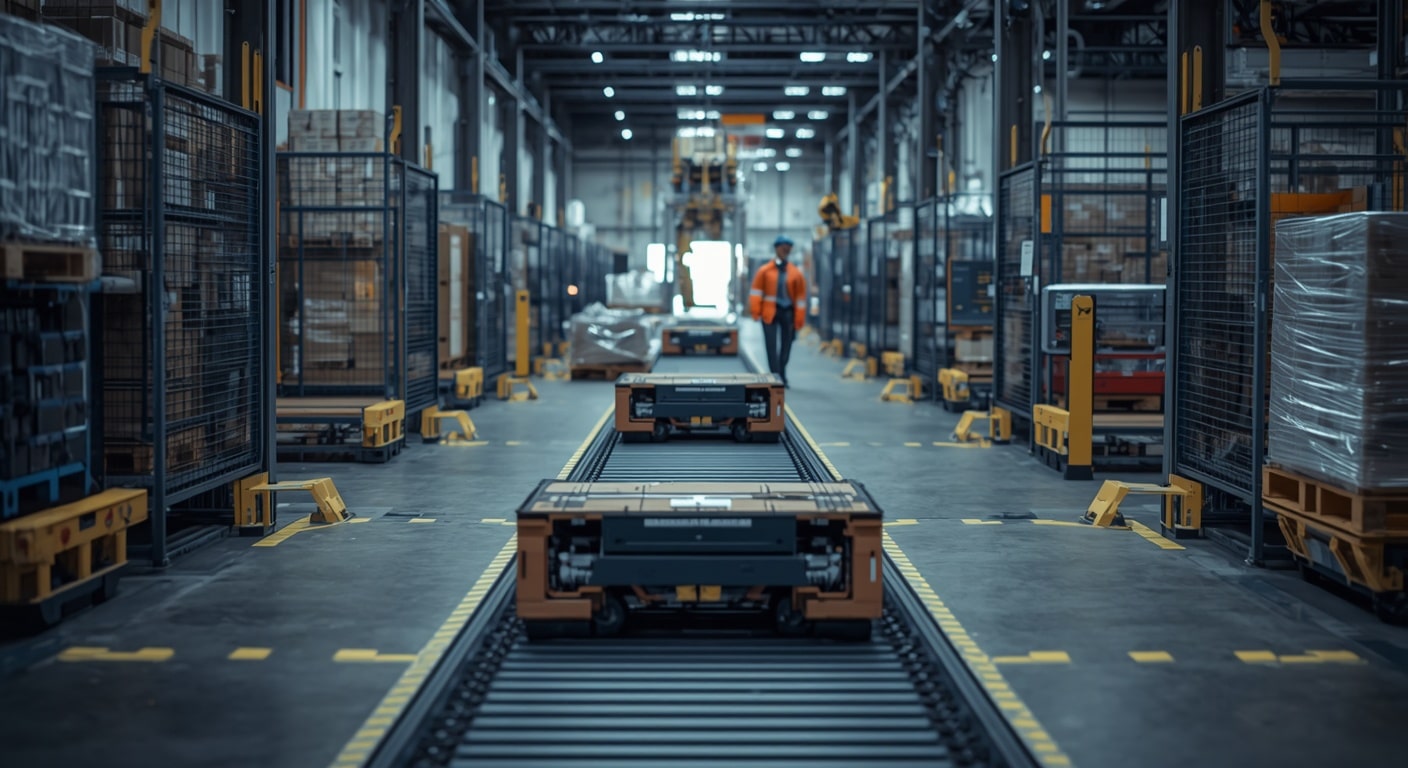
| AGVs / AMRs | Point-to-point transport across changing or mixed-use areas | More flexible routing, useful for line feeding and pallet transfer | Requires traffic planning, charging strategy and operational coordination |
| AS/RS | Dense storage and controlled retrieval | Better storage discipline, improved access control, reduced manual travel | Depends on structured storage logic and integration with surrounding processes |
Conveyor systems
Conveyor systems are one of the most established forms of warehouse automation systems and factory material movement. They are typically used when materials follow a fixed route between stations, such as from processing to inspection, from packaging to palletizing, or from receiving to sorting.
They usually fit best when:
- Product dimensions and handling conditions are reasonably consistent
- Material routes are predictable and repetitive
- The layout is relatively stable
- Throughput depends on continuous flow rather than on-demand transport
Conveyors can support cartons, totes, trays, components or pallets depending on the application. Their main advantage is consistency. Once designed into the layout, they reduce repeated manual transport and help synchronize adjacent processes.
The main limitation is flexibility. If the factory frequently changes product mix, process sequence or floor layout, a fixed conveyor path may become restrictive or require redesign.
Automated guided vehicles and autonomous mobile robots
Automated guided vehicles (AGVs) and autonomous mobile robots (AMRs) are both used for mobile transport, but they differ in how they navigate.
In practical terms, AGVs generally follow defined guidance methods or set routes, while AMRs are designed for more adaptive navigation within mapped environments. In a manufacturing setting, both can be used for pallet handling automation, line-side replenishment, moving work-in-progress between manufacturing cells, or transporting finished goods to staging areas.
AGVs may suit operations where transport routes are repeatable and traffic conditions are controlled. AMRs may suit facilities that need more route flexibility or where paths must adapt around people, equipment or temporary changes.
Both options still require planning. Manufacturers should consider aisle conditions, loading and unloading methods, battery charging arrangements, stopping points, traffic interaction and what happens when a vehicle is unavailable. Mobile automation is flexible, but it is not plug-and-play in every factory environment.
Automated storage and retrieval systems
Automated storage and retrieval systems, often called AS/RS systems, are designed to place materials into storage locations and retrieve them in a controlled way. They are commonly used where inventory density, retrieval accuracy and storage discipline matter.
Typical applications include:
- Component storage near assembly operations
- Controlled pallet storage in warehouses
- Buffer storage between production and packing
- Finished goods storage before dispatch
AS/RS systems can be valuable when floor space is constrained or when manual storage and retrieval creates delays or errors. They are also helpful when traceability matters, because the system can record where inventory is stored and when it is retrieved.
However, automated storage and retrieval systems work best when storage logic, product presentation and inbound/outbound processes are clearly defined. If upstream receiving or downstream picking remain disorderly, storage automation alone may not solve the overall flow problem.
Robotic palletizing and depalletizing
Robotic palletizing and depalletizing automate the repetitive task of stacking or unstacking products, cases or other loads. These systems are commonly placed at the end of packaging lines, in dispatch preparation areas, or in processes where materials arrive in regular stack patterns.
They often complement conveyors, stretch wrapping, labeling and outbound pallet handling. In environments with repetitive load patterns, robotic handling can reduce manual lifting and improve consistency in how pallets are built or broken down.
Their suitability depends on product stability, packaging variation, line layout and the required handoff to downstream equipment or warehouse operations.
Sortation and picking systems
Sortation and picking systems direct items to the correct order, route, container or shipment stream. In warehouses and distribution-supporting operations, they help improve order accuracy and reduce manual decision-making during dispatch.
In manufacturing-related logistics, sortation systems may be used for:
- Routing packed goods to different staging lanes
- Separating orders by destination or customer
- Supporting kitting and component preparation
- Improving picking flow in parts or spare inventory areas
These systems depend heavily on identification and control logic, which is why barcode scanners, RFID and software coordination are often important parts of the design.
Typical applications in Malaysian factories and warehouses
In Malaysia, automated handling systems can be relevant across many manufacturing and logistics environments, especially where material flow is repetitive, labor-intensive or difficult to scale consistently.
Examples include:
- Electronics manufacturing: transporting components, trays or assemblies between storage, kitting and production areas
- Food processing and packaging: moving packed goods, cartons or pallets through inspection, packing and dispatch stages
- Automotive components: line feeding, work-in-progress transfer and finished goods staging
- General manufacturing: managing inbound raw materials, pallet movement and inter-process transfer
- Third-party logistics and warehousing: storage, retrieval, picking, sortation and outbound preparation
Common use cases usually fall into five operational areas:
- Inbound material movement from receiving to inspection or storage
- Line feeding so production cells receive the right materials at the right time
- Work-in-progress transfer between process steps
- Finished goods handling after packing or final inspection
- Warehouse dispatch for staging, sortation and loading preparation
The strongest candidates are often not the most complex factories. They are the sites where material movement is frequent, predictable enough to standardize and important enough that delays affect overall operations.
Benefits and limitations to evaluate
Automated material handling systems can improve factory and warehouse performance, but the benefits depend on process fit and implementation quality.
Potential benefits
- More consistent material flow: Materials follow defined routes and handling rules.
- Reduced manual handling: Repetitive transfer, stacking or transport tasks can be reduced.
- Better traceability: Movement records can improve visibility over inventory and work-in-progress.
- Safer movement conditions: Well-designed systems can reduce unnecessary manual carrying and ad hoc transport activity.
- Support for growth: Standardized internal logistics can make expansion easier to manage.
- Improved space use: Structured storage and routing may reduce congestion or unmanaged buffers.
Limitations and constraints
- Layout dependency: Some systems, especially fixed-route solutions, depend on stable floor layouts.
- Integration complexity: Equipment, controls and software may need careful coordination.
- Training requirements: Operators, technicians and supervisors need new operating procedures.
- Maintenance planning: Reliability depends on preventive maintenance, spare parts and fault response.
- Capital commitment: Automation may require phased investment and careful scope control.
- Process discipline: Poor labeling, inconsistent packaging or unclear routing rules can undermine results.
The practical lesson is simple: benefits come from improving the full material flow, not from adding equipment in isolation.
How to choose the right automated material handling system
Manufacturers should start with process requirements, not with a preferred technology. A simple decision framework can help.
- Define what needs to move.
Document whether the load is a carton, tote, tray, pallet, component rack or something else. Note its size variation, handling sensitivity and presentation requirements. - Map the current route.
Identify where materials start, where they need to go, how often they move and where delays happen today. - Assess route complexity.
If movement is repetitive and fixed, conveyors may fit. If destinations vary or paths must change, AGVs or AMRs may be more suitable. - Review throughput patterns.
Look at whether movement is continuous, batch-based, shift-dependent or highly variable. The handling method should match the real operating rhythm. - Check available space and layout constraints.
Consider aisle width, turning areas, racking, ceiling conditions, pedestrian traffic and whether the layout is likely to change. - Evaluate storage needs.
If the main issue is not transport but dense, controlled storage, an AS/RS approach may be more appropriate than adding mobile transport alone. - Consider safety and interaction points.
Review where people, forklifts, machines and automated equipment will interact. Handover points and exception handling matter as much as movement itself. - Plan software and controls integration.
Decide whether the system needs to exchange information with WMS, MES, ERP, barcode systems or machine controls. Keep compatibility claims general unless technically verified for a real project. - Review maintenance capability.
Choose a system your team can support operationally, whether through in-house maintenance, vendor service or a hybrid approach. - Allow for future expansion.
Ask how easily the system can adapt if product mix, storage demand or factory layout changes over time.
This selection process works better than comparing technologies in the abstract. The right answer may be a simple conveyor, a mobile fleet, a storage-focused solution or a phased mix of systems.
Questions to ask before implementation
Before speaking with vendors or approving a project scope, manufacturers should work through a structured internal checklist.
- Where are the current bottlenecks in material flow?
- Which manual touchpoints are repetitive, stressful or prone to delay?
- Are product dimensions, packaging formats and load conditions consistent enough for automation?
- How often do routes, schedules or line configurations change?
- Is current inventory and movement data reliable enough to support automation design?
- What facility constraints exist around aisles, columns, racking, doorways or transfer points?
- How will operators, warehouse staff and maintenance teams be trained?
- What is the fallback plan if the system is temporarily unavailable?
- Which areas require phased implementation rather than a full rollout?
- How will project success be measured operationally?
These questions help prevent a common mistake: buying technology before defining the handling problem clearly enough.
Integration with factory automation and smart manufacturing
Automated material handling is often most useful when it connects with broader production and logistics systems. A conveyor or mobile robot may move the load, but the bigger value often comes from knowing what the load is, where it is going and what production step it supports.
That is why material flow automation is frequently linked with:
- PLCs for equipment control and sequencing
- WMS for warehouse task coordination and inventory visibility
- MES for production-related tracking and execution
- ERP for planning, inventory records and order flow
- Barcode or RFID systems for identification and status confirmation
For manufacturers building a broader digital roadmap, automated handling supports a more connected internal flow. It sits naturally within Industry 4.0 and smart manufacturing in Malaysia because it creates cleaner movement data, more structured processes and better coordination between physical operations and digital systems.
Even so, integration should be driven by operational need. Not every project requires deep software linkage from the beginning. In some factories, it makes sense to start with a well-contained use case and expand system connectivity later.
Common mistakes manufacturers should avoid
Automating material movement can deliver real operational value, but several avoidable mistakes tend to weaken projects.
- Automating a poor process: If routes, storage logic or handoff points are unclear, automation can lock in inefficiency.
- Ignoring product variability: Different packaging formats, unstable loads or irregular dimensions can create handling issues if not addressed early.
- Choosing technology before defining requirements: A mobile robot, conveyor or AS/RS should be a response to process needs, not the starting point.
- Underestimating maintenance: Equipment availability depends on planned support, troubleshooting capability and spare parts readiness.
- Weak layout analysis: Transfer points, congestion areas and traffic interaction need careful review.
- Insufficient operator training: People still play a central role in loading, exception handling and system discipline.
- Overcomplicating the first phase: A smaller, well-defined application is often easier to execute than a facility-wide rollout all at once.
In practice, the strongest projects usually come from clear process mapping, realistic scope and phased implementation.
Conclusion: when automated material handling systems make sense
Automated material handling systems make the most sense when material movement is frequent, operationally important and structured enough to standardize. They are especially worth evaluating when manual transport creates bottlenecks, inconsistency, visibility gaps or unnecessary handling risk.
The right solution may be as simple as a conveyor between stable process steps or as advanced as a combination of AS/RS, mobile transport and software-connected intralogistics automation. What matters most is matching the system to the actual process, layout and business objective.
For manufacturers looking at broader transformation, material handling is often a practical entry point into wider factory automation in Malaysia planning, where equipment, data and workflow can be improved together.
Frequently Asked Questions
What are automated material handling systems used for?
They are used to move, store, retrieve, route and track materials such as components, cartons, pallets and finished goods with less manual handling. Common uses include receiving, storage, line feeding, work-in-progress transfer, palletizing and dispatch preparation.
What is the difference between AGVs, AMRs and conveyor systems?
Conveyor systems move materials along fixed paths and are best for repetitive, stable routes. AGVs are mobile vehicles that generally follow defined guidance or set routes. AMRs are mobile robots designed for more flexible navigation in changing environments. The best choice depends on layout stability, route variability and handling requirements.
Which industries benefit most from automated material handling systems?
Industries with frequent, repetitive internal movement often benefit most. Examples include electronics, food processing, packaging, automotive components, warehousing, logistics and general manufacturing operations with regular inbound, inter-process or outbound flow.
How do manufacturers choose the right automated material handling system?
They should begin by mapping the material flow, load types, route complexity, throughput pattern, space constraints, storage needs, safety considerations and software requirements. The correct system should fit the process, not the other way around.
Can automated material handling systems integrate with warehouse or production software?
Yes, many systems can connect with tools such as WMS, MES, ERP, barcode scanners or RFID-based identification. However, the depth of integration depends on the system design and should be confirmed during project planning rather than assumed in advance.