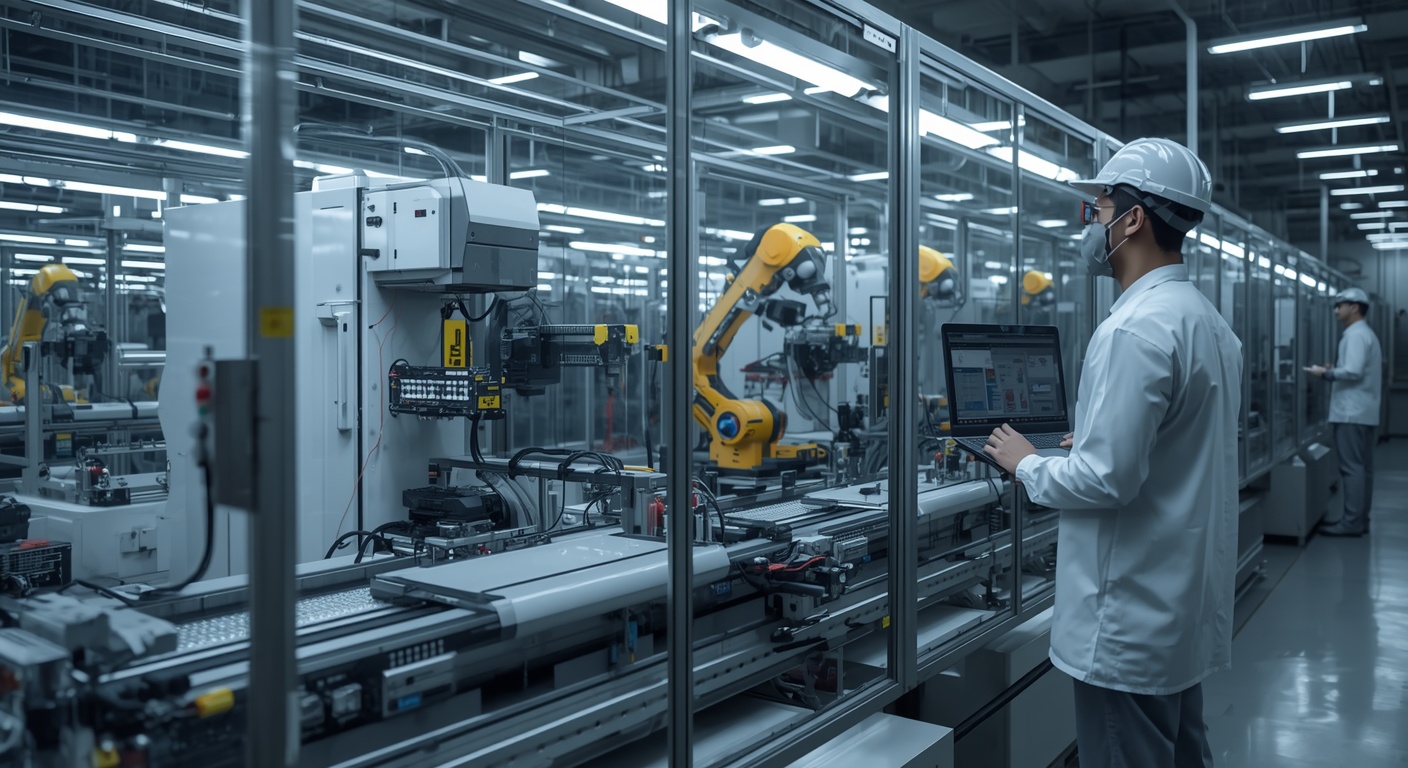
AI in manufacturing refers to the use of data-driven software systems to improve how factories operate. Instead of relying only on fixed rules, manufacturers can use machine learning, computer vision and predictive analytics to detect patterns, support decisions and improve production, maintenance, quality and planning.
For manufacturers, the practical question is not whether artificial intelligence sounds advanced, but where it solves a real operational problem. In many factories, AI works best when it is tied to clear use cases such as predictive maintenance, visual inspection, production scheduling or demand forecasting. This article explains how AI works in a manufacturing environment, where it is commonly used, what benefits and limitations to expect, and how manufacturers in Malaysia can start sensibly.
What Is AI in Manufacturing?
AI in manufacturing is the use of data-based systems such as machine learning, computer vision and predictive analytics to help factories improve production, quality, maintenance and decision-making. It turns data from machines, sensors, cameras and software into alerts, predictions or recommendations that support better operational control.
In simple terms, AI helps manufacturers move from reacting to problems after they happen to spotting patterns earlier and responding more consistently. It does not replace every decision made by operators, engineers or managers. In most factories, it works as a decision-support layer on top of existing processes, equipment and software.
AI is also part of the broader shift toward Industry 4.0 and smart manufacturing in Malaysia, where connected systems, operational data and digital tools are used to improve visibility and performance across the factory.
How AI Works in a Manufacturing Environment
Most industrial AI systems follow a practical workflow. The details vary by use case, but the logic is usually similar.
- Data is collected from machines, sensors, PLCs, cameras, MES, ERP, SCADA systems or manual records.
- The data is organized and analysed using rules, statistical models or machine learning models to detect patterns and abnormalities.
- The system produces an output such as a prediction, a defect alert, a maintenance warning, a scheduling recommendation or a process adjustment suggestion.
- People or connected systems act on that output by inspecting a machine, changing a setting, reordering work or escalating a problem.
For example, a machine may generate temperature, vibration or cycle-time data. AI software can analyse that information over time and identify conditions that often appear before performance deteriorates. In another case, a vision system can compare images of finished parts with expected patterns and flag possible defects for review.
This is why AI in manufacturing depends heavily on data quality and process visibility. If the factory has inconsistent records, disconnected equipment or unclear operating procedures, AI will struggle to produce reliable results. The technology is not magic. It needs a stable operational foundation and useful data to work well.
Integration also matters. Many manufacturers already run some combination of ERP, MES, PLC, SCADA or machine-level monitoring tools. AI usually delivers the most value when it fits into those existing workflows instead of becoming a separate dashboard that nobody uses.
Common Applications of AI in Manufacturing
AI applications in manufacturing are most useful when they address repeatable operational issues. Rather than treating AI as a single product, it is more accurate to view it as a set of methods that can be applied to maintenance, quality, planning, process control and supply chain decisions.
Below are some of the most common AI use cases in manufacturing.
Predictive Maintenance
Predictive maintenance uses AI to analyse equipment data and identify patterns linked to wear, degradation or abnormal operating behaviour. Instead of depending only on fixed maintenance intervals or waiting for a failure to occur, maintenance teams can use these signals to prioritize inspections and schedule interventions more effectively.
Typical inputs may include vibration trends, temperature readings, motor current, pressure data, alarm history or downtime records. Machine learning models can compare current patterns with historical behaviour and flag equipment that may be moving away from normal operating conditions.
The business value is mainly operational. Manufacturers may be able to reduce unplanned downtime, improve spare parts planning and make maintenance work more targeted. Results still depend on the condition of the equipment, the quality of historical data and whether abnormal events are recorded consistently enough to train a useful model.
Predictive maintenance is often discussed alongside broader factory automation in Malaysia because maintenance visibility improves when production assets are monitored more systematically.
Quality Control and Visual Inspection
Quality control automation is one of the clearest applications of AI in manufacturing. Using computer vision, factories can analyse images or video from cameras to detect scratches, dimensional inconsistencies, missing components, labelling issues, surface defects or assembly errors.
Traditional visual inspection often depends on manual judgment, which can vary between shifts or inspectors. AI-supported inspection helps standardize repetitive checks and can improve consistency in high-volume environments. It can also help quality teams review large numbers of items faster than purely manual inspection processes.
This does not mean human inspectors become unnecessary. In many operations, AI works best as a support tool. It can pre-screen products, flag suspicious items and allow inspectors to focus on exceptions, root-cause analysis and process improvement. Complex or ambiguous defects may still require human confirmation.
Machine vision in manufacturing is especially useful where the product appearance is important, defect categories can be visually defined and inspection conditions such as lighting and image quality can be controlled.
Production Planning and Scheduling
Production planning AI can help manufacturers make better sequencing and scheduling decisions when conditions change frequently. Many factories deal with competing priorities such as delivery dates, machine availability, labour constraints, changeover time and material shortages. AI can evaluate this mix of variables more dynamically than static spreadsheet-based planning.
In practical terms, AI can support:
- job sequencing based on constraints and priorities
- capacity planning across lines or work centres
- bottleneck identification
- resource allocation
- schedule revisions when disruptions occur
The main advantage is not that AI makes production planning effortless, but that it can surface better options faster. Planners still need to apply operational judgment, especially where customer priorities, engineering restrictions or shop-floor realities are not fully visible in the system.
Process Optimization
Process optimization uses AI to identify relationships in manufacturing data that may not be obvious through manual review alone. This can include patterns between machine settings, raw material variation, environmental conditions, cycle times, throughput or reject rates.
Once those patterns are understood, manufacturers can test process adjustments to improve consistency, reduce waste or stabilize output. In some environments, AI may also support energy-related decisions by highlighting operating patterns associated with less efficient performance, though outcomes depend heavily on the process and available data.
Process optimization works best in operations where the process is already reasonably controlled and a useful amount of production data exists. If the underlying process is unstable, poorly documented or constantly overridden manually, AI recommendations may be difficult to trust or act on.
Supply Chain and Demand Forecasting
Manufacturers do not use AI only inside the production line. Supply chain forecasting AI can also support demand planning, procurement and inventory decisions by identifying trends, seasonality, exceptions or anomalies across order history, lead times and stock movement.
Examples of manufacturing-relevant use cases include:
- forecasting likely demand changes for finished goods or key product families
- highlighting inventory items with unusual consumption patterns
- improving raw material planning based on expected production needs
- identifying sourcing risks or supply variability that may affect schedules
These tools are most useful when forecasting is difficult to manage manually or when planners need faster warning of changing conditions. They are less useful when data is sparse, product mix changes too often or demand is driven by one-off projects that are hard to model historically.
Robotics and Human-Machine Collaboration
Not all industrial robots use AI. Many robotic systems follow programmed paths and fixed rules very effectively without any learning capability. AI becomes relevant when robotic systems need better perception, adaptive decision-making or more flexible interaction with variable conditions.
For example, AI-enabled vision can help a robot identify part orientation, locate objects in less controlled environments or respond to product variation more effectively than a purely fixed setup. In collaborative applications, better sensing and contextual decision-making may also support safer or more responsive human-machine workflows, depending on the system design.
The key distinction is that fixed automation is designed to repeat predefined tasks, while industrial AI can help a system handle greater variation and use real-world data more intelligently. Whether that added flexibility is worthwhile depends on the process, product mix and required reliability.
Benefits of AI in Manufacturing
The benefits of AI in manufacturing are usually strongest when the use case is clearly defined and operational data is available. Rather than promising universal transformation, it is more practical to evaluate AI in terms of the specific business problem it helps solve.
| Benefit | How it helps manufacturers |
|---|---|
| Better quality consistency | Supports more standardized inspection and earlier detection of deviations. |
| Lower unplanned downtime | Helps maintenance teams identify risk patterns before failures disrupt production. |
| Faster decision-making | Turns large data sets into alerts, priorities or recommendations that are easier to act on. |
| Improved planning | Supports more responsive scheduling, forecasting and resource allocation. |
| Reduced waste and rework | Can reveal process conditions linked to scrap, variation or unstable output. |
| Stronger operational visibility | Makes it easier to see trends across machines, lines, products or shifts. |
| Better use of skilled staff | Allows engineers, planners and inspectors to focus on higher-value exceptions and analysis. |
These benefits do not appear automatically. AI performs best when manufacturers have enough process discipline to act on what the system shows. A model that identifies risk is useful only if the maintenance team can verify and respond. A vision system that flags defects adds value only if the inspection workflow, lighting and defect definitions are properly managed.
Challenges and Limitations Manufacturers Should Expect
AI adoption in manufacturing is often limited less by the algorithm itself and more by operational readiness. Manufacturers should expect practical constraints and plan around them.
Data quality problems
Many factories have missing records, inconsistent naming conventions, fragmented machine data or limited historical fault information. AI models trained on weak data will produce weak outputs.
Legacy equipment and connectivity gaps
Older machines may not produce the data needed for industrial AI projects, or they may require additional sensors, interfaces or integration work before useful monitoring is possible.
Integration complexity
Linking AI tools with MES, ERP, SCADA, maintenance systems or quality workflows can be more difficult than expected. If outputs do not fit operational routines, adoption suffers.
Skills gaps
Manufacturers may need a mix of production knowledge, engineering understanding, data handling capability and vendor coordination. AI projects often fail when they are treated as purely IT exercises without shop-floor involvement.
Change management issues
Operators and supervisors may resist systems they do not trust or understand. Clear communication, practical training and visible problem-solving value are important for adoption.
Cybersecurity and data governance concerns
Connecting more assets and systems can increase cybersecurity exposure. Manufacturers need to think carefully about access control, network architecture, vendor connectivity and data handling responsibilities.
Unclear use-case selection
One of the most common mistakes is starting with a vague goal such as “use AI in the factory” instead of a specific operational problem. AI is not a plug-and-play solution. It works best when built around measurable business needs.
How to Start Implementing AI in Manufacturing
Manufacturers do not need to begin with a large smart factory programme. A smaller, disciplined pilot is often the better starting point.
- Identify a specific business problem. Start with an issue that matters operationally, such as recurring downtime, difficult inspection tasks, unstable scheduling or excess scrap.
- Assess data availability. Check what machine, process, quality or planning data already exists, how reliable it is and whether it is accessible in usable form.
- Choose one pilot use case. Pick a narrow application with clear boundaries. Predictive maintenance for one asset group or vision inspection for one product line is usually easier than a plant-wide deployment.
- Involve operations, maintenance, engineering and IT. AI projects need process owners, not just software vendors. The people who run the operation should help define the problem and validate the outputs.
- Define success metrics. Decide in advance how the pilot will be judged. This may include fewer false alarms, better defect detection consistency, faster planning response or improved visibility into a recurring issue.
- Test on a limited scope. Run the pilot in a controlled environment, compare AI outputs with real operating results and refine the model or workflow before broader rollout.
- Scale only after validation. If the use case proves useful, standardize the process, improve integration and expand carefully to other machines, lines or sites.
For SME manufacturers, this step-by-step approach reduces risk. It also helps management separate genuinely useful industrial AI projects from expensive technology experiments with no clear operational owner.
What Malaysian Manufacturers Should Consider
For manufacturers in Malaysia, AI adoption often depends on digital maturity more than ambition. Some factories already have connected equipment, production monitoring and structured data. Others are still working with a mix of manual records, isolated machines and spreadsheet-based planning. That difference matters because AI performs better when upstream systems and processes are stable.
SMEs may also face tighter budget, staffing and implementation constraints than large manufacturers. In those cases, the best AI use cases are usually practical, narrow and tied to a visible pain point. A focused inspection, maintenance or planning pilot is often more realistic than trying to launch multiple smart manufacturing initiatives at once.
Workforce readiness is another key consideration. Engineers, supervisors and technicians need to understand what the system is doing, how to interpret outputs and when human judgment should override a recommendation. Adoption is easier when AI tools are introduced as operational support, not as opaque systems imposed from above.
Manufacturers should also verify any grants, incentives, support schemes, standards or compliance requirements directly with the relevant official authority or programme owner before making investment decisions. Requirements can vary by sector, business size, technology scope and current policy status, so it is safer to confirm details than rely on assumptions.
AI vs Traditional Automation: What Is the Difference?
Traditional automation and AI are related, but they are not the same. Traditional automation follows predefined logic. AI-enabled systems use data to identify patterns, adapt to variation or generate predictions.
| Aspect | Traditional automation | AI-enabled systems |
|---|---|---|
| Decision logic | Fixed rules and programmed instructions | Data-driven models or pattern recognition |
| Flexibility | Best for stable, repetitive tasks | Better suited to variable conditions and more complex patterns |
| Learning capability | Does not learn unless reprogrammed | Can improve or adapt when models are updated with relevant data |
| Data dependence | Can operate with limited data | Usually depends on sufficient and reliable data |
| Best-fit use cases | Conveying, fixed sequencing, repetitive machine motions, standard control logic | Predictive maintenance, visual inspection, forecasting, advanced scheduling, anomaly detection |
In practice, many factories use both. A production line might rely on conventional automation for machine control while using AI for inspection, forecasting or maintenance decisions. The right mix depends on whether the problem is mainly about repeatability or about interpreting complex data and variation.
Frequently Asked Questions
What is AI in manufacturing in simple terms?
It is the use of software that analyses factory data to help improve decisions about production, quality, maintenance and planning. Instead of relying only on fixed rules, AI looks for patterns in data and turns them into alerts, predictions or recommendations.
What are the most common AI applications in manufacturing?
Common applications include predictive maintenance, machine vision for defect detection, production scheduling support, process optimization, demand forecasting and inventory planning. Some manufacturers also use AI with robotics where tasks involve more variation or visual sensing.
How does AI improve quality control in factories?
AI improves quality control mainly through computer vision and pattern analysis. It can review images of parts or products, detect visual inconsistencies and flag possible defects more consistently in repetitive inspection tasks. Human review is still important for confirmation and root-cause analysis.
What is the difference between AI and traditional automation?
Traditional automation follows fixed instructions. AI uses data to recognize patterns, make predictions or support decisions in changing conditions. Traditional automation is ideal for repeatable control tasks, while AI is more useful when manufacturers need insight from complex or variable data.
How can a small manufacturer start using AI?
A small manufacturer should start with one practical use case tied to a clear problem, such as downtime, inspection or scheduling. Check whether enough usable data exists, run a limited pilot, involve the people who own the process and scale only if the results are validated.
What challenges can manufacturers face when adopting AI?
Typical challenges include poor data quality, disconnected legacy equipment, integration difficulty, limited in-house skills, resistance to change, cybersecurity concerns and unclear project goals. Many problems come from operational readiness gaps rather than the AI tool itself.
Conclusion
AI in manufacturing is most valuable when it is applied to a specific operational problem and supported by reliable data. It can help manufacturers improve maintenance, quality, planning and process visibility, but it is not a shortcut around weak systems or unclear processes.
A practical approach is usually the strongest one: choose a focused use case, test it on a limited scope, measure whether it improves operations and scale only when the results are clear. For manufacturers evaluating broader digital transformation, AI should be treated as one part of a wider smart manufacturing strategy rather than a standalone solution.