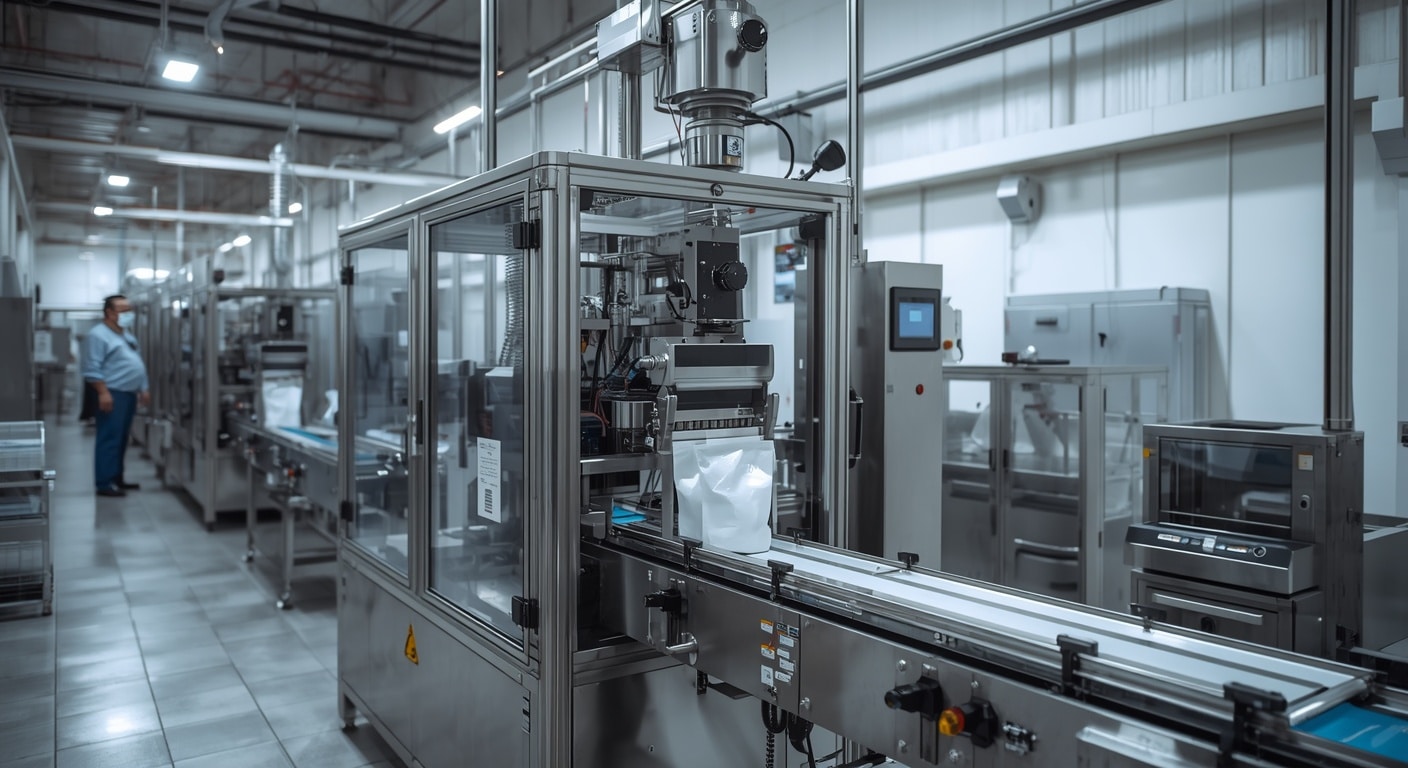
A VFFS packaging machine is widely used in manufacturing to create, fill, and seal bags from roll film in one continuous process. It is common in food packaging machinery and other automated packaging equipment because it can handle a wide range of products, bag formats, and production line layouts. For manufacturers evaluating packing line equipment, understanding how VFFS machines work, where they fit, and what their limits are is essential before making a purchase decision.
This guide explains the basics of vertical form fill seal packaging, the main machine components, common applications, the difference between VFFS and HFFS systems, and practical selection points for Malaysian factories.
What is a VFFS packaging machine?
A VFFS packaging machine is a vertical form fill seal machine that forms a bag from a roll of packaging film, fills it with product, and seals it in a top-down process. It is commonly used for powders, granules, snacks, dry foods, frozen foods, and other packaged goods that suit vertical bagging.
In simple terms, the machine turns flat film into a tube, creates a sealed bag, doses product into it, then seals and cuts the pack. Because the process is integrated, a VFFS machine is often chosen when manufacturers want a compact bagging machine that can work with upstream filling and downstream conveying or coding equipment.
How a VFFS packaging machine works
A vertical form fill seal machine works through a repeated sequence of forming, filling, sealing, and discharging. While exact designs vary by manufacturer and application, the operating logic is usually similar.
- Film unwinding: A roll of packaging film is mounted on the machine and fed forward under controlled tension.
- Bag forming: The film passes over a forming collar and around a forming tube, which shapes the flat film into a vertical tube.
- Vertical sealing: The machine creates a longitudinal seal to join the film edges and make a continuous tube.
- Product dosing: The filling system drops or dispenses the product through the forming tube into the partially formed bag.
- Horizontal sealing: Sealing jaws close across the tube to create the top seal of one bag and the bottom seal of the next.
- Cutting: A cutter separates the finished pack from the film tube.
- Discharge: The sealed pack is released to a conveyor, collection area, or downstream inspection and packing system.
For buyers, the key point is that machine performance depends not only on the VFFS frame itself but also on the product feeding method, packaging film, sealing conditions, and downstream line coordination.
Main components of a VFFS machine
Understanding the core components helps manufacturers compare machines more effectively. A VFFS machine may look straightforward from the outside, but packaging quality depends on how well these systems work together.
Film roll holder and film feed system
This section supports the packaging film roll and feeds material into the machine at a controlled rate. Stable film handling matters because poor tension control can affect tracking, bag length consistency, and seal alignment.
Forming collar and forming tube
The forming collar guides the film into shape, while the forming tube creates the vertical path for both the bag and the product. These parts are central to vertical form fill seal packaging because they determine how the flat film becomes a usable pouch or bag.
Sealing jaws
Sealing jaws create the cross seals that close the package. The machine also creates a vertical seal along the back or side of the bag, depending on the bag style. Seal quality is critical because weak or inconsistent seals can lead to leakage, contamination risk, or transport damage.
Filling system
The filling system is selected according to product type. Common examples include:
- Auger filler for powders
- Multihead weigher for snacks and irregular dry products
- Volumetric cup filler for free-flowing granules and similar products
The filler is not a minor accessory. It is one of the main factors that determines whether a packaging machine for powders and granules will actually perform well in day-to-day operation.
Control system
The control system manages timing, sealing sequence, bag length, film feeding, and coordination with feeders or other line equipment. A well-designed interface can make changeovers, troubleshooting, and operator training easier.
Cutter
The cutter separates completed bags after sealing. In some applications, clean and consistent cutting is important for appearance, pack count accuracy, and downstream cartoning or case packing.
Discharge area and conveyor
After cutting, finished packs move to a discharge chute, conveyor, date coder, checkweigher, metal detector, or manual packing station. Compatibility with downstream handling should be considered early, not after the machine has been specified.
What products are commonly packed with VFFS machines?
VFFS applications in manufacturing are broad because the machine concept is flexible. That said, not every product is suitable. The best fit depends on how the product flows, whether it is fragile, how much dust it creates, and what package style is needed.
Common product categories include:
- Powders such as beverage mixes, flour-like products, or seasoning blends
- Granules such as sugar, rice, salt, seeds, or pellets
- Snacks such as chips, crackers, nuts, or puffed products
- Dry foods such as pasta, cereals, beans, and bakery ingredients
- Frozen foods where suitable packaging materials and line conditions are used
- Coffee and similar dry consumer goods
- Small hardware items such as screws, fasteners, or accessory kits
- Household and consumer packaged goods that suit bag-based formats
In food manufacturing, VFFS systems are especially common because they pair well with weighers, dosing equipment, and continuous packaging lines. In non-food sectors, they can also be used for industrial consumables or small parts where bagging is more practical than tubs, bottles, or cartons.
However, highly irregular products, products that break easily, or items requiring careful orientation may be better suited to a different machine concept. Product trials are often more useful than assumptions when evaluating suitability.
Types of bags and pack formats a VFFS machine can produce
A VFFS machine can support several bag styles, but available formats depend on machine design, forming sets, sealing arrangement, and optional attachments. Buyers should avoid assuming that every pouch packaging machine can make all bag styles equally well.
Pillow bags
Pillow bags are among the most common outputs. They are simple, efficient, and widely used for snack foods, powders, granules, and general consumer goods.
Gusseted bags
Gusseted bags include side folds that can improve pack shape and shelf presentation. They may be useful when manufacturers want a neater pack profile or need more efficient case packing.
Sachets
A sachet packaging machine format may be achievable on some VFFS systems, especially for smaller single-use or portion packs. However, the exact sachet range depends on the machine configuration and tooling.
Other pouch-style variations
Some machines can be configured for additional pouch or bag variations through accessories or model-specific features. Manufacturers should confirm what is standard, what is optional, and what requires a different platform entirely.
Stick packs should be considered separately. Although buyers sometimes discuss them together with VFFS equipment, dedicated stick-pack equipment is often a distinct machine category and should not be assumed to be part of a standard vertical form fill seal machine offering.
VFFS vs HFFS: what is the difference?
The main difference between VFFS and HFFS machines is orientation and product handling. A VFFS machine forms and fills bags vertically, while a horizontal form fill seal machine works in a horizontal layout and is often preferred for products that need more controlled placement or presentation.
| Factor | VFFS | HFFS |
|---|---|---|
| Machine orientation | Vertical | Horizontal |
| Typical product feed | Product drops through a forming tube | Product is placed or fed into a horizontal web or pouch area |
| Common applications | Powders, granules, snacks, dry goods, bagged consumer products | Items needing controlled placement, tray or flow-wrap style handling, or more delicate presentation |
| Package styles | Commonly pillow bags, gusseted bags, some sachet-style packs | Often used where horizontal pack formation better suits the product or final appearance |
| Line layout | Usually compact in footprint and suited to top-down filling | Often requires a different line arrangement based on product infeed and pack transfer |
| Best fit | Free-flowing or weighable products suited to vertical bagging | Products that are fragile, need orientation, or do not suit gravity-fed filling |
Neither approach is automatically better. Packaging machine selection should be based on product behavior, bag style, handling needs, and how the machine fits within the overall production process.
Benefits of using a VFFS packaging machine
For the right application, a VFFS machine offers several practical advantages.
- Integrated packaging process: Forming, filling, sealing, and cutting happen in one machine sequence.
- Good fit for automation: It integrates well with weighers, auger fillers, conveyors, date coders, and other packing line equipment.
- Consistent package formation: When properly specified and maintained, it can improve bag uniformity compared with highly manual packing methods.
- Reduced manual handling: Automation can reduce repetitive manual bagging tasks and improve line organization.
- Efficient use of floor space: The vertical layout can be attractive where line footprint matters.
- Versatility across product categories: With the right filling system and film setup, the same machine platform may support multiple SKUs or related products.
These benefits make VFFS systems common in food packaging machinery, consumer goods manufacturing, and operations seeking a practical level of industrial automation without moving to a much more complex packaging architecture.
Limitations and practical challenges to understand
A VFFS machine is not a universal solution. Buyers should understand the operational challenges as clearly as the benefits.
Film compatibility matters
Packaging film must suit the sealing method, product, and desired bag style. Even a well-built machine can struggle if the film structure is poorly matched to the application.
Seal quality requires control
Seal consistency depends on factors such as film behavior, machine condition, timing, and product contamination in the seal area. Manufacturers should plan how seal integrity will be checked during production.
Dust and product contamination can affect performance
Powders and dusty granules can interfere with filling accuracy, sealing cleanliness, and housekeeping around the machine. This is one reason filler selection and extraction or cleaning arrangements deserve attention.
Changeovers may be more involved than expected
Changing bag sizes, films, or products may require forming set changes, parameter adjustments, filler setup changes, and validation checks. This becomes more important when a factory handles many SKU variations.
Maintenance and parts support are ongoing needs
Sealing elements, cutters, moving assemblies, and sensors all require upkeep. A low purchase price may be less attractive if spare parts are difficult to obtain or technical support is limited.
Not every product suits vertical bagging
Very fragile items, sticky materials, or products that need careful orientation may not run well on a standard VFFS platform. In such cases, a different packaging concept may be more appropriate.
How to choose the right VFFS packaging machine
Choosing a VFFS packaging machine starts with process fit, not brochure claims. The most useful approach is to define the product, the required pack, and the production environment first, then match the machine around those needs.
- Define the product clearly. Consider whether it is a powder, granule, snack, frozen item, small part, or another product type. Review flow behavior, dust generation, fragility, and fill consistency.
- Confirm the required bag format. Identify whether the line needs pillow bags, gusseted bags, sachets, or another format. Do not assume all formats are available on one base machine.
- Select the right filling method. Match the filler to the product. Powders may need auger filling, while many snacks or irregular pieces are better paired with a multihead weigher.
- Review production needs realistically. Look at normal operating requirements, product mix, and shift pattern rather than choosing only for a best-case scenario.
- Check available floor space and line flow. Include infeed, film handling space, operator access, discharge, coding, inspection, and secondary packing areas.
- Assess integration needs. Consider upstream feeders and downstream conveyors, date coders, inspection stations, and case packing processes.
- Consider cleaning and hygiene needs. This matters especially when product dust, allergens, flavor carryover, or frequent product changeovers are involved.
- Review operator requirements. A machine that is difficult to set up or change over can create avoidable production delays.
- Check spare parts and after-sales support. For Malaysian factories, local or regional support availability can be just as important as the machine itself.
- Request product trials. Trial runs using actual product and intended packaging film can reveal issues that specifications alone do not show.
Manufacturers comparing options across broader categories may also benefit from this industrial machinery and equipment guide, especially when packaging automation is part of a larger line upgrade.
Questions Malaysian manufacturers should ask suppliers
Before buying automated packaging equipment, Malaysian manufacturers should ask suppliers practical questions that go beyond basic presentation slides.
- Has the machine been used for products with similar flow, density, fragility, or dust characteristics?
- Which packaging film structures are compatible with the proposed sealing system?
- What filling system is included, and why is it suitable for this product?
- What parts need to be changed when switching bag size or SKU?
- How is seal quality checked during setup and production?
- What routine maintenance tasks are expected from operators and technicians?
- Which spare parts should be stocked at site for normal operation?
- What training is included for operators, supervisors, and maintenance personnel?
- Is local technical support available, and what is the normal service arrangement?
- What documentation is provided for operation, cleaning, maintenance, and troubleshooting?
- What safety features are included on the machine?
- How will the machine integrate with existing conveyors, coding devices, or inspection equipment?
If the machine is for food, pharmaceutical, or other regulated applications, the factory should verify current industry-specific requirements with the relevant authority and with its own quality or compliance team before purchase. Requirements can vary depending on product category, process, and site conditions.
Common mistakes when evaluating VFFS machines
Several recurring mistakes can lead to poor packaging machine selection.
Choosing based only on purchase price
A lower initial quote may hide issues with changeover time, maintenance difficulty, limited support, or poor fit for the product. The machine has to work reliably in the real production environment.
Ignoring product behavior
Two products that look similar can behave very differently in a filler or forming tube. Flowability, dust, static, breakage risk, and bulk density all affect machine suitability.
Assuming any film will run well
Film choice affects bag forming, seal integrity, print registration, and overall pack appearance. Packaging material should be discussed early, not after equipment installation.
Overlooking seal testing and quality checks
Good-looking packs are not always well-sealed packs. Buyers should think about how package quality will be monitored in routine production.
Underestimating maintenance and training needs
Even a capable VFFS machine can become a weak point if operators are not trained properly or if maintenance routines are inconsistent.
Not planning for future SKU changes
A machine that fits today’s bag size and product may become restrictive if the business later introduces new formats, pack weights, or materials. Reasonable flexibility can matter more than maximum complexity.
Final takeaway for manufacturers
A VFFS packaging machine is a practical option for manufacturers that need a compact, automated way to form, fill, and seal bags for powders, granules, snacks, dry goods, and other suitable products. Its value depends less on broad claims and more on correct matching between the machine, filling system, packaging film, product behavior, and line layout.
For manufacturers comparing packaging systems as part of wider factory investment planning, the best results usually come from evaluating the machine in the context of the full production line, not as a standalone purchase. For broader equipment research, see the industrial machinery and equipment guide.
Frequently Asked Questions
What does VFFS stand for in packaging?
VFFS stands for Vertical Form Fill Seal. It refers to a machine that forms a bag from roll film, fills it with product, and seals it in a vertical process.
How does a VFFS packaging machine work?
The machine unwinds packaging film, forms it into a tube around a forming collar and tube, creates a vertical seal, doses product into the bag, makes horizontal seals, cuts the finished pack, and discharges it for the next stage.
What products are suitable for a VFFS machine?
Common examples include powders, granules, snacks, cereals, coffee, frozen foods, dry ingredients, and some small hardware items. Suitability depends on product flow, fragility, dust, and the required bag format.
What is the difference between VFFS and HFFS machines?
VFFS machines package products vertically, usually using gravity-assisted filling into a bag formed from film. HFFS machines operate horizontally and are often used when products need more controlled placement or a different package style.
How do you choose the right filling system for a VFFS machine?
Choose the filling system based on product behavior. Auger fillers are commonly used for powders, multihead weighers for many snack and irregular products, and volumetric cup fillers for some free-flowing granules. Product trials are important before final selection.