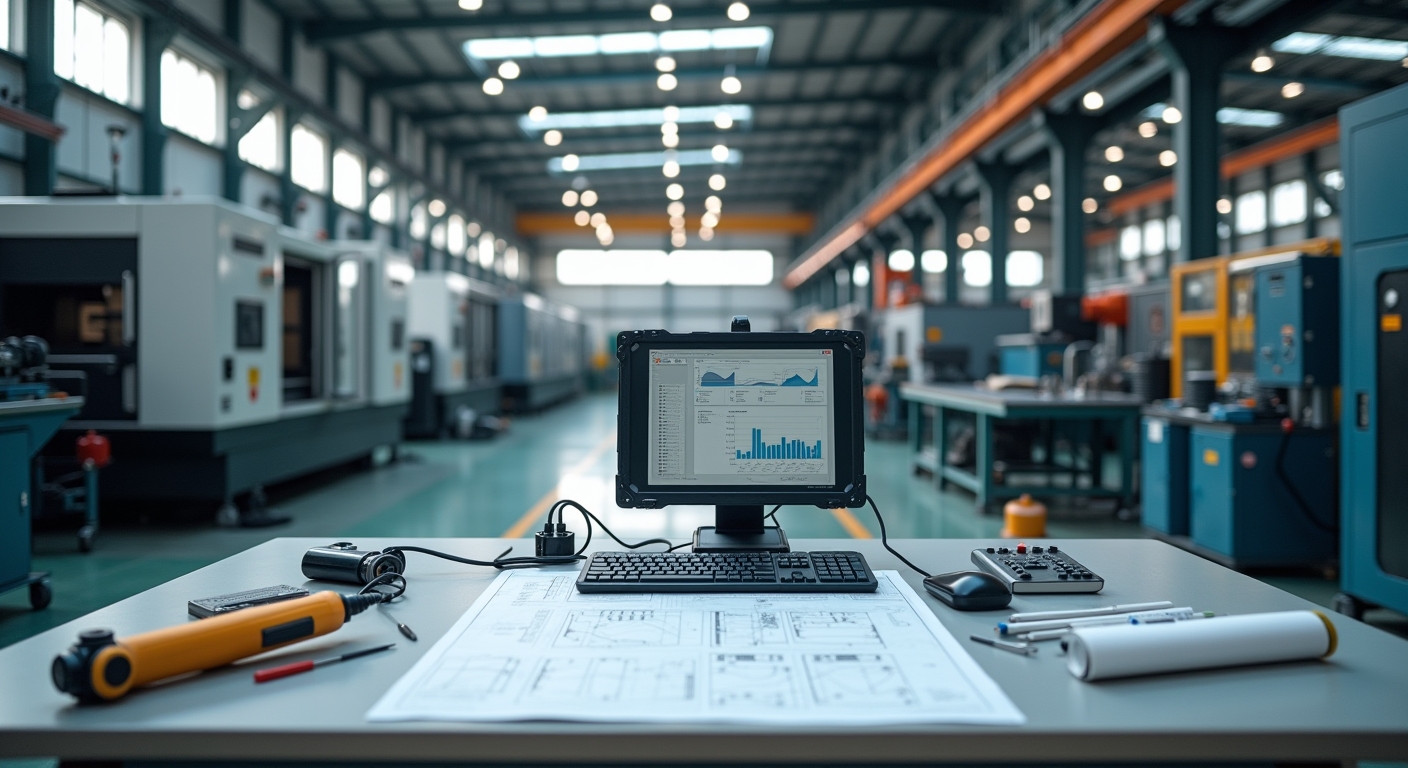

Industrial machinery Malaysia buyers typically compare far more than machine type alone. They need to understand how different machines fit the production process, what support systems are required, how maintenance affects uptime, and which buying factors matter before committing to a supplier. This guide explains the main categories of industrial machines for manufacturing, how they differ from broader industrial equipment, and how factories can evaluate machinery more carefully.
Whether you are planning a new production line, replacing ageing factory machinery, or building a manufacturing equipment buyers guide for internal procurement, the goal is the same: match the machine to the operation, the available utilities, the workforce and the expected output.
What is industrial machinery?
Industrial machinery refers to powered machines and production-related systems used to manufacture, process, move, package or support materials in industrial operations. Unlike hand tools or general workplace assets, industrial machinery usually performs a repeatable process function and is designed for factory-scale use.
In practice, the term can include both stand-alone machines and integrated production systems. A CNC machine, conveyor, mixer, press, packaging line or robotic cell may all fall under industrial machinery, depending on how the factory uses them. The common feature is that the machine contributes directly to production flow, product handling or an essential operating process.
How industrial machinery supports manufacturing operations in Malaysia
Industrial machinery plays a central role in how manufacturers run daily operations. In Malaysian factories, as in other manufacturing environments, machinery is often the difference between a manual operation with variable output and a controlled process with better consistency and planning.
The most immediate impact is on production capacity. Machines can process more material, repeat the same action more consistently and reduce bottlenecks between workstations. For example, a manual cutting or packing activity may be suitable at low volume, but once order volume increases, production equipment Malaysia manufacturers rely on often becomes necessary to maintain delivery schedules.
Machinery also supports quality control. A well-matched machine can improve repeatability in cutting, mixing, forming, filling, sealing or handling. Repeatability matters because product variation creates scrap, rework and customer complaints. Even where a machine does not guarantee quality by itself, it can make the process more stable and easier to monitor.
Labour efficiency is another major factor. This does not simply mean reducing headcount. In many cases, factory machinery Malaysia businesses invest in helps workers focus on monitoring, setup, inspection or higher-value tasks rather than repetitive manual handling. In sectors such as food processing, metalworking, plastics, electronics support and packaging, that shift can improve throughput and reduce fatigue-related errors.
Workplace safety can also improve when the right equipment is used properly. Conveyors can reduce repeated carrying, lifting systems can support heavy movement, and automated end-of-line equipment can reduce manual intervention in repetitive tasks. Actual safety outcomes depend on the machine design, guarding, procedures, training and site practices, so manufacturers should review those points carefully during selection and installation rather than assume every machine improves safety by default.
Finally, machinery supports better planning. When production steps are more defined, managers can estimate output more reliably, schedule maintenance, track downtime and identify where process improvements are needed.
Main types of industrial machinery and equipment
Most factories use several categories of machinery rather than one single machine type. Some machines transform material, some move products between processes, some support packaging and shipping, and others provide utilities or control functions. The right mix depends on the product, process flow, material characteristics and target output.
Processing and production machines
Processing and production machines are the systems that directly change materials or components into a finished or semi-finished product. In many plants, these are the core revenue-producing assets.
Examples include CNC machines, cutting machines, presses, forming machines, mixers, moulding-related systems and other process-specific production units. A CNC machine uses programmed instructions to carry out machining operations with repeatable movement. A press applies force to shape, stamp or form material. A mixer blends ingredients or materials to achieve a required consistency. The exact configuration depends on the process, but the purpose is the same: convert inputs into output through a controlled manufacturing step.
When assessing this category, buyers usually look at process suitability, output consistency, changeover needs, operator skill requirements and how the machine fits upstream and downstream processes.
Material handling and movement equipment
Material handling equipment supports the movement, storage and transfer of raw materials, work-in-progress and finished goods. Although these systems may not change the product itself, they strongly affect workflow and throughput.
Common examples include conveyor systems Malaysia factories use to move products between stations, forklifts for pallet movement, hoists for lifting, pallet handling systems and storage support equipment. Conveyors are particularly useful where products need a repeatable route through inspection, assembly, packing or transfer zones. Forklifts help with loading, unloading and internal logistics, while hoists and lifting systems may be necessary where materials are heavy or movement must be controlled more precisely.
Poor material flow can create hidden losses even when production machines are capable. Delays at loading points, manual transfer bottlenecks and unclear routing often reduce the real performance of the line. For that reason, material handling equipment Malaysia manufacturers select should be evaluated as part of the full process, not as an isolated purchase.
Packaging and end-of-line equipment
Packaging machinery sits near the end of the production sequence and prepares products for storage, distribution or sale. Depending on the product, this equipment may fill, seal, label, wrap, code, inspect or palletise finished goods.
Packaging machinery Malaysia factories use can range from simple semi-automatic stations to more integrated line systems. A filling machine dispenses product into a container. A sealing machine closes the package. A labelling machine applies identification or branding. Wrapping and palletising systems prepare goods for transport or warehousing.
This stage matters because even a strong production process can be undermined by inconsistent packing, poor labelling control or inefficient end-of-line handling. Packaging systems often affect presentation, traceability, handling condition and shipping readiness. They can also influence labour requirements and dispatch speed.
Utility and support systems
Utility and support systems are essential operating assets even when they do not touch the product directly. These can include compressors, pumps, boilers, chillers, extraction systems and dust collection systems where relevant to the process.
An air compressor supplies compressed air for pneumatic tools, actuators or production machinery. Pumps move fluids through processing, cooling or transfer systems. Boilers generate heat or steam for suitable industrial processes. Chillers help control process temperature. Extraction or dust collection systems help manage airborne particles, fumes or process by-products in operations where those issues arise.
Support systems are often overlooked during purchasing discussions because they are not always the visible centre of the line. However, if utility support is unstable, the production machine may not perform as intended. Buyers should therefore consider utility capacity, serviceability and compatibility during planning.
Automation and control systems
Modern industrial equipment Malaysia manufacturers adopt increasingly includes automation and control elements. These do not always look like traditional machines, but they are often what makes a production line consistent and manageable.
Common components include PLC control systems, sensors, HMIs and robotic systems. A PLC, or programmable logic controller, is an industrial control device that runs machine logic and coordinates inputs and outputs. Sensors detect conditions such as position, presence, pressure or temperature. An HMI, or human-machine interface, allows operators to monitor status and interact with the system. Robotic systems can automate repetitive handling, loading, unloading or assembly tasks where the application suits them.
Automation matters because it connects machine movement with control logic, monitoring and repeatability. It can also improve process visibility, support troubleshooting and make integration between different production stages more practical.
Industrial machinery vs industrial equipment: what is the difference?
Industrial machinery usually refers to powered machines that perform a process or production function. Industrial equipment is a broader term that can include machinery as well as support assets, handling devices, tools and utility systems. In real factory use, the two terms often overlap.
| Aspect | Industrial machinery | Industrial equipment |
|---|---|---|
| General meaning | Usually powered machines used for a production or process task | Broader category that can include machinery, tools, support systems and handling assets |
| Main function | Transforms, processes, packages or moves materials through a defined operation | Supports operations, production, maintenance, handling, storage or utilities |
| Moving parts | Often has moving parts or automated functions | May or may not have moving parts |
| Examples | CNC machines, presses, mixers, conveyors, packaging lines | Machinery plus forklifts, compressors, storage racks, measuring devices and other support assets |
| Usage in practice | Often used when discussing production assets specifically | Often used as a wider purchasing or asset-management term |
If a procurement team asks for industrial equipment Malaysia suppliers, they may be looking for everything from production machines to utility systems. If they ask for industrial machinery Malaysia, the focus is usually narrower and more process-related.
How to choose the right industrial machinery
The right way to choose industrial machinery is to start with the production process, then check capacity, utilities, maintenance support, integration and total cost of ownership. Buyers should evaluate how the machine will perform in the real factory environment, not just how it appears in a quotation or demonstration.
Match the machine to your production process
Start by defining what the machine must do. That includes the product type, raw material or component characteristics, required process step, output expectations, acceptable variation and line layout. If a machine is selected before the process is clearly defined, there is a higher risk of mismatch.
Useful questions include:
- What material or product will the machine handle?
- What operation must it perform?
- What quality outcome is required?
- What level of precision or repeatability is important?
- How will the machine fit into the production sequence?
- Will the product or packaging format change often?
For example, machinery selection for factories producing multiple product variants may need to prioritise changeover flexibility, while a dedicated high-volume line may prioritise repeatable throughput and stable process control.
Assess capacity, footprint and utilities
Once the process is clear, assess whether the machine fits the site and the intended operating conditions. Buyers often focus on output first, but physical and utility constraints can be just as important.
Review:
- Expected production volume and peak demand
- Available floor space and access routes
- Operator working space around the machine
- Power supply and control panel placement
- Compressed air, water or drainage needs where relevant
- Ventilation, extraction or environmental control needs where relevant
- Material infeed and outfeed flow
A machine may appear suitable on paper but still create installation or workflow problems if the layout is tight or if surrounding utilities were not considered early enough.
Evaluate maintenance, spare parts and service support
After-sales support is a major buying factor, especially for machines that are central to production. A lower purchase price may not be attractive if spare parts are difficult to obtain or technical support is slow.
Buyers should ask about:
- Preventive maintenance requirements
- Availability of service personnel
- Response time expectations
- Spare parts availability and lead times
- Operator and technician training
- Maintenance manuals and documentation
- Remote troubleshooting capability if offered
This is particularly important for manufacturing SMEs, which may not have large in-house engineering teams. Local or regional support can make a practical difference when a machine goes down.
Consider integration with existing systems
A machine rarely works in isolation. It must fit with upstream supply, downstream handling, existing controls, operator workflow and data collection needs.
For example, a new packaging machine may need to receive product at a consistent rate from an upstream process and discharge finished packs to a conveyor or palletising area. A CNC machine may need to fit a workshop’s tooling, workholding and inspection flow. Automated systems may also need interface compatibility with sensors, PLC control systems, HMIs or production monitoring tools already in use.
If integration is not reviewed properly, an otherwise capable machine can introduce stoppages, workarounds or additional manual handling.
Review total cost of ownership
Purchase price is only one part of the decision. Total cost of ownership looks at what the machine will cost to install, operate, maintain and support over time.
Typical cost drivers include:
- Installation and commissioning work
- Tooling, fixtures or change parts
- Energy and utility consumption
- Consumables and wear items
- Routine maintenance labour
- Spare parts
- Operator training
- Downtime risk and production disruption
- Future modifications or expansion needs
This broader view helps buyers compare offers more realistically, especially when one option appears cheaper upfront but may be harder to maintain or integrate later.
Key considerations when buying industrial machinery in Malaysia
When comparing factory machinery Malaysia suppliers or imported equipment options, local execution matters as much as the machine itself. Even a suitable machine can become a difficult project if delivery, installation and support are not planned properly.
Key considerations include:
- Supplier support: Understand who will handle installation, setup, troubleshooting and training.
- Lead times: Imported machinery may involve longer delivery planning, especially if customisation or special components are required.
- Installation readiness: Confirm site access, lifting needs, foundations if required, utility preparation and production disruption planning.
- Documentation: Operators and maintenance personnel should have clear manuals, parts information and operating guidance.
- Training: New equipment often requires operator, setup and maintenance training, not just handover.
- Compliance review: Requirements can vary depending on the machine, industry, product and workplace setup, so buyers should verify applicable obligations with the relevant authorities and qualified advisers where necessary.
- Long-term support: Check how the supplier handles breakdown calls, spare parts and future upgrades.
For many manufacturers, the better buying decision is not simply the most advanced machine. It is the machine that can be installed successfully, run reliably and supported over its working life.
Common maintenance approaches for industrial machinery
Industrial equipment maintenance generally falls into three broad approaches: preventive, predictive and corrective maintenance. Preventive maintenance is planned routine care to reduce failure risk. Predictive maintenance uses condition data or monitoring to identify likely issues earlier. Corrective maintenance fixes a problem after a fault appears.
Preventive maintenance is scheduled work such as inspection, cleaning, lubrication, adjustment and replacement of wear parts before obvious failure occurs. This approach is common because it supports uptime and can reduce unplanned stoppages.
Predictive maintenance uses condition indicators to guide maintenance timing. Depending on the machine and the factory’s capability, this may involve monitoring vibration, temperature, pressure, cycle behaviour or other performance trends. The goal is to detect developing problems early enough to intervene before breakdown.
Corrective maintenance happens when a fault must be repaired after a machine has already shown failure or underperformance. Corrective action is sometimes unavoidable, but relying on it alone can increase downtime, product loss and urgent repair pressure.
A practical maintenance routine often combines these approaches. The exact intervals should follow OEM guidance, machine duty, process conditions and engineering judgement rather than a generic schedule copied from another site.
Basic maintenance checklist
Daily, weekly and scheduled checks vary by machine, but a simple framework is useful:
- Daily: check cleanliness, obvious leaks, unusual noise, alarm conditions, guarding condition, basic lubrication points where applicable and general operating behaviour.
- Weekly: review fasteners, belts, hoses, filters, sensors, wear surfaces and output consistency.
- Scheduled: carry out deeper inspection, part replacement, calibration or servicing according to machine documentation and operating conditions.
Good maintenance records also matter. They help a factory see recurring issues, compare downtime events and decide whether the machine problem is operational, mechanical, electrical or process-related.
Signs a machine may be underperforming
A machine may be underperforming if downtime is increasing, output becomes inconsistent or operators notice physical warning signs such as vibration, leaks or overheating. Performance issues often develop gradually, so early recognition is important.
Common warning signs include:
- More frequent stops or unplanned downtime
- Output that no longer matches expected production flow
- Inconsistent product quality or repeatability
- Excessive vibration during operation
- Unusual noise compared with normal running condition
- Fluid, air or oil leaks
- Overheating or unstable temperature behaviour
- Higher levels of scrap, defects or rework
- Repeated alarm events or sensor faults
- Greater operator intervention to keep the machine running
These signs do not always point to one single root cause. The issue may involve wear, alignment, process settings, controls, utilities, operator practice or material variation. Diagnosis should follow OEM guidance and qualified technical review, especially for critical production assets.
Should manufacturers buy new, used or custom machinery?
Manufacturers should choose between new, used or custom machinery based on process fit, budget structure, lead time, support needs and acceptable risk. No single option is best for every factory.
| Option | Advantages | Limitations | Best suited for |
|---|---|---|---|
| New machinery | Current condition, supplier support, training availability, easier standardisation, potentially simpler integration planning | Higher upfront investment in many cases, possible lead time depending on build and delivery | New lines, critical production assets, operations that need support and documented handover |
| Used machinery | May reduce initial capital outlay, can be useful for secondary operations or expansion where exact latest features are not essential | Condition varies, support may be limited, spare parts risk may be higher, documentation may be incomplete, refurbishment may be needed | Cost-sensitive projects with strong technical inspection capability |
| Custom machinery | Can be designed around a specific product, layout or automation need, may solve unusual process constraints | Longer project coordination, higher engineering complexity, testing and modification risk, support quality depends heavily on builder capability | Specialised applications where standard equipment does not fit the process well |
Before choosing used or custom equipment, buyers should be clear about inspection, acceptance testing, documentation, serviceability and parts support. A lower-entry option can still become expensive if major modifications are needed after delivery.
Industrial machinery checklist for factory buyers
Before requesting quotations, use this checklist to compare machinery options more systematically:
- Define the process: clarify the product, material, operation and required output.
- Set quality needs: identify consistency, tolerance or finish expectations relevant to the process.
- Confirm capacity needs: compare normal demand, peak demand and future expansion plans.
- Check site space: review footprint, access, infeed and outfeed routes, and operator clearance.
- Review utilities: confirm power, compressed air, water, extraction, drainage or environmental support where relevant.
- Assess safety features and operating practicality: review guarding, access points, maintenance access and operator workflow as applicable.
- Check integration needs: confirm compatibility with upstream and downstream systems, controls and data needs.
- Review support capability: ask about installation, commissioning, training and troubleshooting.
- Confirm spare parts availability: understand wear items, critical parts and expected lead times.
- Request documentation: manuals, parts lists, operating procedures and maintenance guidance should be available.
- Plan installation and testing: define who is responsible for setup, trial runs, acceptance criteria and handover.
- Compare total cost of ownership: include operation, maintenance, downtime risk and future change needs, not only purchase price.
This checklist is especially useful when several suppliers appear to offer similar machinery. It makes comparison more practical and reduces the chance of overlooking lifecycle issues.
Frequently Asked Questions
What is considered industrial machinery?
Industrial machinery generally means powered machines used in manufacturing, processing, material movement, packaging or essential production support. Examples include CNC machines, presses, conveyors, mixers and packaging systems. The term usually refers to assets that perform a repeatable industrial function rather than simple hand tools.
What types of industrial machinery are most common in manufacturing plants?
Common categories include processing and production machines, material handling equipment, packaging and end-of-line equipment, utility systems and automation controls. The most suitable mix depends on the factory’s product, workflow and operating environment.
How do I choose the right machinery for a factory?
Start with the production process. Define the material, product, output needs, layout, utilities, operating conditions, maintenance support and integration requirements. Then compare options based on total cost of ownership rather than purchase price alone.
What is the difference between industrial machinery and industrial equipment?
Industrial machinery usually refers to powered machines that carry out a process or production task. Industrial equipment is a wider term that can also include utility systems, handling devices, tools and support assets. In everyday use, the terms often overlap.
Should a manufacturer buy new or used machinery?
It depends on process criticality, budget, technical risk and support needs. New machinery usually offers clearer support and condition visibility, while used machinery may reduce initial spending but often needs more careful inspection, documentation review and parts planning.
Why is preventive maintenance important for industrial machines?
Preventive maintenance helps reduce unplanned breakdowns, supports output consistency and can extend service life by dealing with wear before it leads to larger problems. It also improves visibility into machine condition and helps maintenance teams plan work more effectively.
Conclusion
Industrial machinery decisions affect output, quality, maintenance workload and long-term operating cost. The best choice is usually the one that fits the production process, available utilities, site constraints and support capability rather than the one with the strongest headline features. For manufacturers comparing industrial machinery Malaysia options, careful planning before purchase is often what prevents expensive problems after installation.