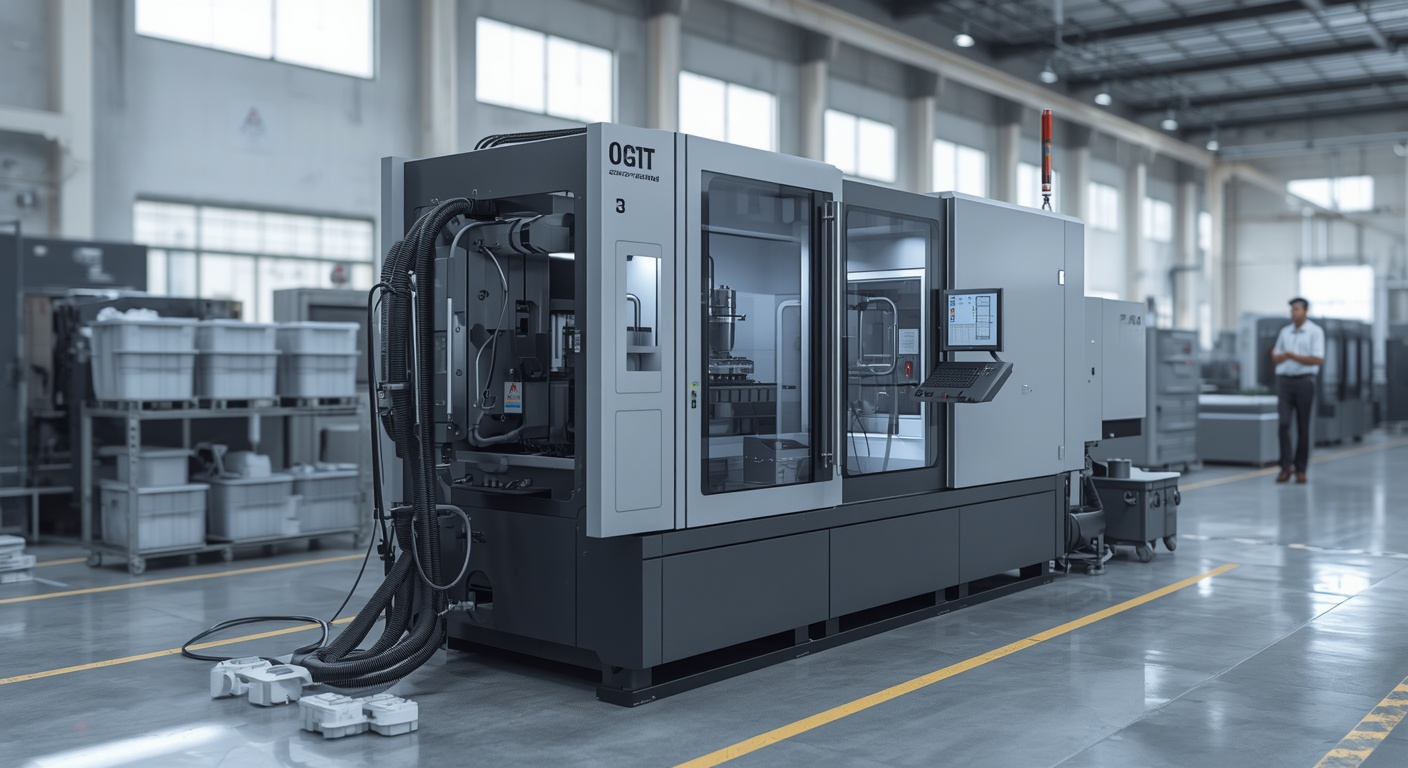
An injection moulding machine is used to melt plastic material and inject it into a mould so manufacturers can produce large volumes of repeatable parts. It is a core piece of plastic manufacturing equipment for products that need consistent shape, surface finish and dimensional repeatability.
For manufacturers, buyers and production teams, understanding how injection moulding machines work is essential before comparing models, mould requirements or automation options. This guide explains the basic process, the main machine components, the common types of injection moulding machines, typical applications, and the practical factors that matter when selecting a machine.
What Is an Injection Moulding Machine?
An injection moulding machine is an industrial machine that heats plastic material until it melts, then injects that molten plastic into a mould cavity under pressure. After the material cools and solidifies, the mould opens and the finished part is ejected, allowing the cycle to repeat for mass production.
How an Injection Moulding Machine Works
The injection moulding process follows a repeating production cycle. While machine settings vary by material, mould and product design, the basic sequence is usually as follows:
- Feed the raw material. Plastic resin, usually in pellet form, is loaded into the hopper.
- Melt the material. The pellets move into the barrel, where heater bands and the rotating screw help melt and homogenise the material.
- Close and clamp the mould. The clamping unit keeps the two halves of the mould shut with enough force to resist injection pressure.
- Inject the melt. The screw moves forward and pushes molten plastic through the nozzle into the mould cavity.
- Pack and hold. Additional pressure may be applied briefly to help fill the cavity and reduce defects caused by shrinkage.
- Cool the part. The plastic cools inside the mould until it is solid enough to retain its shape.
- Open the mould. The clamping unit separates the mould halves after cooling is complete.
- Eject the finished part. The ejection system pushes the moulded part out so the next cycle can begin.
This repeatable cycle is what makes injection moulding suitable for high-volume plastic parts manufacturing. Product quality depends not only on the machine, but also on the mould design, material behaviour, temperature control and process consistency.
Main Components of an Injection Moulding Machine
An injection moulding machine has two main assemblies: the injection unit and the clamping unit. Working together, they melt the material, inject it into the mould, keep the mould closed during filling, and release the finished part after cooling.
For non-specialist buyers, this distinction matters. The injection unit mainly controls how the material is prepared and delivered, while the clamping unit mainly controls mould movement, closing force and part removal. The mould itself is a separate but equally important part of the production system.
Injection Unit
The injection unit handles material feeding, melting and injection. Its main components typically include the hopper, barrel, screw, heaters and nozzle.
- Hopper: Holds the plastic pellets before they enter the machine.
- Barrel: A heated chamber where the plastic is conveyed and melted.
- Screw: Rotates to move the material forward, mix it and build up a shot of molten plastic before injection.
- Heater bands: Supply controlled heat to bring the resin to the required melt condition.
- Nozzle: Connects the barrel to the mould inlet so molten plastic can be injected into the cavity.
In simple terms, the screw does more than push plastic forward. It also helps mix and compress the melt so the material reaches the mould in a more uniform condition. That melt consistency matters because poor temperature control or uneven mixing can affect fill quality, part stability and surface appearance.
When manufacturers compare machines, they often look beyond the machine frame and focus on how well the injection unit matches their materials and moulding requirements. A machine used for commodity thermoplastics may not be the best fit for every engineered material, filled resin or tight-tolerance product.
Clamping Unit
The clamping unit opens and closes the mould and holds it shut during injection and cooling. Its key elements usually include the platens, tie bars and the clamping mechanism itself.
- Platens: Rigid plates that support and mount the mould halves.
- Tie bars: Structural members that help guide platen movement and support the clamping system.
- Clamping mechanism: Applies the force needed to keep the mould closed while molten plastic is injected.
Clamping force is important because the mould must remain tightly closed while pressurised plastic enters the cavity. If the machine cannot maintain enough clamping force for the mould and part design, defects such as flash may occur. On the other hand, choosing a machine much larger than necessary can create inefficiencies in floor space use, tooling setup and operating practices.
Buyers will also come across terms such as toggle clamping and hydraulic clamping. These describe different mechanical approaches to generating and controlling clamping force. The right choice depends on production priorities, mould requirements and machine design preferences rather than one system being universally better for all applications.
Mould and Ejection System
The mould gives the plastic part its final shape. Inside the mould are one or more cavities, along with runners, gates, cooling channels and surfaces that influence how the part forms.
Cooling channels help remove heat from the part so it can solidify at a controlled rate. Good cooling design matters because it affects cycle efficiency, dimensional stability and the risk of defects such as warpage.
After cooling, the ejection system pushes the part out of the mould. Depending on the mould design, this may involve ejector pins, sleeves or other mechanisms. Ejection must be controlled carefully to avoid marking or deforming the finished part, especially for cosmetic components or thin-wall products.
Types of Injection Moulding Machines
Injection moulding machines are commonly grouped into hydraulic, electric and hybrid designs. The difference is not only how the machine moves, but also how it controls injection, clamping and auxiliary functions.
| Machine Type | How It Operates | Typical Strengths | Common Considerations |
|---|---|---|---|
| Hydraulic | Uses hydraulic power to drive major machine movements | Widely used, suited to many general-purpose moulding tasks, strong force capability | May require more hydraulic system maintenance and fluid management |
| Electric | Uses servo-driven electric motors for machine movements | Known for precise control, repeatability and cleaner operation | Machine suitability depends on application, tooling and budget priorities |
| Hybrid | Combines hydraulic and electric systems in one machine | Balances characteristics of both designs for specific production needs | Selection should focus on actual process requirements and support availability |
For many buyers, the practical question is not simply hydraulic vs electric injection moulding machine, but which design best fits the product, mould, process stability requirements and maintenance capability of the factory.
Hydraulic Machines
Hydraulic machines have long been used across plastic parts manufacturing. They use hydraulic pressure to power key movements such as clamping, injection and mould opening.
These machines are often considered for general production environments where robust force and broad application flexibility are important. They are commonly seen in factories running a variety of moulds and plastic products.
However, hydraulic machines require attention to the condition of pumps, seals, hoses and hydraulic fluid. Maintenance discipline matters because system wear or contamination can affect machine response and process stability over time.
Electric Machines
Electric injection moulding machines use motor-driven axes instead of relying mainly on hydraulic power. This design is often associated with high control precision, repeatability and a cleaner operating environment because there is less dependence on hydraulic fluid for major movements.
They are frequently considered for parts where process consistency, controlled motion and repeatable production conditions are important. Decision-makers may also prefer them in environments where cleanliness and reduced mechanical variation are priorities.
That said, machine selection should still be based on the mould, resin, part geometry and production strategy. An electric system is not automatically the best option for every moulding application.
Hybrid Machines
Hybrid machines combine electric and hydraulic features. For example, some designs use electric drive systems for selected movements while retaining hydraulic power where it offers practical advantages.
This can make hybrid machines attractive to manufacturers looking for a balance between control, force capability and machine architecture. They are typically evaluated when a factory wants some of the operating characteristics of electric machines without committing to a fully electric platform.
As with any machine category, the value of a hybrid design depends on the moulding application, the supplier’s support capability and how well the machine integrates into the production line.
Common Applications and Products
Injection moulding machines are used to make a wide range of plastic parts across many industries. They are especially suitable for products that need repeatable geometry, consistent quality and medium- to high-volume production.
Common injection moulding machine applications include:
- Packaging components such as caps, closures and containers
- Consumer goods including household plastic parts and appliance components
- Automotive plastic components such as interior trim pieces, covers and clips
- Electronics housings, connectors and protective casings
- Industrial components used in assemblies, fittings and enclosures
- Medical-related plastic parts where controlled and repeatable processing is important
The exact product range depends on the machine, mould design, resin selection and quality requirements. A plastic injection moulding machine used for simple utility parts may be configured very differently from one used for thin-wall packaging, precision technical components or highly cosmetic consumer products.
Key Performance Factors That Affect Output
When evaluating injection moulding machines, output is not determined by one number alone. A machine must be matched to the mould, product design and production objective.
Clamping force
Clamping force is the machine’s ability to keep the mould closed during injection. It must be suitable for the projected area of the part and the pressure involved in filling the mould. Too little force may lead to flash or unstable moulding conditions. Too much machine size may add unnecessary cost and footprint without improving the process.
Shot size
Shot size refers to how much molten material the machine can prepare and inject for each cycle. The machine should be properly matched to the part volume, runner system and any process allowance needed. An unsuitable shot capacity can make processing less stable or less efficient.
Mould compatibility
A good machine-mould match involves more than clamping force. Buyers should also consider platen size, tie bar spacing, mould height range, nozzle interface and ejection arrangement. If these are not compatible, the mould may not fit properly or may require modifications.
Material type
Different thermoplastics behave differently during melting, injection and cooling. Some materials are easier to process, while others require tighter control of temperature, residence time or moisture handling. The machine and its screw design should be suitable for the materials the factory plans to run.
Cycle time
Cycle time is the total time needed to complete one moulding cycle. It is influenced by material behaviour, cooling efficiency, mould design, part geometry and machine response. Shorter cycles can improve output, but only if quality remains stable.
Repeatability
Repeatability is critical for consistent part quality. Machines that can repeatedly control temperatures, injection movement, pressure and clamping behaviour help reduce variation between parts and between production runs.
Maintenance condition
Even a well-specified machine can produce inconsistent results if it is poorly maintained. Wear on screws, non-return valves, hydraulic components, sensors or heaters can affect melt quality and process stability. For used machines in particular, condition assessment is essential.
How to Choose the Right Injection Moulding Machine
Choosing the right machine starts with the product and mould, not with the machine brochure alone. A practical selection checklist includes the following:
- Define the part clearly. Confirm part dimensions, wall thickness, quality requirements and expected production volume.
- Match the machine to the mould. Check clamping requirements, platen dimensions, tie bar spacing, mould height and ejection needs.
- Confirm material compatibility. Make sure the machine configuration suits the resin type and processing characteristics.
- Assess shot capacity. The injection unit should comfortably handle the part and runner volume under stable processing conditions.
- Decide on the required precision level. Tight-tolerance or appearance-critical parts may need stronger process control and repeatability.
- Review production volume and automation plans. Consider whether the machine will operate manually, semi-automatically or with integrated automation.
- Check available floor space and utilities. Installation space, material handling layout and factory services should be confirmed before purchase.
- Consider operator skill and training. A machine is only as effective as the team setting, monitoring and maintaining it.
- Evaluate service support and spare parts. Local technical support can be as important as the machine specification.
- Look at total cost of ownership. Compare not only purchase price, but also maintenance demands, downtime risk, tooling fit and long-term usability.
Manufacturers comparing a new or used injection moulding machine should also think about future needs. If product sizes, materials or quality expectations may change, buying only for the current job can limit flexibility later.
What Malaysian Manufacturers Should Consider
For manufacturers in Malaysia, machine selection should include local operating realities as well as general technical fit. An injection moulding machine for manufacturers in Malaysia should be evaluated in terms of practical support, not just headline features.
Key considerations include:
- Supplier presence and response time: Access to technical service, troubleshooting support and spare parts availability can affect downtime exposure.
- Operator and maintenance training: A well-supported commissioning and training plan can improve process stability and reduce avoidable errors.
- Power and utility compatibility: Buyers should verify actual site requirements with the supplier and installer before purchase.
- Production environment: Heat, dust control, material handling setup and factory layout can influence machine reliability and working efficiency.
- Automation compatibility: If the factory plans to add robots, conveyors or in-line inspection, those requirements should be addressed early.
- Used equipment due diligence: For imported or second-hand machinery, condition checks, documentation and after-sales support are especially important.
Any local compliance, safety, electrical, environmental, import or factory requirements should be verified with the relevant supplier, installer and official authority before a purchasing decision is finalised. Requirements can vary depending on the machine configuration, factory setup and intended manufacturing activity.
Readers comparing this equipment with other production assets can also explore the broader industrial machinery and equipment guide for a wider view of factory equipment categories.
Common Mistakes When Evaluating Injection Moulding Machines
Many machine buying problems come from looking at headline features without testing how well the machine fits the actual job. Common evaluation mistakes include:
- Choosing based only on purchase price. A lower initial price can become costly if support, uptime or process stability are weak.
- Ignoring mould compatibility. A machine that does not properly match existing moulds can create installation and production problems.
- Focusing on machine type before product needs. Hydraulic, electric or hybrid should be chosen based on application requirements, not trend alone.
- Underestimating maintenance needs. Maintenance capability, spare parts access and service planning affect long-term performance.
- Overlooking operator training. Even advanced machines can produce unstable results if the operating team is not properly trained.
- Not planning for future production changes. If part size, resin type or automation needs may expand, a very narrow machine choice can limit future options.
- Assuming one machine suits every application. Different products, moulds and materials place different demands on the machine.
A disciplined evaluation process usually gives better results than choosing purely on brand familiarity or sales claims. The machine should work as part of a complete manufacturing system that includes tooling, materials, people and maintenance support.
Frequently Asked Questions
What does an injection moulding machine do?
An injection moulding machine melts plastic material and injects it into a mould to produce repeatable parts. After the plastic cools and solidifies, the machine opens the mould and ejects the finished part so the production cycle can continue.
What are the main parts of an injection moulding machine?
The main parts are the injection unit, the clamping unit, and the mould system. The injection unit includes components such as the hopper, barrel, screw, heaters and nozzle. The clamping unit closes the mould and keeps it shut during injection, while the mould and ejection system form and release the part.
What is the difference between hydraulic and electric injection moulding machines?
Hydraulic machines use hydraulic power for major machine movements, while electric machines use motor-driven systems. Electric machines are often chosen for precision and repeatability, while hydraulic machines remain widely used for general moulding applications. The better option depends on the mould, product and production requirements.
How do you choose the right injection moulding machine for a product?
Start with the part design, resin and mould requirements. Then check clamping suitability, shot capacity, mould fit, required precision, production volume, automation plans, floor space and service support. The right machine is the one that fits the product and process reliably, not simply the one with the lowest purchase price.
What products are commonly made with injection moulding machines?
Common products include packaging components, consumer goods, automotive plastic parts, electronics housings, industrial components and some medical-related plastic parts. The final product range depends on the mould design, material type and quality requirements.
Final Takeaway
An injection moulding machine is designed to melt plastic, inject it into a mould and repeat that cycle efficiently to produce consistent parts. For manufacturers, the key issues are not only how the machine works, but also how well it matches the mould, material, product quality target and support environment.
When comparing injection moulding machines, focus on process fit, mould compatibility, repeatability, maintenance needs and supplier support rather than headline claims alone. For readers evaluating this equipment within a wider factory investment plan, the broader machinery landscape is covered in ManufacturingGuide’s industrial machinery pillar.