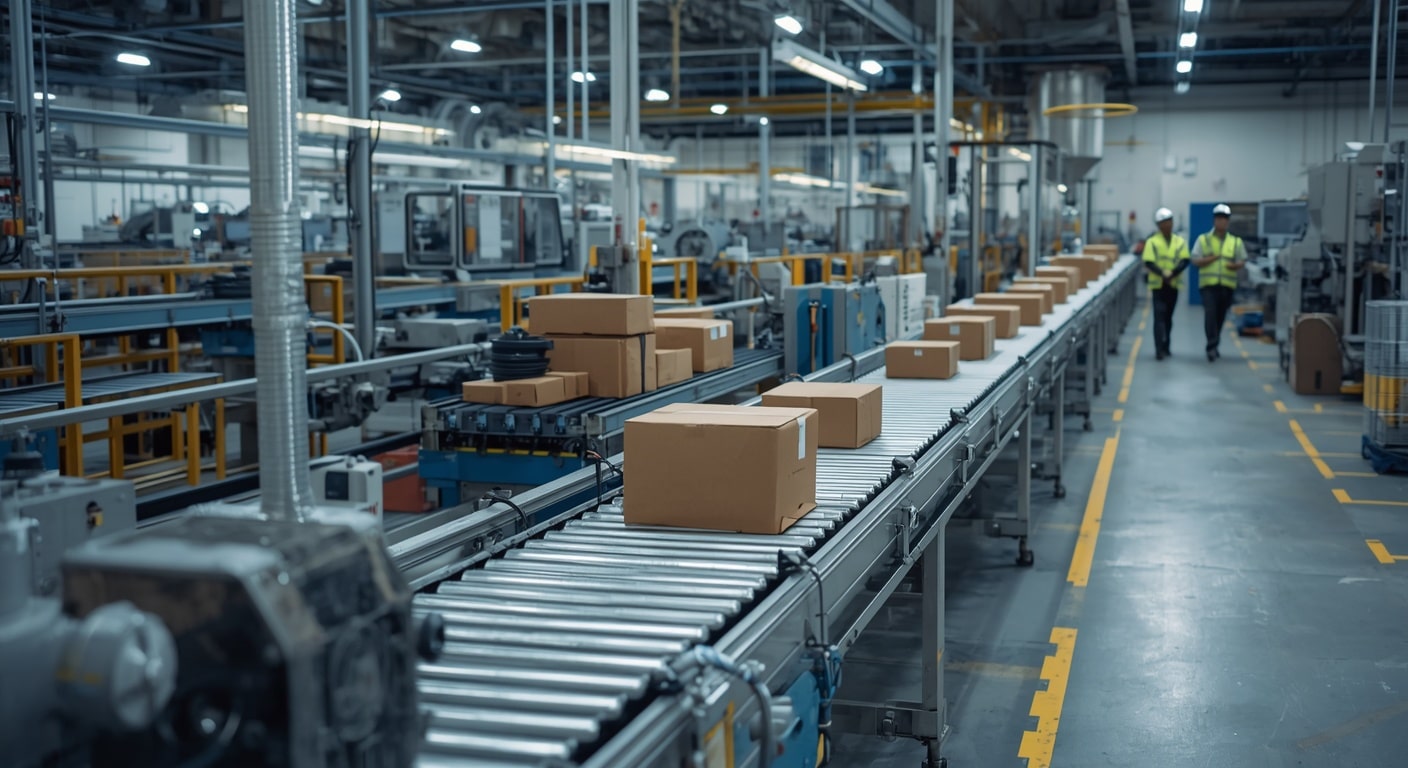
Industrial conveyor systems are a core part of modern material handling in factories, packaging operations, warehouses and distribution environments. They help move products, components or bulk materials from one point to another more consistently than manual handling alone. For manufacturers, the real value is not just movement, but smoother process flow, better line integration and more predictable operations.
This guide explains how conveyor systems work, the main types used in industry, where they fit in manufacturing and warehousing, and what to consider before selecting one for a facility in Malaysia or elsewhere.
What are industrial conveyor systems?
Industrial conveyor systems are material handling equipment used to move products, parts or bulk materials through manufacturing, packaging, storage or distribution processes. They can use belts, rollers, chains, screws or overhead carriers, and are configured based on product type, plant layout, workflow and the level of automation required.
In practice, conveyor systems can be very simple or highly integrated. A small factory may use a basic belt conveyor between workstations, while a larger plant may connect inspection, packaging, sorting and pallet handling equipment into one coordinated system.
How industrial conveyor systems work in a factory
The basic principle is straightforward: a powered or gravity-assisted mechanism moves material along a defined path so it reaches the next production or storage point with less manual handling.
In a typical powered conveyor, an electric motor drives movement through components such as belts, rollers, chains or screws. Products are then transferred between stations for assembly, inspection, labeling, packaging, storage or dispatch. This helps maintain flow and can reduce unnecessary carrying, lifting or waiting between steps.
Most manufacturing conveyor systems include some combination of the following elements:
- Frame or support structure to carry the conveyor and its load
- Drive system such as a motor, gearbox and transmission components
- Carrying medium such as a belt, roller bed, chain or screw
- Controls to start, stop and coordinate movement
- Sensors to detect product presence, position or blockage
- Transfer points where items move between conveyors or machines
- Guarding and emergency stop arrangements to support safer operation
Some conveyor automation setups are standalone. Others are tied into PLC-based controls, inspection devices, robots, packaging lines or warehouse systems. The more integrated the line becomes, the more important proper sequencing, product spacing and maintenance access become.
Readers comparing conveyors with other categories of factory equipment can also refer to this industrial machinery and equipment guide.
Main types of industrial conveyor systems
There is no single best conveyor for every factory. The right choice depends on what is being moved, how it must be handled, how far it needs to travel and how the conveyor fits into the wider process.
| Conveyor type | Typical uses | Key considerations |
|---|---|---|
| Belt conveyor | Cartons, packaged goods, unit loads, light bulk materials | Good for continuous flow; product base and environment matter |
| Roller conveyor | Boxes, trays, pallets, flat-bottom items | Can be gravity or powered; item stability is important |
| Chain conveyor | Heavy loads, pallets, industrial containers | Useful in tougher environments; load handling must suit chain layout |
| Overhead conveyor | Hanging parts, paint lines, assembly support | Saves floor space; requires suitable overhead support and access planning |
| Screw conveyor | Powders, grains, granules and other bulk materials | Best for enclosed transfer; material properties affect suitability |
| Modular or specialized conveyor | Curves, inclines, sanitary handling, flexible layouts | Chosen for layout or application-specific needs |
Belt conveyors
A belt conveyor uses a continuous belt running over pulleys to carry items along a path. It is one of the most common conveyor systems because it handles many unit-load applications well, especially cartons, bags, packaged goods and components moving between defined stations.
Belt conveyors are often selected when manufacturers want a continuous conveying surface rather than separated rollers. That can be useful for smaller items, unstable products or products with bases that do not travel well on rollers. Some belt conveyor designs are also used for light bulk materials, depending on the product and process.
Selection factors include the product base, incline requirements, cleanliness needs, transfer points and whether the belt material suits the operating environment.
Roller conveyors
Roller conveyor systems move products across a series of rollers. They are commonly used for boxes, totes, trays and pallets with reasonably flat, stable bottoms.
There are two broad approaches:
- Gravity roller conveyors, which rely on push force or slope
- Powered roller conveyors, which use a drive system to move items automatically
Gravity sections can work well in low-complexity zones such as packing support areas or staging lanes. Powered rollers are more suitable when controlled flow, accumulation or system integration is needed. Roller conveyors are often seen in warehouse and factory conveyors where cartons or pallets need straightforward movement between work areas.
Chain conveyors
Chain conveyors use one or more chains to move heavier or more demanding loads. They are often used where pallets, fixtures, industrial containers or robust components need more positive handling than a belt or standard roller setup may provide.
In manufacturing environments, chain conveyor designs are common in tougher duty applications, especially where load weight, heat, dirt or impact make other conveyor types less suitable. They can also be used when the product is better supported on chain tracks or slats.
The trade-off is that chain systems can be noisier, more application-specific and less forgiving if the load format changes often.
Overhead conveyors
Overhead conveyors suspend items from carriers mounted above the floor. This makes them useful when floor space is limited or when parts need to remain hanging through multiple steps.
Typical applications include paint finishing, drying, curing support, garment handling, and certain assembly operations involving suspended parts. In some factories, overhead conveyor layouts help separate people, mobile equipment and products more clearly than floor-mounted alternatives.
They are especially useful when the workflow naturally suits hanging parts, but they require good planning for support structures, maintenance access and loading or unloading points.
Screw and bulk material conveyors
Screw conveyors use a rotating helical screw inside a trough or tube to move bulk materials. They are generally used for powders, grains, granules and similar materials rather than boxed or packaged goods.
This type of conveyor is common in enclosed transfer processes where manufacturers want to control spillage, contain material or feed bulk material between process stages. Material behavior matters a great deal. Flowability, moisture, particle size and the tendency to compact or bridge can all affect performance and selection.
For that reason, screw conveyors are usually chosen around the properties of the material itself, not just the distance it needs to travel.
Modular and specialized conveyors
Not every factory conveyor system fits neatly into one standard category. Many operations use modular conveyor system designs or specialized conveyors built around layout, hygiene or product-handling needs.
Examples include:
- Modular plastic belt conveyors for flexible layouts and certain washdown-oriented applications
- Inclined conveyors for changing elevation
- Curved conveyors for routing flow through tighter footprints
- Sanitary-oriented conveyors for applications where cleaning and product contact considerations are important
- Transfer conveyors designed to bridge small gaps between machines
These systems are often chosen not because they are more complex, but because they solve a layout or process problem that a standard straight conveyor cannot.
Common applications in manufacturing and warehousing
Industrial conveyors are used anywhere materials or products need controlled, repeatable movement. In manufacturing, that usually means connecting process steps. In warehousing, it often means improving flow between receiving, storage, picking, packing and dispatch activities.
Common applications include:
- Assembly lines where parts or subassemblies move station to station
- Packaging lines for filling, sealing, labeling, checkweighing or case packing support
- Inspection areas where products pass through visual, sensor-based or quality-control checks
- Sorting and routing between parallel process paths
- Pallet movement between production, wrapping and staging areas
- Raw material transfer for bulk ingredients or process materials
- Warehouse flow for cartons, totes and dispatch preparation
In Malaysia-relevant manufacturing contexts, conveyors are commonly associated with food processing, electronics assembly, automotive component production, packaging operations and general industrial manufacturing. The exact design varies widely. A food processing line may prioritize cleanability and controlled product handling, while an electronics line may focus more on smooth movement of lightweight assemblies and workstation coordination.
Benefits of industrial conveyor systems
Industrial conveyor systems can improve material flow, reduce manual handling and support more consistent movement of products between process steps. They are often used to connect production, packaging, inspection and warehouse activities, and can also support automation, space use and line coordination when the application is well designed.
Practical benefits may include:
- Reduced manual handling for repetitive or frequent movement tasks
- Improved process consistency because products follow a defined route
- Better workflow visibility across production or warehouse areas
- Support for automation through integration with sensors, PLC controls, inspection systems or packaging equipment
- Potential space optimization in layouts that use elevation, overhead routing or more organized line design
- Lower handling delays between stations when bottlenecks are caused by transport rather than processing time
- Easier scaling of repeatable processes where volume and product format are relatively stable
That said, these benefits are not automatic. A poorly chosen conveyor can add complexity instead of removing it. The strongest results usually come when the conveyor is designed around the process rather than added as an afterthought.
Limitations and challenges to consider
Conveyor systems are useful, but they are not ideal for every operation. The same system that improves one factory’s flow may create restrictions in another.
Common limitations and challenges include:
- Layout constraints because conveyors create fixed routes that are not always easy to change
- Product compatibility issues if items are fragile, irregular, unstable or vary in size
- Maintenance dependence because worn belts, rollers, chains or sensors can affect the whole line
- Downtime risk when one failed section interrupts upstream and downstream processes
- Cleaning requirements in environments where dust, residue or product spillage is a concern
- Changeover complexity if the factory handles many product formats
- Limited benefit in low-volume or highly variable processes where manual or mobile handling may be more flexible
The main point is that conveyor systems work best when flow is predictable enough to justify a defined path. If the operation changes constantly, fixed conveying may become harder to justify.
How to choose the right industrial conveyor system
Choosing the right conveyor system starts with the process, not the machine type. Manufacturers should first understand what needs to move, how often it moves and what role the conveyor will play in overall production flow.
- Define the material or product. Identify whether you are moving cartons, pallets, components, powders, packaged goods or irregular items.
- Assess load characteristics. Consider product size, base stability, orientation, fragility and how consistently the load presents to the conveyor.
- Map the required flow. Determine where the product starts, where it must go and whether it needs accumulation, indexing, elevation change or routing.
- Check speed and throughput needs. The conveyor should match the process pace without creating starvation or blockage between stations.
- Review space and layout constraints. Available floor space, overhead clearance, aisle access and future reconfiguration all matter.
- Consider the operating environment. Dust, moisture, cleaning needs, temperature and hygiene expectations affect conveyor choice.
- Plan integration with other equipment. Look at upstream and downstream machinery, sensors, controls, packaging systems and operator interaction.
- Evaluate maintenance access and expansion. A suitable conveyor should be serviceable and capable of fitting future process changes where possible.
In practical terms, conveyor system selection often comes down to a few recurring questions:
- Does the product travel better on a continuous belt or on rollers?
- Are the loads light, heavy, fragile or irregular?
- Will the system operate as a standalone transfer or as part of conveyor automation?
- Do cleaning and hygiene requirements limit material or design choices?
- Will the factory need to add stations, merge lines or change routing later?
Early involvement from production, maintenance, engineering and safety personnel usually leads to better decisions than selecting purely on initial equipment preference.
Key components and integration considerations
Even a simple conveyor system depends on several components working together reliably. Understanding these parts helps manufacturers evaluate not only the conveyor itself, but also the support systems around it.
Drives, motors and motion components
The drive system provides the force that moves the conveyor. Depending on the design, this may include electric motors, gearboxes, pulleys, sprockets, chains or drive rollers. These components need to suit the duty of the application and the way the product moves through the line.
A mismatch here can create issues such as poor starting behavior, unstable product flow or avoidable wear.
Controls and sensors
Controls determine how the conveyor starts, stops, accumulates and interacts with other equipment. Sensors may detect product presence, spacing, jams or transfer conditions. In more automated lines, conveyors may communicate with PLC logic, inspection devices or packaging machines so the line responds as one system rather than a series of disconnected machines.
Good controls matter because material flow is not just mechanical. It is also about timing and coordination.
Transfer points and product handling
Transfer points are often where the most practical problems appear. Products may tip, catch, rotate or jam when moving from one conveyor to another or between a conveyor and a machine. For small, unstable or delicate products, the transfer design can be as important as the conveyor type itself.
Manufacturers should pay close attention to how items enter, travel and exit each conveyor section.
Support structures, guarding and access
Support structures keep the system stable and correctly aligned. Guarding helps reduce exposure to moving parts and hazardous areas. Access for cleaning, inspection and repair is equally important. A conveyor that fits the process but is difficult to maintain can become a long-term operating problem.
When evaluating factory conveyor systems, it is useful to consider the full system footprint, not just the moving surface.
Maintenance and operational best practices
Preventive maintenance is critical for conveyor reliability. Because conveyors often connect multiple stages of production, a relatively small fault can disrupt a much larger process.
Routine good practice usually includes:
- Visual inspection of belts, rollers, chains, guards and support points
- Cleaning to remove debris, dust, spilled product or residue that may interfere with movement
- Tracking and alignment checks where belts or chains must run correctly
- Monitoring roller and bearing condition for signs of wear or seizure
- Lubrication where applicable according to manufacturer documentation and site procedures
- Checking sensors and controls for reliable detection and response
- Spare parts planning for items with predictable wear or critical downtime impact
- Operator reporting so unusual noise, drift, slipping or jams are escalated early
It is usually better to detect wear gradually than to wait for a failure that stops the line. Maintenance teams should also review recurring fault patterns, since repeat issues often point to alignment, loading or integration problems rather than isolated part failure.
Safety considerations for conveyor systems
Conveyor systems can present hazards if they are poorly designed, used incorrectly or maintained without proper isolation. The exact controls and obligations can vary by site, process and current legal requirements, so manufacturers should verify applicable Malaysian workplace and machinery compliance expectations with authoritative sources before treating any measure as mandatory.
Key safety issues commonly considered in conveyor operations include:
- Pinch points where parts move together or against fixed surfaces
- Entanglement hazards involving clothing, gloves, hair or loose materials
- Unexpected start-up during cleaning, adjustment or maintenance
- Unsafe access to elevated or enclosed conveyor sections
- Product fall hazards at transfer points or elevated routes
- Inadequate emergency stopping arrangements for the way operators interact with the system
Good practice usually involves a combination of guarding, emergency stop access, safe operating procedures, maintenance isolation procedures, housekeeping and operator training. It also helps to design for safety early, especially around loading points, discharge points and maintenance access zones.
Where a conveyor is integrated with other machinery, the whole system should be reviewed as one operating line rather than only as separate machines.
When a conveyor system makes sense for your operation
A conveyor system generally makes sense when product movement is frequent, repetitive and predictable enough to benefit from a fixed path. Manufacturers often consider conveyors when they see recurring transport bottlenecks between stations or when manual handling is adding delay, inconsistency or unnecessary labor effort to the process.
Typical signs that conveyors may be worth evaluating include:
- Products repeatedly moving between the same process steps
- Stable production flow with relatively consistent item formats
- Manual carrying, pushing or pallet movement creating inefficiency
- Bottlenecks between machines rather than within the machines themselves
- A need to integrate inspection, packaging or other downstream equipment more closely
- Pressure to improve line organization and reduce work-in-progress congestion
On the other hand, if products change constantly, routing is highly flexible or flow volumes are low, other material handling systems may be more suitable. The best decision is usually based on process mapping, not on copying what another factory uses.
In short, industrial conveyors are most effective when they support a clearly defined flow, fit the product being handled and can be maintained safely and reliably over time.
Frequently Asked Questions
What is the difference between a belt conveyor and a roller conveyor?
A belt conveyor uses a continuous moving belt, which is often better for smaller, unstable or uneven-bottom products. A roller conveyor uses a series of rollers and is typically better for boxes, trays or pallets with flat, stable bases. The right choice depends mainly on product characteristics and process flow.
Which industries commonly use industrial conveyor systems?
Industrial conveyor systems are used in many sectors, including food processing, electronics manufacturing, automotive component production, packaging operations, warehousing and general industrial manufacturing. Different industries choose different conveyor designs based on load type, hygiene needs, layout and automation level.
How do manufacturers choose the right conveyor system?
They usually start by reviewing the product, load stability, path of travel, throughput needs, available space, incline or decline requirements, environmental conditions and integration with other equipment. Maintenance access and future expansion should also be considered before final selection.
Can industrial conveyor systems be integrated with automation?
Yes. Conveyor systems can be integrated with sensors, PLC controls, inspection equipment, packaging machines, sortation logic and other automated processes. The level of integration depends on the application, but many manufacturers use conveyors as the transport layer that connects automated production steps.
What maintenance is usually required for conveyor systems?
Typical maintenance includes routine inspection, cleaning, alignment or tracking checks, monitoring roller or chain condition, lubrication where applicable, sensor checks and spare parts planning. The exact maintenance scope depends on the conveyor type, operating environment and manufacturer recommendations.
What safety issues should factories consider with conveyors?
Common issues include pinch points, entanglement hazards, unexpected start-up during maintenance, unsafe access, product fall risks and emergency stop access. Factories should verify current site-specific legal and technical requirements with authoritative sources, especially for guarding and machine isolation procedures.
For manufacturers, the value of industrial conveyor systems lies in improving flow where movement is repetitive and process integration matters. The best system is not the most complex one, but the one that fits the product, layout, maintenance capability and operational goals of the facility.