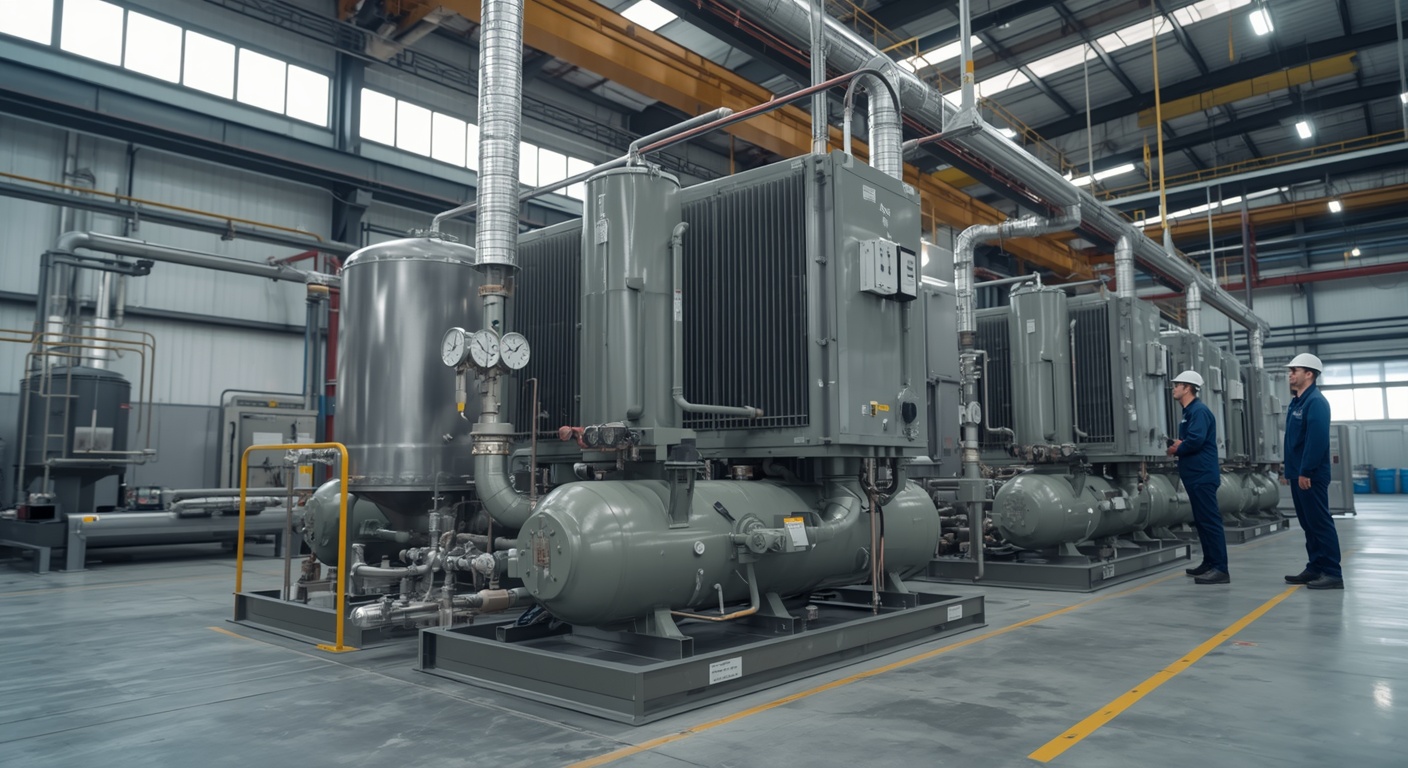
An industrial air compressor Malaysia buyers evaluate for manufacturing is not just a standalone machine. It is the core of a compressed air system that supports tools, automation, packaging, spraying and general plant utility needs. Choosing the right setup means looking at compressor type, air demand, air quality, maintenance needs and long-term operating efficiency.
This guide explains how industrial air compressors are used in manufacturing, the main compressor types, what affects sizing, which supporting equipment matters, and what factory teams should check before buying.
What is an industrial air compressor and how is it used in manufacturing?
An industrial air compressor is a machine that converts power into compressed air for factory use. In manufacturing, it supplies pressurized air to pneumatic tools, cylinders, actuators, packaging machines, spray systems and other plant equipment that need a reliable utility source.
In practical terms, compressed air often works like a factory utility alongside electricity and water. It may be used directly at a workstation or distributed through plant piping to multiple processes across a production line.
Common uses include:
- Powering pneumatic hand tools
- Operating cylinders and actuators in automation systems
- Supporting packaging and labeling equipment
- Feeding spray painting or coating systems
- Providing blow-off air for cleaning or part handling
- Serving general workshop and maintenance tasks
Why compressed air matters in factory operations
Compressed air matters because many manufacturing processes depend on it for consistent motion, control and utility support. When the air supply is unstable, contaminated or poorly sized, factories may face production interruptions, inconsistent machine performance or increased maintenance problems.
For some plants, compressed air is needed only for workshop tasks and occasional machine functions. For others, it is central to the production process and must be available continuously. That difference affects compressor choice, redundancy planning and system design.
Reliable compressed air can influence:
- Uptime: production equipment that uses pneumatic components can stop if pressure drops or supply becomes unreliable.
- Product quality: air used in spraying, packaging or sensitive processes may need better moisture and contamination control.
- Maintenance planning: poor filtration, condensate buildup or leakage can shorten equipment life and create avoidable service work.
- Energy use: compressed air systems can consume significant power, especially when leaks, oversizing or poor controls are present.
Different industries can also have different air quality expectations. A metal fabrication workshop may have different needs from an electronics line or a manufacturer handling products with tighter contamination concerns. Requirements should always be evaluated based on the actual process, product and customer expectations.
Main types of industrial air compressors
The best compressor type depends on how the factory uses air, how often demand occurs, and how critical the supply is to operations. Before comparing brands or models, manufacturers should first decide whether they need a compressor for continuous production duty, intermittent workshop use, cleaner air output, or future system expansion.
The main categories most manufacturers will compare are rotary screw compressors, reciprocating or piston compressors, and oil-lubricated versus oil-free air compressor designs.
Rotary screw compressors
A rotary screw air compressor is commonly selected for factory environments that need a steady supply of compressed air over long operating periods. It uses intermeshing rotors to compress air continuously, making it well suited to production plants where multiple machines or workstations draw air throughout the day.
Rotary screw systems are often preferred when manufacturers need:
- Continuous-duty operation
- More stable airflow for plant distribution
- Integration with dryers, filters and receiver tanks
- A central compressed air system serving several departments
They are widely considered for assembly plants, packaging lines, automation cells and general factory utility networks. In many cases, the compressor becomes part of a broader compressed air system Malaysia manufacturers use across the facility rather than serving a single machine.
Key considerations include maintenance access, cooling and ventilation, noise management, condensate handling and whether the system should include storage and air treatment equipment from the start.
Reciprocating or piston compressors
A piston air compressor, also called a reciprocating compressor, compresses air using a piston moving inside a cylinder. These compressors often fit smaller workshops, intermittent-duty applications, maintenance departments or operations where air demand is not constant throughout the day.
They may be suitable when a manufacturer needs:
- Compressed air for occasional tool use
- A workshop or maintenance air source
- A simpler setup for lower and less continuous demand
- A dedicated compressor for a limited process area
Compared with rotary screw units, piston compressors are generally considered more suitable for intermittent use than for serving a large production plant with continuous air demand. That does not make them inferior; it simply means they fit a different operating profile.
Oil-lubricated vs oil-free compressors
The difference between oil-lubricated and oil-free compressors relates to how the compression system is designed and how contamination risk is managed.
Oil-lubricated compressors use lubrication within the machine and are common in many industrial applications. They are often paired with proper filtration and air treatment equipment depending on the process requirement.
Oil-free air compressor designs are considered where cleaner air is especially important or where manufacturers want to reduce the risk of oil carryover in the compressed air stream. This may be relevant for certain product-contact or contamination-sensitive environments.
The right choice depends on process risk, downstream air quality needs, customer specifications and system design. Manufacturers should avoid assuming that oil-free is necessary for every factory, or that standard lubricated systems are always acceptable for sensitive applications. The process should drive the decision.
How to choose the right industrial air compressor
Choosing the right air compressor for factory use starts with understanding how compressed air supports the production process. A machine that looks adequate on paper may perform poorly if the plant has peak demand spikes, air quality issues or space constraints that were not considered early.
A practical factory air compressor selection process should review the following points:
- Application: What equipment will use the air, and is the air for production, maintenance or both?
- Duty cycle: Will the compressor run occasionally, in long shifts, or almost continuously?
- Pressure requirement: What pressure do downstream machines or tools actually need?
- Airflow demand: How much air is needed across normal and peak operating periods?
- Air quality requirement: Does the process need dry air, filtered air or cleaner air with lower contamination risk?
- Future expansion: Will additional lines, workstations or automation cells be added later?
- Installation conditions: Is there enough space, ventilation, service access and suitable utility support?
- Noise and plant layout: Should the compressor be isolated from production or office areas?
- Maintenance support: Can the site team handle routine checks, and is reliable after-sales support available?
For manufacturers comparing multiple equipment categories, the broader industrial machinery and equipment guide can help place compressors within the wider factory equipment planning process.
Key sizing factors manufacturers should understand
Industrial air compressor sizing for manufacturing should be based on actual plant demand, not guesswork. The right size depends on airflow, pressure, how many users operate at the same time, peak demand periods, allowance for leakage and sensible planning for future growth.
Many buying mistakes come from selecting a compressor that is either too small for peak demand or too large for the real operating profile. Both can create operational and cost problems.
Key sizing factors include:
- Required airflow: total air consumption of connected tools, machines and pneumatic devices
- Required pressure: the pressure needed by the most demanding relevant application, while allowing for system losses
- Simultaneous use: whether equipment runs one at a time or together during production
- Peak demand: short periods when the plant uses much more air than normal
- Duty profile: whether demand is steady, variable or highly intermittent
- Leakage allowance: existing or expected losses in plant piping and connections
- Storage support: whether an industrial air receiver tank will help smooth demand fluctuations
- Expansion planning: expected future machines, lines or shifts
Terms such as flow rate, CFM and bar pressure are commonly used when discussing sizing, but the correct interpretation depends on the supplier’s data format and the actual process needs. Rather than relying on generic formulas alone, manufacturers should confirm detailed sizing with a competent supplier assessment based on measured or documented demand.
Essential components in a complete compressed air system
The compressor itself is only one part of a working system. A reliable setup usually includes storage, air treatment, distribution and condensate management components that affect pressure stability, air quality and equipment life.
Important system elements include:
Air receiver tank
An air receiver tank stores compressed air and helps stabilize system pressure. It can also reduce rapid cycling and support short bursts of demand. In many plants, receiver sizing and placement are important to overall system behavior, especially where demand fluctuates.
Air dryer
An air dryer and filtration system is often needed when moisture can affect production quality, pneumatic components or downstream equipment. Dryers reduce water content in the compressed air stream, helping protect tools, valves, cylinders and process equipment.
Filters
Air filters remove unwanted particles and, in some system designs, help manage oil and moisture carryover. The required filtration level depends on how the air will be used. General plant air may need a different treatment approach from air used in spray finishing or contamination-sensitive processes.
Piping and distribution
Poor piping design can create pressure drops, uneven supply and maintenance headaches even when the compressor itself is properly selected. Layout, pipe sizing, routing and drain management all influence system performance.
Condensate management
Compressed air systems generate condensate that must be handled properly. Drain points, separators and maintenance routines are part of keeping the system reliable. Site-specific handling requirements can vary depending on the equipment, process and local compliance context, so manufacturers should verify the appropriate approach for their installation.
Common manufacturing applications in Malaysia
Across Malaysian manufacturing settings, compressed air is used in many practical ways. The exact mix depends on industry, plant layout and the level of automation, but several applications are widely relevant.
- Assembly operations: pneumatic tools, fixtures and pick-and-place movements
- Packaging lines: actuators, sealing equipment, product transfer and labeling functions
- CNC support functions: auxiliary air use for machine functions, tool changes or cleaning support where applicable
- Material handling: pneumatic controls, gates and certain conveying or transfer functions
- Spray finishing: coating and finishing processes that depend on stable air supply and suitable air treatment
- Automation equipment: cylinders, valves and control components in production cells
- Workshop utilities: maintenance tools, inflation, cleaning and general service use
These examples show why industrial air compressors for manufacturing are often selected as part of broader production planning. In some plants, compressed air supports only secondary processes. In others, it is integrated directly into line operation and product handling.
Energy efficiency and operating cost considerations
Compressed air can become an expensive utility if the system is oversized, poorly maintained or allowed to leak. For that reason, manufacturers should assess lifecycle considerations rather than focusing only on the initial purchase price.
Important cost and efficiency drivers include:
- Load profile: a compressor should suit the plant’s real demand pattern, not just the maximum possible load.
- Oversizing: buying too much capacity can create inefficiency and unnecessary capital cost.
- Leaks: air losses in hoses, fittings, valves and old piping waste energy continuously.
- Pressure settings: running higher pressure than the process actually needs can increase system burden.
- Maintenance condition: clogged filters, neglected drains and poor servicing can reduce performance.
- System design: storage, control strategy, piping and air treatment all affect operating behavior.
A more economical system is not always the cheapest compressor at purchase. In many cases, a better-matched compressor with appropriate treatment and distribution design delivers more dependable long-term value. This is especially relevant where the compressed air system supports core production equipment and any interruption affects output.
Maintenance basics for industrial air compressors
Good industrial compressor maintenance helps preserve reliability, air quality and operating efficiency. The exact service routine depends on compressor type and manufacturer guidance, but several principles apply broadly.
Routine maintenance typically includes:
- Checking for abnormal noise, vibration or heat
- Inspecting filters and replacing them when required
- Reviewing lubrication condition where applicable
- Draining and managing condensate appropriately
- Checking hoses, fittings and piping for leaks
- Monitoring pressure stability and system behavior
- Keeping cooling paths and surrounding areas clean
- Following scheduled servicing by trained personnel
Maintenance should cover the whole system, not only the compressor package. A neglected dryer, blocked filter or corroded drain point can create just as many problems as poor compressor upkeep.
For production-critical systems, many factories also benefit from keeping basic service records. Even simple tracking of recurring alarms, pressure complaints or condensate issues can help identify problems before they disrupt operations.
Mistakes to avoid when buying an industrial air compressor
- Buying on price alone. A low upfront price does not guarantee the right fit for production duty, air quality or operating cost.
- Ignoring the full system design. Compressor, receiver, dryer, filters and piping should be evaluated together.
- Underestimating air quality needs. Some processes can tolerate general plant air, while others need drier or cleaner supply.
- Failing to plan for expansion. A system that barely meets current demand may become inadequate after line changes or shift growth.
- Overlooking maintenance support. After-sales service, spare parts availability and site service capability matter.
- Guessing the size. Selection should be based on actual demand and usage pattern, not rough assumptions.
- Assuming one compressor type suits every factory. Continuous-duty plants and intermittent workshop users often need different solutions.
A practical buyer checklist for manufacturers
Before approaching suppliers, use this checklist to make discussions more productive and reduce the risk of buying the wrong system.
- List every process, tool and machine that will use compressed air.
- Separate continuous demand from intermittent or peak demand.
- Confirm the required operating pressure for each key application.
- Estimate total airflow based on simultaneous use, not just individual equipment ratings.
- Decide whether the factory needs general plant air, dry air, filtered air or cleaner air with stricter contamination control.
- Review whether a rotary screw compressor or piston air compressor better matches the duty cycle.
- Check available installation space, ventilation and service access.
- Assess whether an air receiver tank, dryer and filters are needed from day one.
- Ask how condensate will be managed in the actual installation.
- Consider future expansion, additional shifts or new production lines.
- Review maintenance responsibilities, service response and spare parts support.
- Compare options based on total operating suitability, not price alone.
Frequently Asked Questions
What is an industrial air compressor used for in manufacturing?
It is used to supply compressed air for pneumatic tools, cylinders, actuators, packaging equipment, spray systems, maintenance work and general plant utility functions. In some factories it supports secondary tasks, while in others it is integrated into the production line.
How do I choose between a rotary screw and a piston air compressor?
A rotary screw compressor is generally more suitable for continuous or high-use factory environments, while a piston compressor often fits smaller or intermittent-duty applications. The right choice depends on duty cycle, total air demand, air quality needs, maintenance expectations and future expansion plans.
What factors determine the right air compressor size for a factory?
The main factors are required airflow, required pressure, simultaneous equipment use, peak demand periods, system leakage, storage capacity and future growth. Detailed sizing should be confirmed using actual usage data or a supplier assessment rather than rough estimation alone.
Do manufacturers need oil-free compressed air?
Not always. Oil-free compressed air may be preferred where contamination risk is a major concern, but many industrial processes use oil-lubricated systems with suitable downstream treatment. The correct decision depends on the process, product sensitivity and air quality requirement.
What equipment is needed besides the air compressor itself?
A complete system may also include an air receiver tank, dryer, filters, piping network, drains and condensate management equipment. These components affect pressure stability, moisture control, air cleanliness and overall system reliability.
Conclusion
The right industrial air compressor for manufacturing depends on more than compressor type alone. Manufacturers should assess how air is used, whether demand is continuous or intermittent, what air quality the process requires, and how the full system will be maintained over time.
A well-matched setup can support stable production, while a poorly planned one can create recurring pressure, moisture and maintenance issues. For readers evaluating other factory equipment alongside compressors, the wider industrial machinery and equipment guide is a useful next step.