A food packaging machine is not a single piece of equipment. It is a broad category that includes machines used to fill, seal, wrap, cap, label, code, and prepare food products for storage, handling, and sale. For food manufacturers, processors, and SMEs, the right machine depends on the product, the pack format, and how the production line operates.
This guide explains the main types of food packaging machines, how they work in a packaging line, and how to choose equipment that fits your operation. It also covers the difference between automatic and semi-automatic systems, along with practical buying considerations for manufacturers in Malaysia.
If you are comparing this topic with broader factory equipment categories, see our industrial machinery and equipment guide.
What is a food packaging machine?
A food packaging machine is equipment used to fill, seal, wrap, label, or otherwise package food products so they can be stored, transported, and sold in a controlled and consistent way. It is used across food manufacturing, processing, and SME production for products such as snacks, sauces, powders, beverages, chilled foods, and ready-to-eat items.
Why food packaging machines matter in food manufacturing
Packaging equipment does more than place food into a bag, tray, bottle, or carton. In practical factory use, it helps standardize how products are presented and handled at the end of production.
Well-matched food packaging equipment can support several important goals:
- Product protection: Packaging helps shield food from handling, leakage, or exposure during storage and distribution.
- Consistency: Equipment supports more repeatable filling, sealing, and labeling than purely manual packing methods.
- Workflow efficiency: A suitable packaging machine for food industry use can reduce bottlenecks between processing and dispatch.
- Reduced manual handling: Moving from hand packing to semi automatic packaging machine or automatic packaging machine setups can reduce repetitive manual steps.
- Better pack presentation: Uniform packs are easier to stack, label, scan, and sell.
- Traceability support: Coding, labeling, and end-of-line systems help manufacturers identify batches and organize outbound products.
The value of a machine depends on how well it fits the product and production method. A machine that works well for dry snacks may be unsuitable for hot-filled sauces, fragile bakery items, or chilled prepared meals.
Main types of food packaging machines
There are many types of food packaging machines, and each is designed around a particular product form, container style, or production workflow. Some machines perform primary packaging, where the food is first enclosed. Others handle secondary or end-of-line packaging after the primary pack is complete.
| Machine type | Main function | Common food applications |
|---|---|---|
| Filling machines | Dispense product into bottles, jars, pouches, tubs, or other containers | Beverages, sauces, oils, powders, granules, pastes |
| Form-fill-seal machines | Form a package, fill it, and seal it in one process | Snacks, sachets, powders, frozen foods, pouches |
| Vacuum packaging machines | Remove air and seal the package | Meat, seafood, specialty foods, shelf-life-sensitive products |
| Tray sealing and thermoforming machines | Seal filled trays or form packs from rollstock material | Prepared meals, fresh produce, chilled foods, convenience packs |
| Sealing, capping, labeling, and coding machines | Close, identify, and finish packaged products | Bottles, jars, pouches, trays, cartons |
| Cartoning and end-of-line machines | Place products into cartons, cases, or transport packs | Retail packs, multipacks, shipping cartons |
Filling machines
Filling machines are used to place a measured amount of product into a container. The right filling system depends heavily on the product’s flow behavior and the package format.
For example, different approaches may be used for:
- Liquids: such as water, beverages, vinegar, or cooking oil
- Pastes and sauces: such as chili sauce, jam, mayonnaise, or curry paste
- Powders: such as seasoning, milk powder, or flour blends
- Granules: such as sugar, rice, beans, or snack inclusions
A bottling and filling machine may be suitable when the product goes into bottles or jars, while other systems are designed for tubs, cups, sachets, or stand-up pouches. Product viscosity, particle size, temperature, and cleanliness requirements all affect machine choice.
Form-fill-seal machines
A form fill seal machine creates the package, fills it with product, and seals it as part of one integrated operation. This makes it one of the most widely used categories of food packing machine in modern production.
At a high level, there are two common concepts:
- Vertical form-fill-seal: often used for products dropped into a bag or pouch from above, such as snacks, powders, grains, or small solids.
- Horizontal form-fill-seal: often used for products that are loaded into packs in a horizontal flow, including bars, bakery items, or certain prepared products.
Form-fill-seal systems are commonly selected for sachets, pillow bags, pouches, and similar flexible packaging formats. They are often paired with a weighing system or dosing unit to control product feed before sealing.
Vacuum packaging machines
A vacuum packaging machine removes air from the package before sealing it. The purpose is to create a tighter pack environment around the product.
This approach is often considered for products where pack atmosphere matters to handling or product preservation, such as meat, seafood, cheese, or specialty processed foods. However, the actual effect on product condition or shelf life depends on the food itself, packaging material, sealing quality, storage conditions, and the wider process. Those outcomes should be evaluated based on the specific product and validated packaging method.
Vacuum systems may be used as standalone machines or integrated into a wider food packaging line.
Tray sealing and thermoforming machines
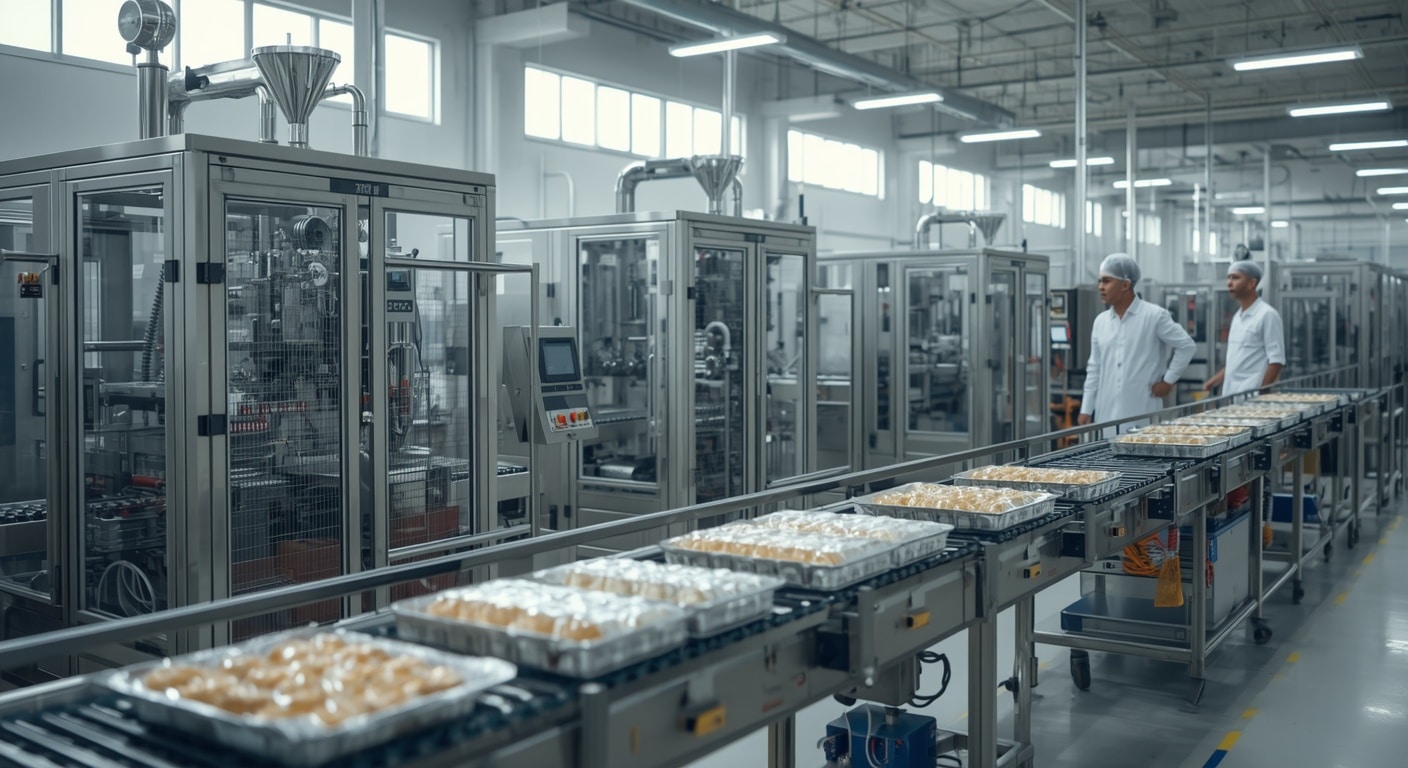
Tray sealing machines are used when food is placed into a pre-made tray and then sealed with a top film. This is common for prepared foods, fresh items, chilled products, and convenience packs.
Thermoforming machines work differently. Instead of starting with a ready-made tray, they form the package cavity from packaging film, load the product, and then seal it. In simple terms:
- Tray sealing: seal a filled tray that already exists
- Thermoforming: create the pack shape from film before filling and sealing
The best choice depends on pack format, integration needs, changeover frequency, and how the product is handled on the line.
Sealing, capping, labeling, and coding machines
Some packaging steps are easy to overlook because they happen after filling, but they are essential to making the pack complete and usable.
- Sealing machines close pouches, bags, cups, or trays.
- Capping machines apply and tighten caps or closures on bottles and jars.
- Labeling machine systems apply product labels to support branding and identification.
- Coding machines add information such as batch or date marking, depending on the production and labeling setup.
These machines can be standalone units or part of a connected packaging line. Even where the primary packaging machine performs well, poor closure, labeling, or coding can create downstream handling and quality problems.
Cartoning and end-of-line packaging machines
After primary packaging is complete, products often move into secondary packaging. Cartoning machine systems place individual packs or grouped products into cartons. Other end-of-line equipment may handle case packing, collation, or preparation for pallet movement.
This stage matters because it affects how products are grouped, protected for transport, and prepared for warehouse or retail channels. For manufacturers running multiple SKU sizes, end-of-line flexibility can be just as important as the primary packaging step.
How food packaging machines work in a production line
In a typical food packaging line, packaging equipment works as a sequence rather than as isolated machines. The exact layout varies, but the general flow often looks like this:
- Product feed: Product arrives from the upstream process, such as cooking, mixing, sorting, or batching.
- Dosing or weighing: A weighing system, pump, auger, or volumetric unit helps control the amount of product sent to the package.
- Container or pack presentation: Bottles, trays, pouches, film, or cartons are positioned for filling.
- Filling or loading: Product enters the container or formed package.
- Sealing or closing: The package is sealed, lidded, capped, or otherwise closed.
- Inspection or checking: Sensors, vision devices, or other checks may confirm presence, closure, or label application.
- Labeling and coding: Product identity and handling information are added where required by the process.
- Secondary packing: Finished primary packs move into cartons or cases.
- Dispatch preparation: Products are grouped, boxed, and prepared for storage or shipping.
Conveyor system design plays an important role here. Even if each machine works properly on its own, poor transfer between machines can slow the line or create jams. Integration points, sensors, and product orientation all influence line stability.
How to choose the right food packaging machine
Choosing the right food packaging machine starts with understanding the product and the production process, not just the package appearance. A machine should fit the product, the line, the operators, and the support available after installation.
- Define the product clearly. Identify whether you are packing liquids, powders, granules, solids, sticky pastes, fragile items, or chilled foods.
- Confirm the packaging format. Decide whether you need bottles, jars, trays, pouches, sachets, bags, cups, or cartons.
- Map the production workflow. Review how the machine will connect to upstream processing and downstream packing steps.
- Estimate practical production needs. Consider batch frequency, shift pattern, and expected line demand rather than choosing blindly.
- Check available floor space. Include room for operators, conveyors, maintenance access, and material handling.
- Choose the right automation level. Decide whether manual loading support, semi-automatic operation, or a more integrated automatic packaging machine setup makes sense.
- Review hygiene and cleaning needs. Packaging machines in food use should be practical to clean, inspect, and change over.
- Assess operator skill requirements. The best machine is not always the most complex one if staffing or training is limited.
- Plan for maintenance and spare parts. Downtime risk should be considered before purchase, not after installation.
- Think about future expansion. Product variation, pack changes, or higher throughput later may affect today’s buying decision.
Match the machine to the food product and packaging format
Different products behave differently in a packaging process. Solids may need counting, orientation, or gentle transfer. Powders may need controlled dosing and dust management. Liquids may need filling systems suited to free-flowing or viscous materials. Fragile foods may need a machine design that minimizes breakage during transfer and sealing.
Packaging format matters just as much. A pouch line, tray line, and bottling line are not interchangeable. Ready-to-eat products, chilled items, or multi-component meals may also need closer attention to handling sequence, sealing design, and changeover practicality.
Before choosing a machine, define both sides of the equation:
- What is the product like?
- What final package is required?
The machine should be selected around that match.
Consider automation level and labor requirements
A semi automatic packaging machine typically still depends on operator input at one or more stages, such as loading product, placing containers, or removing finished packs. An automatic packaging machine is more likely to link multiple steps and reduce direct operator involvement during normal running.
This is not simply a question of speed. It also affects:
- workflow consistency
- line integration
- operator workload
- changeover procedures
- staff training needs
For some SMEs, semi-automatic equipment offers a practical balance between process control and flexibility. For larger or more integrated food packaging line setups, higher automation may better suit repeatable high-volume production.
Check hygiene, cleaning, and material compatibility
Food packaging equipment should be practical to clean and inspect based on the product being handled. Surfaces that are hard to access, product-contact areas that trap residue, or awkward disassembly can create recurring operational problems.
Important points to review include:
- ease of cleaning around product-contact parts
- surface finish and general hygienic design
- whether washdown or moisture exposure is relevant to the area
- how easy it is to switch between products or pack sizes
- compatibility between the machine and the intended packaging materials
Material compatibility is especially important. A machine may work well with one film, tray, cap, or label type but not another. This should be confirmed through supplier testing or validated trials rather than assumed.
Review maintenance, spare parts, and supplier support
Packaging equipment selection should include the ownership and support side, not just the machine demonstration. Even a suitable machine can become a weak point if spare parts are difficult to obtain or if operators are not trained properly.
Before buying, review:
- access for routine maintenance
- availability of operator and maintenance training
- spare parts planning
- service response expectations
- documentation for setup, cleaning, and troubleshooting
This matters for food manufacturers in Malaysia as much as anywhere else. If a line depends on imported parts, external service visits, or specialized setup knowledge, downtime planning becomes more important.
Automatic vs semi-automatic food packaging machines
The difference between automatic and semi-automatic systems is mainly about how much of the packaging process is handled by the machine versus the operator.
| Factor | Semi-automatic packaging machine | Automatic packaging machine |
|---|---|---|
| Operator involvement | Higher operator input at one or more stages | Lower routine operator input during normal running |
| Workflow | Often suited to batch or step-by-step operations | Better suited to continuous or more integrated flow |
| Flexibility | Often easier to adapt for smaller runs or manual intervention | Can be efficient for repeatable packaging processes with defined formats |
| Line integration | May operate as a standalone station | More often linked with conveyors, dosing, capping, labeling, or end-of-line systems |
| Suitability | Common for SMEs, pilot production, or mixed product runs | Common for more mature lines with stable packaging requirements |
Neither option is automatically better. The better choice depends on the product mix, staffing model, packaging format, and how the overall line is intended to run.
Common mistakes when selecting packaging equipment
Many buying problems come from selecting the machine too early, before the process is properly defined. Common mistakes include:
- Choosing by price alone: A lower initial price may not reflect suitability, support, or changeover practicality.
- Ignoring packaging material compatibility: Film, trays, labels, and closures must work with the machine.
- Underestimating cleaning needs: Hard-to-clean equipment can create daily operational friction.
- Overlooking changeovers: Frequent product or pack-size changes can slow production if the machine is not designed for them.
- Not checking floor space properly: The machine footprint is only part of the requirement; operators, conveyors, and maintenance access also need room.
- Buying excess complexity: Advanced features are not always useful if they do not match the process.
- Failing to plan for future variation: New SKUs or alternative pack formats may be difficult to add later.
A structured equipment review usually prevents these issues better than comparing brochures alone.
Questions to ask suppliers before buying
Before committing to a food packing machine, ask suppliers detailed questions about fit, operation, and support. A practical checklist includes:
- Is the machine suitable for my exact product type?
- Has the supplier tested similar products or packaging materials?
- Can sample trials be carried out before purchase?
- What footprint and operator clearance does the machine require?
- What utilities or supporting equipment are needed for installation?
- What training is provided for operators and maintenance staff?
- What routine maintenance tasks are expected?
- How are spare parts handled and what support is available?
- Can the machine integrate with existing conveyors, fillers, or coding systems?
- What documentation is supplied for operation, cleaning, and troubleshooting?
- What is the expected lead time for delivery and setup?
These questions help move the buying process from a generic machine comparison to a line-fit evaluation.
Food packaging machine selection for Malaysian manufacturers
For manufacturers in Malaysia, the technical selection process is broadly the same as elsewhere, but several local operating realities may influence the final decision.
These can include:
- Service access: Check whether supplier support is available locally or depends on remote assistance and imported parts.
- Operator training: A machine should match the skill level of the team that will run and maintain it daily.
- Lead time planning: If equipment or critical components are sourced from overseas, replacement timing may affect risk planning.
- Factory layout constraints: Existing premises may limit how much space is available for conveyors, guarding, pack-off tables, or end-of-line systems.
- Product and labeling requirements: Packaging, food safety, and labeling obligations can vary depending on the food category, process, and market channel.
Any current food manufacturing, packaging, hygiene, labeling, or machinery compliance requirements should be verified with the relevant Malaysian authorities, qualified advisors, and equipment suppliers before a purchase decision is finalized. Requirements can vary depending on the product, process, and operating environment.
Frequently Asked Questions
What does a food packaging machine do?
A food packaging machine helps prepare food products for storage, transport, and sale by carrying out tasks such as filling, sealing, wrapping, capping, labeling, or coding. Some machines handle one step only, while others combine several packaging steps in one system.
What are the different types of food packaging machines?
Common types include filling machines, form-fill-seal machines, vacuum packaging machines, tray sealing machines, thermoforming machines, capping machines, labeling machines, coding machines, cartoning machines, and other end-of-line packaging systems. The right type depends on the product and the required package format.
How do I choose a food packaging machine for my product?
Start with the product type, then define the package format, line workflow, automation level, cleaning needs, floor space, operator capability, and maintenance support. Sample trials and packaging material checks are also important before purchase.
What is the difference between automatic and semi-automatic packaging machines?
Semi-automatic machines still rely on operators for part of the process, such as loading or unloading. Automatic machines handle more steps with less routine operator input and are usually easier to integrate into a continuous packaging line.
Can one food packaging machine handle different packaging formats?
Some machines can handle more than one format or size, but not every machine is designed for wide variation. Change parts, configuration limits, and packaging material compatibility should be checked carefully with the supplier before assuming one machine can cover multiple formats.
Conclusion
The best food packaging machine is the one that matches the product, the packaging format, and the way the factory actually runs. Filling, sealing, vacuum packing, tray sealing, labeling, and cartoning all solve different packaging needs. A careful selection process that considers hygiene, automation level, maintenance support, and future product changes will usually lead to a better equipment decision than choosing on headline features alone.