Plastic manufacturing Malaysia covers a wide range of industrial activities, from packaging and household goods to precision parts for electronics, automotive and medical applications. For buyers, engineers and factory planners, understanding the main processes, materials and supplier selection factors helps reduce risk and improve product quality, lead times and long-term production performance.
Malaysia’s plastic industry supports many downstream sectors by converting polymer raw materials into finished products and components. The industry includes contract manufacturers, specialist moulders, packaging producers and suppliers serving both domestic and export-oriented production.
For broader context on how this sector fits into the country’s industrial base, see Manufacturing Industries in Malaysia.
What is plastic manufacturing in Malaysia?
Plastic manufacturing in Malaysia is the industrial process of converting polymer raw materials into finished or semi-finished products for sectors such as packaging, automotive, electronics, healthcare and consumer goods. It includes methods such as injection moulding, blow moulding, extrusion and thermoforming, depending on the product shape, function and production requirements.
In practice, this means turning plastic resins into items such as bottles, containers, housings, trays, fittings, films, pipes and technical parts. Some manufacturers focus on high-volume standard products, while others support custom components, contract manufacturing or sector-specific production with tighter quality and traceability needs.
Why plastic manufacturing matters to Malaysia’s industrial sector
Plastic manufacturing plays an important supporting role across Malaysia’s wider industrial economy because many products depend on plastic parts, protective packaging or functional polymer components somewhere in the supply chain.
For example, manufacturers in food and beverage need bottles, caps, trays, pouches and transport packaging. Electrical and electronics producers use enclosures, connectors, cable-related parts and protective components. Automotive supply chains use interior trim, clips, housings, fluid-related parts and other moulded items. Healthcare and consumer product sectors also rely on plastic production for disposables, containers, casings and product assemblies.
This makes the plastic industry relevant not only to large OEM-linked operations but also to SMEs that need custom packaging, contract moulding, short-run development work or outsourced component production. A capable plastics supplier can affect product quality, production continuity, inventory planning and speed to market.
Common plastic products made in Malaysia
Plastic manufacturers in Malaysia commonly produce both everyday consumer items and industrial-use components. The product mix depends on the process used, the resin selected and the requirement of the end-use sector.
- Packaging products such as bottles, caps, trays, films, containers and protective packaging
- Household and consumer goods such as storage items, kitchenware, dispensers and product casings
- Automotive plastic parts such as clips, panels, covers, housings and interior components
- Electrical and electronics components such as enclosures, insulation-related parts, cable accessories and device housings
- Medical plastic products such as selected disposables, trays, packaging and device-related components
- Industrial parts such as fittings, profiles, guards, containers and application-specific components
A simple way to view the range is by matching product category to typical application.
| Product category | Typical examples | Common end-use sectors |
|---|---|---|
| Packaging | Bottles, caps, tubs, films, trays | Food and beverage, retail, consumer goods |
| Rigid containers | Jars, drums, storage boxes, technical containers | Industrial supply, household, chemicals |
| Precision moulded parts | Housings, fittings, connectors, clips | Electronics, automotive, appliances |
| Sheets and profiles | Plastic sheets, strips, channels, tubing | Construction, signage, industrial use |
| Medical and clean-use items | Disposable components, packaging, trays | Healthcare, laboratory, medical device supply |
| Consumer products | Casings, dispensers, storage and utility items | Retail, homecare, personal care |
Main plastic manufacturing processes
The main plastic manufacturing process depends on the shape of the product, the production volume, the material and the required finish. Some methods are better for solid precision parts, while others are designed for hollow containers or continuous products.
Most plastic production in Malaysia falls into a few core categories: injection moulding, blow moulding, extrusion and thermoforming. Other methods may also be used for specialised applications.
Injection moulding
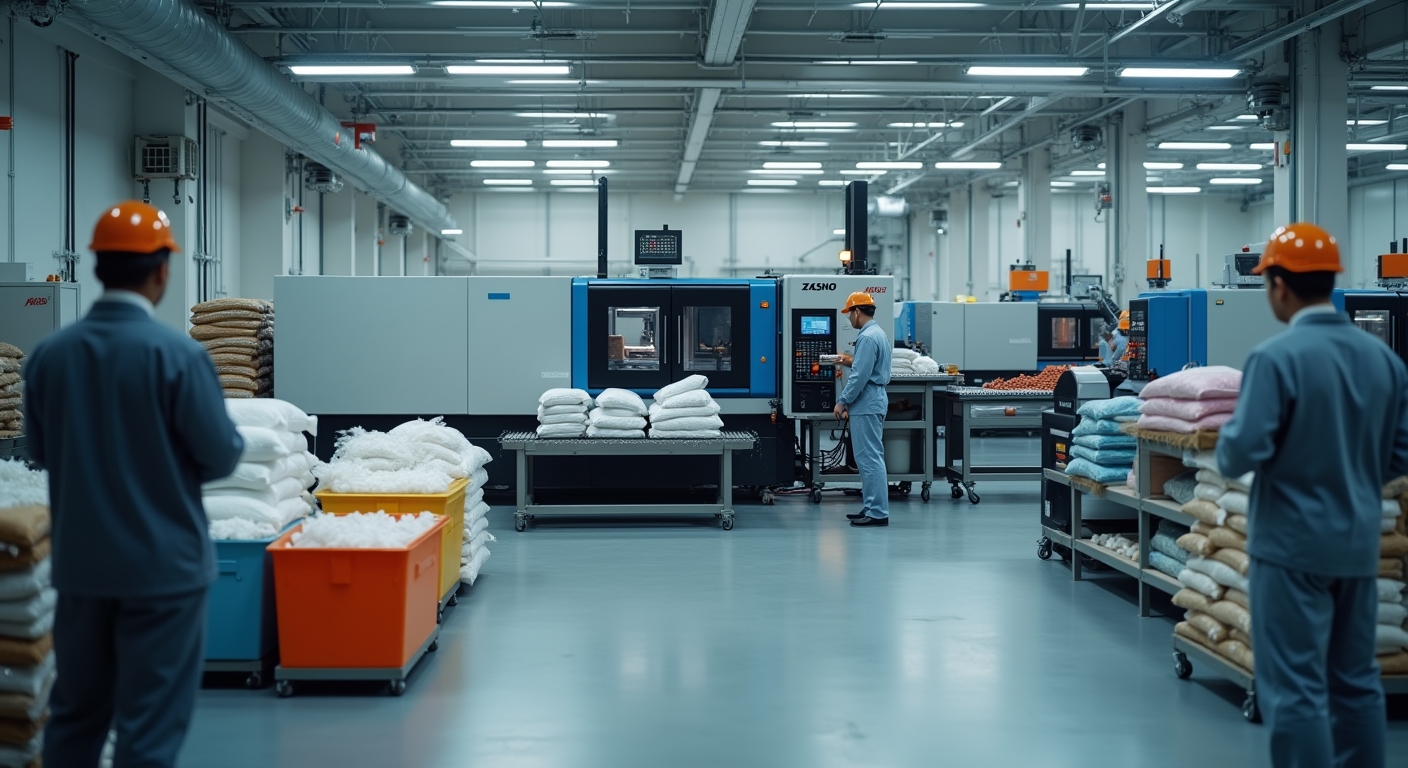
Injection moulding forms plastic parts by melting resin and injecting it into a mould cavity. After cooling, the mould opens and the part is removed. This process is widely used because it can produce repeatable shapes with consistent dimensions when tooling and process control are properly managed.
It is commonly used for:
- caps and closures
- electrical housings
- consumer product casings
- fittings and connectors
- automotive components
- precision technical parts
For buyers, the main considerations usually include mould design, tooling ownership, part complexity, surface finish, material suitability, expected volumes and the supplier’s ability to maintain consistency over repeat production runs.
Blow moulding
Blow moulding is mainly used to produce hollow plastic products. In broad terms, heated plastic is formed into a tube or preform and then expanded with air inside a mould to create the final shape.
This process is common in plastic packaging manufacturing Malaysia because it suits products such as:
- bottles
- jerry cans
- small containers
- selected industrial packaging items
Blow moulding Malaysia suppliers are often relevant to businesses that need volume packaging production, especially when strength, weight, stackability and filling-line compatibility matter.
Extrusion
Extrusion shapes plastic continuously rather than as one part at a time. Melted plastic is pushed through a die to create a constant profile, then cooled and cut or wound depending on the product form.
Extrusion Malaysia applications commonly include:
- pipes and tubing
- films and sheets
- profiles and strips
- coated or layered materials
This method is suitable when a manufacturer needs long, uniform products rather than individual moulded components. It is widely used in packaging, construction-related materials and industrial supply products.
Thermoforming and other methods
Thermoforming shapes heated plastic sheet over a mould, usually for trays, lids, clamshell-style packaging and other thin-wall products. It is often chosen when the product is relatively shallow and made from formed sheet rather than injected resin.
Other methods may also be relevant depending on the application:
- Compression moulding for certain formed parts where material is pressed into shape
- Rotational moulding for larger hollow items made by rotating a mould during heating
- Fabrication and secondary processing for cutting, welding, printing, assembly or finishing after primary production
Not every plastic manufacturer offers every process. Many specialise in one or two areas and build their tooling, quality systems and workforce around those capabilities.
Raw materials used in plastic production
Material selection is central to plastic manufacturing because the resin affects product strength, flexibility, clarity, chemical resistance, heat performance, finish and processability. In commercial terms, the right material choice also affects supply stability, consistency and suitability for the intended end use.
Common plastic raw materials Malaysia buyers will encounter include:
- Polyethylene (PE) for films, containers and flexible or semi-rigid products
- Polypropylene (PP) for packaging, household goods, components and various moulded parts
- Polyethylene terephthalate (PET) for bottles, containers and clear packaging applications
- Polyvinyl chloride (PVC) for selected pipes, profiles, cable-related uses and construction-linked products
Manufacturers may also use engineering plastics, additives, colorants, masterbatch, recycled content or custom formulations depending on customer requirements. The correct choice depends on how the product will be used, whether it must withstand heat or handling stress, whether clarity matters, and whether the end market has specific compliance expectations.
For example, a food packaging item, an automotive under-the-hood component and a consumer electronics housing may all use very different materials and quality controls even if they are produced in the same country and with similar equipment categories.
Industries that depend on plastic manufacturing
Plastic manufacturing supports a broad mix of industries because plastics can be lightweight, formable, durable and cost-efficient depending on the application. However, product requirements vary significantly by sector.
Packaging and food-related supply chains
The packaging industry depends heavily on plastic production for bottles, trays, films, tubs, closures and transit protection. In these applications, manufacturers often focus on consistency, appearance, sealing performance and suitability for filling, transport and storage.
Automotive manufacturing
Automotive plastic parts Malaysia suppliers may produce interior trim parts, clips, housings, fluid-related components and other moulded items. Automotive buyers typically pay close attention to repeatability, part fit, documentation, tooling management and supplier discipline.
Electrical and electronics manufacturing
Malaysia’s electrical and electronics base creates demand for enclosures, connector-related parts, trays, insulation-related components and product housings. In this segment, dimensional stability, cosmetic finish and process control are often important.
Healthcare and medical-related production
Medical plastic products Malaysia can include selected disposable items, packaging, trays and device-related components. Requirements in this area may be more controlled than in general consumer production, especially where traceability, cleanliness or customer documentation is important. Exact requirements depend on the product type and market served.
Construction and industrial use
Construction and industrial sectors use plastic pipes, profiles, sheet products, fittings, tanks, covers and protective components. Product selection may depend on exposure conditions, installation needs and handling requirements.
Consumer goods
Consumer plastic products manufacturing covers a wide range of items, from household storage and utility products to personal care packaging and appliance-related parts. In this category, design flexibility, visual finish and production efficiency can be major priorities.
Key factors when choosing a plastic manufacturer in Malaysia
Choosing among plastic manufacturers in Malaysia is not only about price. The right supplier should fit the product, the expected production scale and the quality expectations of the end market.
Use this checklist when evaluating a potential manufacturing partner:
- Confirm process capability. Check whether the supplier is strong in injection moulding, blow moulding, extrusion, thermoforming or a combination that matches your product.
- Assess tooling support. Ask whether the manufacturer can support mould development, maintenance, modifications and troubleshooting throughout the product life cycle.
- Review material options. Make sure the supplier has experience with the resin family your product requires, including colour, finish or recycled-content considerations where relevant.
- Evaluate quality systems. Look for structured inspection, in-process checks, defect control, traceability practices and documentation appropriate to your sector.
- Check prototyping and development support. Early samples, pilot runs and design-for-manufacture feedback can prevent costly production issues later.
- Understand production scalability. A supplier suitable for low-volume custom work may not be ideal for large recurring orders, and the reverse is also true.
- Discuss lead times and planning. Review how the factory manages scheduling, raw material supply, changeovers and urgent orders.
- Ask about secondary processes. Some products need printing, assembly, welding, trimming, packing or labelling after the main moulding process.
- Consider export and customer support experience. If your product enters a regulated or highly documented supply chain, communication discipline matters.
- Review sustainability practices. Understand how the supplier approaches scrap reduction, regrind use where suitable, recycling and waste control.
It is also useful to compare suppliers on a few decision points before moving into tooling or production.
| Evaluation area | What to look for | Why it matters |
|---|---|---|
| Process fit | Relevant moulding or extrusion capability | Reduces product and quality mismatch |
| Tooling support | Mould maintenance and engineering response | Affects uptime and part consistency |
| Material knowledge | Experience with suitable resin families | Improves product function and manufacturability |
| Quality control | Inspection discipline and traceability approach | Helps prevent repeat defects |
| Scale and planning | Capacity alignment with your order profile | Supports delivery reliability |
| Value-added services | Assembly, printing, packing or finishing | Simplifies supply chain management |
Quality, compliance and sustainability considerations
Quality in plastic manufacturing goes beyond making parts that look acceptable. For industrial buyers, it can include dimensional consistency, visual finish, assembly fit, sealing performance, material control and repeatability across production batches.
Typical quality control practices may involve incoming material checks, first-article approval, in-process inspection, final checks and handling controls to reduce contamination or damage. The exact level of control depends on the product and sector.
Compliance requirements can also differ widely. A packaging item, an automotive part and a medical-related component may each face different customer, product or market requirements. Businesses should avoid assuming that one quality system or certification automatically covers all applications. Where sector-specific standards, food-contact expectations, medical requirements or electrical application rules are relevant, they should be verified directly against customer specifications and the applicable authority or market requirement before production commitment.
Sustainability is also becoming a more important part of supplier evaluation. In practice, this may include:
- reducing process waste and reject rates
- improving material utilisation
- considering recyclable product design where feasible
- using recycled materials when the application allows and requirements are met
- separating and recovering production scrap
- improving packaging efficiency in logistics
Plastic recycling Malaysia considerations vary by product category, customer expectations and recovery practicality. Not every product can use recycled content in the same way, and not every recycling claim should be treated as equivalent. Buyers should confirm material suitability, consistency and any required documentation for their specific application.
Challenges facing the plastic manufacturing industry
The plastic manufacturing industry faces a mix of operational, commercial and sustainability-related pressures. These challenges affect both suppliers and customers.
- Raw material price volatility: Resin cost swings can affect budgeting, quotation validity and contract planning.
- Tooling cost and lead time: New moulds and modifications can require significant upfront investment and careful engineering coordination.
- Quality consistency: Maintaining repeatability across long production runs depends on process control, tooling condition and operator discipline.
- Labour and skills constraints: Production efficiency often depends on experienced technicians, setters, tooling specialists and quality personnel.
- Customer lead-time pressure: Buyers increasingly expect shorter development cycles and more responsive delivery performance.
- Sustainability expectations: Manufacturers face pressure to reduce waste, improve recyclability and respond to customer environmental requirements.
- Waste management complexity: Scrap handling, segregation and recovery require process discipline and practical downstream solutions.
These plastic manufacturing challenges are not unique to Malaysia, but they shape how local suppliers invest in automation, process monitoring, tooling improvement and quality systems.
How the industry is evolving
The plastic industry Malaysia market serves is gradually moving toward more controlled, value-added and efficiency-focused production rather than competing only on basic volume output.
Several broad developments are shaping this shift:
- Automation: More factories are using automated handling, inspection support or process integration to improve consistency and reduce dependence on manual intervention.
- Precision tooling: Better mould design and maintenance help manufacturers achieve more reliable repeat production for technical parts.
- Process monitoring: Closer control of production parameters supports defect reduction and more stable output.
- Lightweighting and design optimisation: Customers increasingly want parts that use material efficiently while still meeting performance needs.
- Higher-value applications: Suppliers may move from simple commodity products into technical components, assemblies or sector-specific production.
- Recycled and more circular material strategies: Where practical, companies are exploring ways to reduce virgin material dependence and improve material recovery.
For companies sourcing custom parts or packaging, this means supplier capability is becoming more important than machine ownership alone. Engineering support, tooling discipline, quality planning and material understanding increasingly separate stronger manufacturers from basic converters.
Conclusion
Plastic manufacturing in Malaysia includes a broad set of processes, materials and supplier types serving packaging, automotive, electronics, healthcare, construction and consumer goods. The right manufacturing approach depends on the product design, resin choice, production volume, quality expectations and downstream application.
Whether a business is sourcing bottles, films, moulded components or technical parts, the key is to match the process and supplier capability to the real production requirement. For a broader view of related sectors, explore Manufacturing Industries in Malaysia.
Frequently Asked Questions
What is plastic manufacturing in Malaysia?
Plastic manufacturing in Malaysia is the conversion of polymer raw materials into finished or semi-finished products such as packaging, containers, housings, films, fittings and technical components using processes like injection moulding, blow moulding, extrusion and thermoforming.
What products do plastic manufacturers in Malaysia commonly make?
They commonly make packaging items, bottles, caps, trays, films, household goods, industrial containers, automotive plastic parts, electronics housings and selected medical or healthcare-related components, depending on the manufacturer’s process capabilities.
What is the difference between injection moulding, blow moulding and extrusion?
Injection moulding produces individual solid parts in a mould, blow moulding creates hollow products such as bottles and containers, and extrusion produces continuous shapes such as pipes, film, sheet and profiles.
Which industries rely most on plastic manufacturing in Malaysia?
Major users include packaging, food and beverage, automotive, electrical and electronics, healthcare, construction and consumer goods. Each sector has different requirements for quality, volume, traceability and material selection.
How do I choose a plastic manufacturer in Malaysia for my business?
Start by checking process capability, tooling support, material knowledge, quality control discipline, prototyping support, production scalability, lead times and any secondary services such as printing or assembly. The best choice is the supplier whose strengths match your product and supply chain needs.