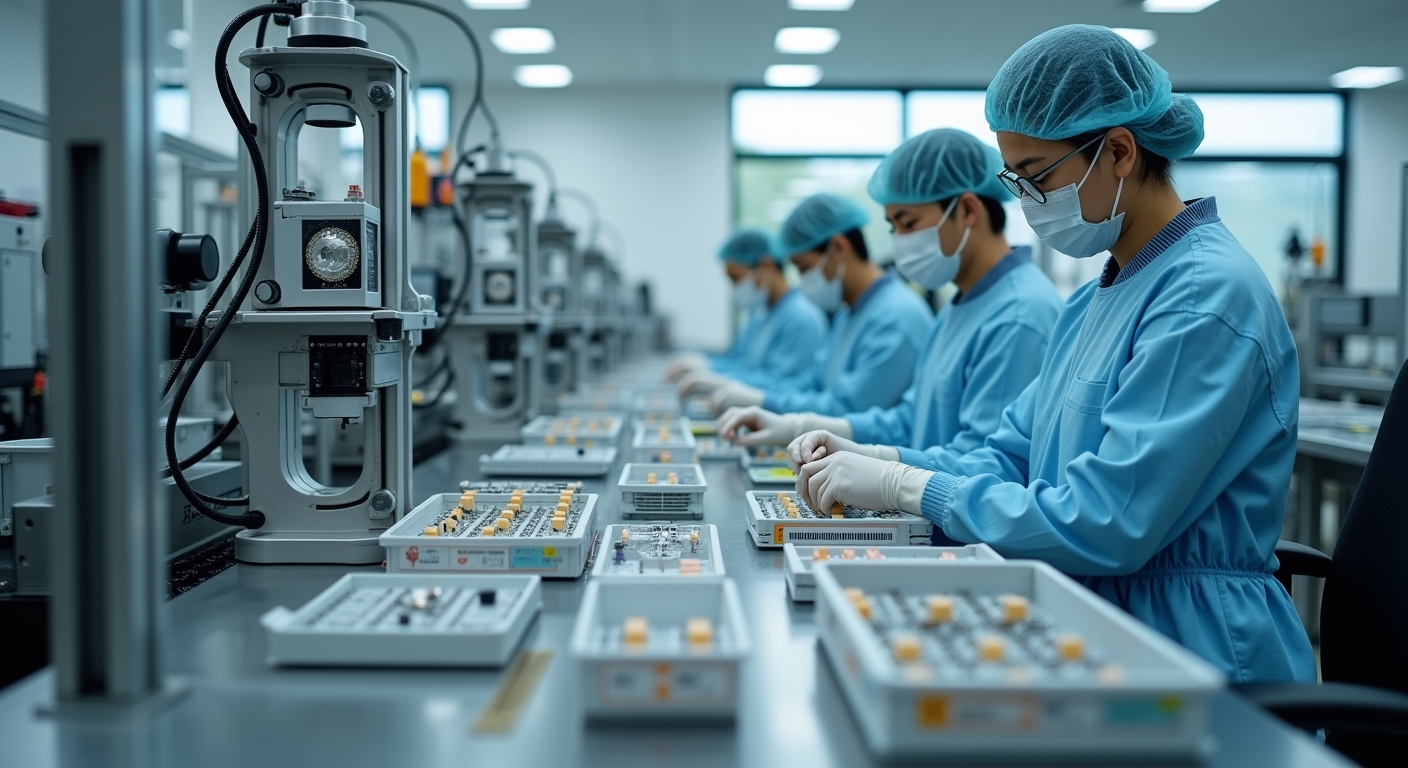
Medical device manufacturing Malaysia refers to the production of medical products and related components in Malaysian manufacturing facilities. It typically includes sourcing materials, component production, assembly, testing, packaging, labeling, documentation and quality control, with the level of process control depending on the device type, intended use and target market.
For businesses evaluating the Malaysia medical device sector, the main questions are usually practical ones: what kinds of products can be made, how production is controlled, what quality systems matter, and how to assess whether a factory is the right fit. This guide explains those fundamentals in a business-focused way without assuming that every medical device factory Malaysia operates to the same model.
Readers looking for broader sector context can also explore Manufacturing Industries in Malaysia.
What is medical device manufacturing in Malaysia?
Medical device manufacturing in Malaysia is the controlled production of medical devices, components or subassemblies in local factories. It can cover fabrication, clean assembly, inspection, testing, packaging, labeling and release documentation, with controls that are generally stricter than ordinary consumer-product manufacturing because product quality, consistency and traceability are critical.
In practice, the term can include several business models:
- OEM medical device manufacturing, where a company manufactures products to another brand owner’s design or specification
- Contract manufacturing, where a specialist manufacturer produces all or part of a medical device on behalf of another company
- Component manufacturing, where a site focuses on parts, molded items, tubing, electronics, packaging or other subcomponents
- Final device assembly, where parts are combined, checked and prepared for distribution
The exact scope depends on the product and facility capability. Some sites are focused on high-volume disposable items, while others handle lower-volume assemblies that require tighter documentation, validation and environmental control.
Why Malaysia is a notable location for medical device manufacturing
Malaysia is often considered for medical device production because it combines established industrial capabilities with an export-oriented manufacturing base. That does not mean every product is suitable for every factory, but it does make the country relevant for companies comparing Asian manufacturing locations.
Established manufacturing ecosystem
Medical devices manufacturing Malaysia benefits from a broader industrial base that supports precision components, plastics processing, electronics-related work, packaging and industrial services. That ecosystem can help manufacturers source inputs, tooling support and secondary processes more efficiently than in locations with a thinner supplier network.
Export-focused operations
Many medical device businesses serve regional or international markets. Malaysia’s manufacturing environment is often evaluated with export production in mind, including packaging, documentation control and shipment readiness. For companies that plan to sell into multiple markets, export discipline can be an important operational factor.
Range of manufacturing models
The country is relevant not only for full-scale device production but also for medical device contract manufacturing Malaysia, subassembly work and medical device components manufacturing. This gives brand owners more flexibility when deciding whether to outsource complete production or only selected stages.
Workforce and operational capability
Medical device production usually requires disciplined process execution, operator training, recordkeeping and quality assurance. Factories serving this sector typically need stronger procedural control than general assembly operations. For buyers, that makes management systems and manufacturing culture just as important as machinery.
Fit matters more than location alone
Malaysia can be a practical option, but location by itself does not guarantee success. The better question is whether a specific manufacturer matches the product’s technical requirements, cleanliness needs, documentation expectations and supply chain risk profile.
What types of medical devices are commonly manufactured
Medical devices manufactured in Malaysia can range from simple disposables to more tightly controlled assemblies. The actual product mix varies widely by company capability, quality system maturity and production environment.
Consumables and single-use devices
Many factories in the medical device industry Malaysia are suited to disposable or short-life-use products that require repeatable, high-volume processes and strong packaging control. These may involve molded plastic parts, tubing, simple assemblies or sterile barrier packaging.
Components and subassemblies
Some facilities do not make finished medical products at all. Instead, they specialize in medical device components manufacturing such as plastic parts, rubber parts, precision-cut materials, cable assemblies, housings, packaging sets or other intermediate items used in a final device elsewhere.
Diagnostic-related products
Diagnostic-related manufacturing can involve cartridges, housings, accessories, sample-handling parts, electronics-integrated items or other products that require controlled assembly and testing. The level of complexity differs significantly from one product family to another.
Packaging-intensive medical products
For certain devices, packaging is not just a shipping function. It can be part of the product protection strategy, labeling compliance process and distribution readiness. That is why medical equipment manufacturing Malaysia may sometimes require as much attention to sealed packaging systems and labeling controls as to the assembly operation itself.
Higher-control assemblies
Some products require tighter environmental control, more process validation, more extensive inspection or more robust traceability. These are often better suited to facilities with stronger quality assurance infrastructure and a deeper understanding of change control, documentation and release processes.
In short, a medical device factory Malaysia may produce:
- Single-use consumables
- Plastic or rubber medical components
- Assemblies requiring clean handling
- Diagnostic-related parts or devices
- Packaging and labeling-intensive products
- OEM or contract-manufactured finished devices
How the medical device manufacturing process typically works
The medical device manufacturing process usually follows a controlled sequence from product specification to distribution readiness. The exact flow varies by device, but most operations include the following stages.
- Design transfer or specification handover
Production begins with approved drawings, material requirements, process instructions, packaging specifications and product acceptance criteria. If the factory is a contract manufacturer, this stage is where responsibilities between the brand owner and manufacturer must be clearly defined. - Supplier and material sourcing
Raw materials, components and packaging items are sourced from approved suppliers. Because medical device supply chain Malaysia operations depend heavily on consistency, supplier qualification and incoming material control are important from the start. - Component production or incoming preparation
Components may be molded, machined, cut, printed, cleaned or otherwise prepared before final assembly. In other cases, parts arrive ready-made from external suppliers and are checked before use. - Assembly
Parts are assembled according to controlled work instructions. Depending on the product, this may involve manual assembly, semi-automated processes or dedicated equipment. Some products require a controlled environment, while others can be assembled under standard industrial conditions. - In-process inspection and testing
Checks are performed during production to confirm that parts, assemblies and process outputs meet defined criteria. This may include visual inspection, dimensional checks, functional tests or packaging integrity checks, depending on the device. - Cleaning, cleanliness control or sterilization preparation
Some devices require controlled cleaning steps or specific handling before packaging. For products intended to be sterile, sterilization planning and packaging compatibility become especially important. - Packaging and labeling
Finished products are packaged and labeled according to documented requirements. In medical device production Malaysia, this stage is often critical because packaging, lot identification and labeling errors can create traceability and compliance problems later. - Documentation and batch record review
Production records, inspection results, deviations and release documents are reviewed before product disposition. This is a major difference between medical device manufacturing and less regulated industrial assembly. - Release and distribution readiness
Once the required checks are complete, products are prepared for storage, export or onward distribution. Documentation quality remains important even after physical production is finished.
Core manufacturing requirements for medical device production
Medical device manufacturing usually requires tighter control than general manufacturing because the product is tied to healthcare use, end-user safety, product consistency and documented quality outcomes. The exact level of control varies by device, but several requirements commonly matter across the sector.
Traceability
Traceability means being able to connect finished products back to materials, components, batches, process records and inspection outcomes. If an issue appears later, traceability helps a manufacturer identify what was made, how it was made and which lots may be affected.
Documentation discipline
Medical device production depends heavily on records. Work instructions, material specifications, inspection results, deviations, change records and training records all support product consistency. A factory may have capable operators and good equipment, but weak documentation can still create serious quality and compliance risks.
Validation
Validation is the documented demonstration that a process, method or system performs as intended under defined conditions. In practical terms, validation matters when product quality cannot be confirmed by simple end-of-line inspection alone. The approach depends on the product and process, so businesses should avoid assuming that one validation model applies to every device.
Cleanliness and contamination control
Not every product needs the same environmental control, but contamination control is frequently important in medical devices manufacturing Malaysia. This can include controlled handling, cleaning procedures, gowning practices, environmental monitoring or cleanroom use where appropriate for the product.
Change control
Even small changes can affect device performance or documentation status. Material substitutions, tooling changes, process changes, label changes or packaging changes should be controlled and reviewed before implementation. Informal changes that might be acceptable in ordinary manufacturing are often far more risky in this sector.
Training and competency
Operator skill alone is not enough; operators, supervisors and quality staff typically need documented training against procedures and product requirements. Consistency depends on people understanding not only what to do, but also why a step matters.
Quality assurance oversight
Quality assurance provides independent oversight of process control, record review, deviations and release decisions. In medical device factories, QA is usually central to maintaining discipline across production, supplier management and product disposition.
Quality systems and compliance considerations
Medical device manufacturing relies on quality systems that define how work is controlled, documented, reviewed and improved. These systems are important whether a company is producing finished devices, subassemblies or medical packaging-related products.
Why a quality management system matters
A medical device quality management system creates structure around document control, training, nonconformance handling, corrective action, supplier management, audits and release decisions. For buyers or brand owners, the presence of a documented system is only the starting point. The more important question is whether the system is actually used in day-to-day manufacturing.
Role of risk management
Risk management helps manufacturers assess how materials, processes, assembly steps, labeling, storage or design changes could affect the product. In a mature operation, risk thinking is built into supplier approval, process development, change review and investigation of quality issues.
Audit readiness and document control
Medical device operations are often judged not only by product output, but by how clearly they can demonstrate control. That makes document retrieval, revision control, batch history and deviation handling especially important. A site that cannot show evidence of control may be difficult to approve, even if its production floor appears well organized.
Standards and regulatory frameworks
Businesses will often encounter references to the Medical Device Authority (MDA), the Ministry of Health Malaysia, ISO 13485 and Good Manufacturing Practice when evaluating this sector. However, current Malaysian regulatory obligations, establishment requirements, registrations, approvals and applicable standard versions should be verified directly with current official sources before being treated as specific requirements for a manufacturer, importer or exporter.
That distinction matters. Some expectations may be market-driven or customer-driven rather than universally imposed on every manufacturer in the same way. Companies should therefore separate:
- Legal obligations
- Customer or contract requirements
- Voluntary certification expectations
- Internal quality best practices
The role of cleanrooms, testing and sterilization
Cleanrooms, testing and sterilization can be central in medical equipment manufacturing Malaysia, but their importance depends on the product. They should be evaluated as product-specific controls rather than assumed as universal requirements.
When cleanrooms matter
A cleanroom is a controlled environment designed to reduce contamination from particles, people and process activity. In medical device production, cleanroom manufacturing medical devices may be important for products that are highly contamination-sensitive, assembled before sterilization, or packaged in a way that demands tighter environmental control.
However, not all medical devices need cleanroom assembly. Some products can be produced in standard industrial environments with suitable cleanliness controls, while others may require more formal environmental management. The right approach depends on product risk, process design and market expectations.
Why testing matters
Testing helps confirm that the product and process are delivering the expected outcome. Depending on the device, testing may involve functionality checks, seal or package integrity checks, visual inspection, dimensional verification, biocompatibility-related considerations, material confirmation or other product-specific methods. The purpose is not simply to catch defects at the end, but to support confidence in process control throughout production.
Where sterilization fits
Sterilization is critical for some product categories, especially where the product is intended to be supplied sterile. In those cases, the manufacturer must pay close attention to packaging compatibility, material behavior, handling controls and documentation. For other devices, sterilization may not apply at all.
Because sterilization methods, validation expectations and release requirements can vary by product and market, companies should verify the current applicable technical and regulatory expectations before finalizing production plans or supplier approvals.
Medical device contract manufacturing vs in-house production
Choosing between medical device contract manufacturing and in-house production depends on the product, available resources, quality capabilities and business strategy. Neither model is automatically better in every situation.
| Factor | Contract Manufacturing | In-House Production |
|---|---|---|
| Control | Shared control with an external manufacturer; depends on the quality of the partnership and agreement structure | Direct day-to-day control over operations, priorities and internal decisions |
| Initial investment | Can reduce the need to build a full factory capability from scratch | Usually requires greater investment in facilities, equipment, systems and personnel |
| Speed to start | May be faster if the manufacturer already has suitable processes and infrastructure | May take longer due to setup, hiring, validation and internal system development |
| Technical expertise | Access to specialist production and quality experience if the manufacturer is well matched | Knowledge remains inside the company, but must be built and maintained internally |
| Scalability | Can offer flexible capacity, depending on supplier capability and scheduling | Scaling may require additional space, equipment, training and management oversight |
| Compliance burden | Operational burden is shared, but oversight responsibilities still remain important for the brand owner | Full internal responsibility for system maturity, audits, process control and documentation |
A practical choice often comes down to this:
- Use contract manufacturing when speed, specialist process capability or lower upfront operational build-out are priorities.
- Use in-house production when direct control, proprietary know-how or deep process integration are more important.
How to evaluate a medical device manufacturer in Malaysia
When comparing suppliers, companies should look beyond basic capacity claims. A suitable medical device manufacturer in Malaysia should fit the product’s technical, quality and documentation requirements, not just offer available floor space or equipment.
Use this checklist as a starting point:
- Capability fit: Does the manufacturer have relevant experience with similar materials, components, assemblies or packaging formats?
- Quality system maturity: Are procedures documented, current and used consistently on the shop floor?
- Documentation discipline: Can the factory maintain traceability, batch records, inspection records and change history reliably?
- Validation approach: Does the manufacturer have a structured method for qualifying or validating processes where needed?
- Cleanroom or cleanliness suitability: Is the environment appropriate for the product, without over- or under-controlling the process?
- Testing capability: Can the site perform required in-process and final checks, either internally or through controlled external arrangements?
- Packaging and labeling control: Can the manufacturer manage label versions, product identification and packaging consistency?
- Supply chain resilience: How dependent is the site on single-source materials or fragile lead times?
- Export readiness: Can the operation support documentation and release processes needed for external markets?
- Communication and governance: Are responsibilities, escalation paths and change notifications clearly managed?
Site visits, sample documentation review and structured supplier audits often provide clearer insight than sales presentations alone.
Common challenges in medical device manufacturing
Medical device factories face many of the same pressures as other manufacturers, but the consequences of weak control are usually more serious. Several operational challenges appear repeatedly across the sector.
Supplier consistency
If incoming materials vary, downstream assembly and product quality can become unstable. This is especially important when the product depends on sealing performance, precise fit, cleanliness or material compatibility.
Regulatory and quality documentation load
Documentation requirements can be heavy compared with general manufacturing. A process may physically run well but still become problematic if records are incomplete, uncontrolled or difficult to retrieve.
Traceability complexity
As product lines grow, traceability becomes harder to manage across materials, components, labels, packaging and rework. Weak lot control can turn a limited quality issue into a much larger business risk.
Process validation and change management
Introducing a new process, changing a material or adjusting a work instruction can require more review than in standard industrial production. Companies that treat changes informally often create downstream approval and release problems.
Contamination control
Products that are sensitive to particles, residues or poor handling need disciplined environmental and personnel control. Even where a formal cleanroom is not required, contamination risk still has to be actively managed.
Demand fluctuation and planning
Medical device supply chains can face changes in customer demand, forecast reliability or market timing. If planning is weak, the result can be excess inventory, rushed changeovers or overdependence on overtime and manual recovery actions.
Useful mitigation steps usually include stronger supplier qualification, clearer process documentation, disciplined change control, operator training and early packaging and labeling review.
Key questions businesses should ask before starting production
Before launching a new product or transferring work to a supplier, businesses should clarify the manufacturing model, control requirements and documentation expectations. The following questions can help frame those decisions.
- What exactly is the product, and how sensitive is it to contamination, handling or environmental conditions?
- Will production involve finished devices, subassemblies or components only?
- What level of traceability is needed across materials, batches and finished goods?
- What testing must be built into the process, and what can realistically be verified at final inspection?
- Does the product require specialized packaging, sealed systems or sterile handling considerations?
- Will sterilization apply, and if so, how will packaging and process planning support it?
- What documentation must the manufacturer maintain for production, release and customer review?
- Which target markets will the product serve, and how might those markets affect labeling or compliance expectations?
- What supplier qualification process will be used for materials, packaging and outsourced services?
- How will engineering changes, deviations and nonconformances be reviewed and approved?
- What lead times are realistic for setup, process qualification and production scale-up?
Asking these questions early helps prevent a common mistake in medical devices manufacturing Malaysia: selecting a factory based on cost or speed alone before confirming quality-system fit and operational readiness.
Frequently Asked Questions
What is medical device manufacturing in Malaysia?
It is the production of medical devices, components or subassemblies in Malaysian facilities under controlled manufacturing conditions. Depending on the product, this can include material sourcing, assembly, testing, packaging, labeling, documentation and release processes.
What kinds of medical devices are made in Malaysia?
The product range can include disposable items, components, subassemblies, diagnostic-related products and packaging-intensive medical products. The actual scope depends on each factory’s technical capability, quality systems and environmental controls.
Do all medical device manufacturers need cleanrooms?
No. Cleanrooms may be important for contamination-sensitive products or specific assembly and packaging stages, but not every medical device requires the same environment. The right level of control depends on the product, process and market expectations.
How is medical device manufacturing different from general manufacturing?
It usually involves tighter process control, stronger documentation, traceability, validation, change control and quality assurance oversight. The goal is not only efficient production, but also consistent and documented product quality.
What should companies check before choosing a medical device manufacturer in Malaysia?
They should assess product capability fit, quality system maturity, documentation discipline, validation approach, cleanliness controls, testing capability, packaging and labeling control, supply chain resilience and communication processes.
Conclusion: what medical device manufacturing in Malaysia means for businesses
Medical device manufacturing in Malaysia can be relevant for companies looking for component production, contract manufacturing or finished-device assembly, but success depends on much more than location. The most important factors are product fit, disciplined quality systems, suitable process controls, documentation strength and a realistic understanding of compliance obligations.
For decision-makers, the key is to evaluate each manufacturer against the product’s actual needs rather than relying on broad assumptions about the sector. For a wider view of where this industry sits in the national production landscape, see Manufacturing Industries in Malaysia.