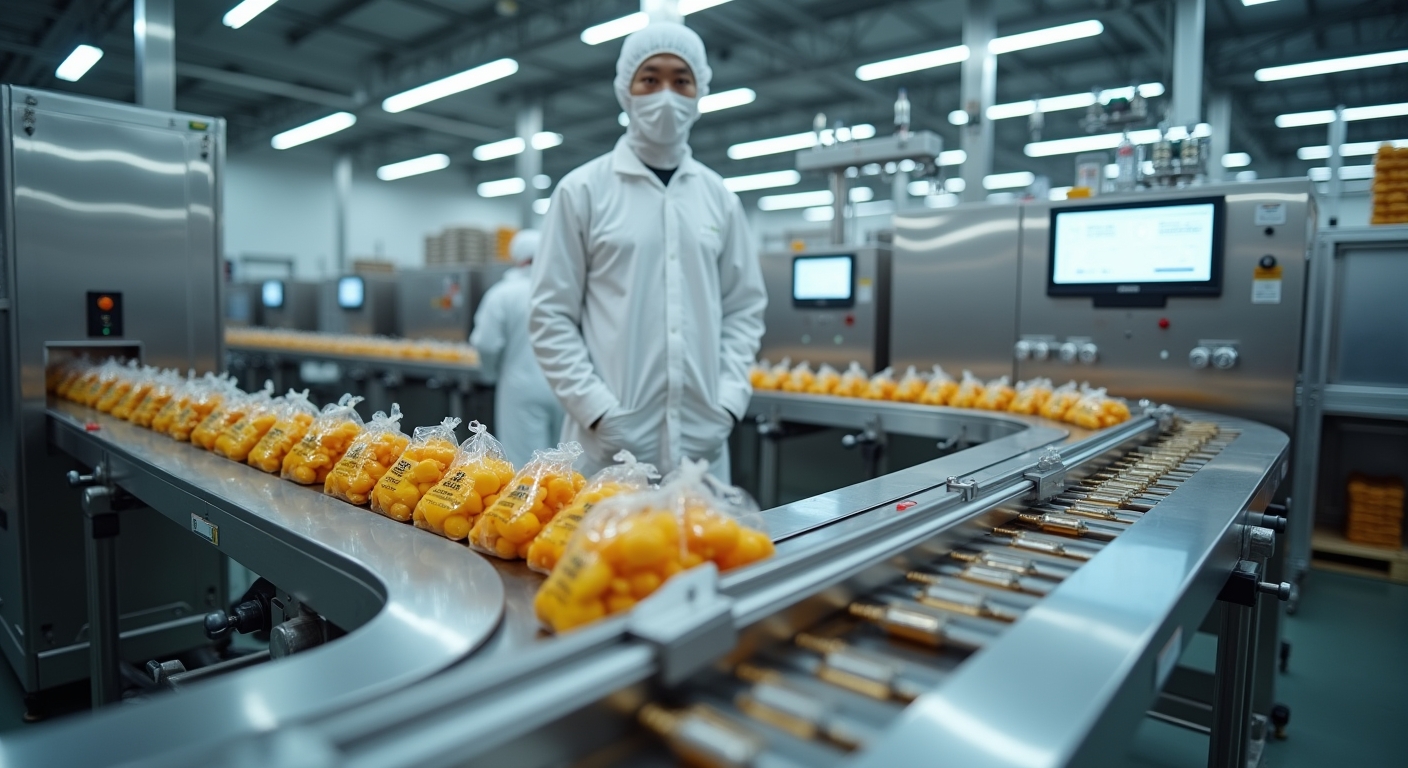
Food manufacturing Malaysia covers the industrial processing of ingredients into packaged, prepared or ready-to-sell food products for domestic and export markets. It includes everything from sauces and snacks to beverages, bakery products, frozen foods and contract manufacturing, making it an important sector for manufacturers, buyers and business decision-makers.
This guide explains how the industry works in practice, the main product segments, the equipment and operational systems commonly used, and the key issues businesses should assess before starting or expanding a food production operation.
What is the food manufacturing industry in Malaysia?
The food manufacturing industry in Malaysia is the group of factories and processing businesses that convert agricultural and imported ingredients into processed, packaged or shelf-ready food products. It spans small and medium enterprises, larger industrial producers, OEM and private label operations, and facilities focused on local distribution, retail supply, foodservice or export-oriented production.
In practical terms, the sector sits between raw material supply and the final market. Manufacturers buy ingredients, process them under controlled conditions, package them for storage and transport, and distribute them through wholesalers, retailers, restaurants or brand owners.
Why food manufacturing matters to Malaysia’s industrial economy
Food manufacturing plays a practical role in Malaysia’s broader industrial base because it turns raw or semi-processed materials into higher-value products that are easier to store, brand, transport and sell. This matters not only for large factories, but also for SME manufacturers that serve local retail, foodservice and niche product markets.
The sector supports domestic food supply by extending shelf life, improving convenience and allowing products to move through modern retail and distribution channels. A manufacturer can take ingredients that are seasonal, perishable or bulk-packed and convert them into products with more consistent quality and wider commercial reach.
It also creates linkages with related industries. Food factories depend on packaging suppliers, refrigeration and cold chain providers, machinery vendors, contract logistics operators, warehouse systems, labeling services and quality assurance practices. Because of that, growth in food processing Malaysia often affects a wider chain of industrial activity.
For businesses exploring the wider manufacturing landscape, this sector fits within the broader picture of Manufacturing Industries in Malaysia, where processing capability, logistics readiness and compliance discipline often determine competitiveness.
Major segments within food manufacturing Malaysia
The food manufacturing sector Malaysia is broad. A single definition does not capture the full range of products, factory models and supply chains involved. The easiest way to understand the industry is by looking at its main subsegments.
Processed and packaged foods
This is one of the most visible parts of the Malaysia food processing industry. It includes products such as snacks, sauces, condiments, canned foods, frozen items, instant foods, ready-to-eat meals and ready-to-cook products.
These businesses usually focus on consistency, shelf life, packaging performance and volume control. Their production lines may involve mixing, cooking, filling, sealing, cooling, freezing or retorting, depending on the product category. The commercial goal is to deliver a product that remains stable, safe and attractive through storage, transport and retail handling.
Processed food manufacturing Malaysia also includes contract production for brand owners that do not operate their own factories. In these cases, the manufacturer may handle formulation, processing, packaging and sometimes label application under agreed customer specifications.
Beverages and drink production
Beverage manufacturing covers bottled drinks, flavored beverages, dairy-based drinks, powdered beverages, functional drink products and other liquid or semi-liquid consumer formats. Compared with many dry food categories, beverage operations often place even greater emphasis on hygiene control, filling accuracy, container integrity and cleaning procedures.
Because liquids are sensitive to contamination, separation between preparation, filling and packaging areas can be important. Some beverage producers focus on house brands, while others operate as OEM food manufacturing partners for retailers, distributors or product marketers.
Packaging choice also has a strong effect on the process. A product packed in bottles, pouches, sachets or cartons may require different filling, sealing and handling systems even when the formulation is similar.
Bakery, confectionery and ingredient manufacturing
Bakery and confectionery production is another major part of food production Malaysia. This includes bread, cakes, biscuits, pastries, chocolates, sweets and snack-like baked products, along with ingredient manufacturing such as spice blends, premixes, fillings or food bases used by downstream producers.
These businesses often deal with formulation precision, dough or mixture consistency, baking or heating profiles, cooling control and packaging suited to texture retention. Ingredient processors also play an important role because they supply intermediate materials that other factories rely on for repeatable product quality.
In the wider manufacturing ecosystem, this segment connects primary processors, branded consumer goods manufacturers, foodservice suppliers and private label producers.
Halal and export-oriented food production
Halal food manufacturing Malaysia is commercially important because halal positioning can influence market access, brand trust and customer requirements across different buyer segments. For some businesses, halal readiness is part of serving the domestic market; for others, it is part of export preparation or contract manufacturing eligibility.
Export-oriented food production usually requires more than product demand alone. Manufacturers may need stronger documentation, tighter quality systems, more disciplined labeling control, better traceability and packaging suitable for longer distribution distances. Exact requirements can vary by product type and destination market, so food manufacturers in Malaysia should verify current obligations with the relevant authorities and certification bodies before making investment or market-entry decisions.
How food manufacturing works: from raw materials to finished products
At a factory level, food manufacturing follows a structured flow designed to protect product quality, safety and consistency. The exact process differs by product, but the typical sequence looks like this:
- Sourcing ingredients and materials
Manufacturers buy raw materials, additives where applicable, primary packaging and outer cartons from approved suppliers based on product needs and commercial terms. - Receiving and inspection
Ingredients and packaging are checked on arrival for condition, labeling, quantity and basic acceptance criteria before they enter production or storage. - Storage
Materials are stored under suitable conditions such as ambient, chilled, frozen or dry storage, depending on the product and material sensitivity. - Preparation
Ingredients may be washed, sorted, weighed, cut, blended, thawed or pre-treated before the main production stage begins. - Processing
The product is manufactured through operations such as mixing, cooking, baking, fermenting, drying, filling or freezing, depending on the category. - Packaging
Finished product is packed into pouches, bottles, trays, cans, bags or other formats designed for protection, transport and shelf presentation. - Labeling and coding
Products receive labels, date or batch coding and other required product identifiers so they can be distributed and traced correctly. - Quality checks
Manufacturers inspect product appearance, packaging integrity, batch consistency and other quality control points before release. - Warehousing
Released goods are stored in finished-goods areas under suitable conditions while awaiting dispatch. - Distribution
Products move through wholesalers, retailers, foodservice operators, distributors or export channels, sometimes with cold chain handling when required.
This step-by-step view helps explain why food factory Malaysia operations require coordination across procurement, production, hygiene, packaging and logistics rather than just a single processing line.
Core operations inside a food manufacturing facility
Behind the visible production line, a food plant depends on several core operational functions.
Production planning
Production planning aligns demand, ingredient availability, packaging stock, labor and machine time. In multi-product factories, sequencing matters because changing from one product to another can affect cleaning time, allergen risk, downtime and material waste.
Hygiene control
Hygiene control is not limited to cleaning floors or equipment. It includes personnel practices, traffic flow, sanitation routines, tool segregation and cleaning verification. In food processing, poor hygiene control can affect product safety, shelf life and customer confidence.
Batch consistency
Consistency means producing the same product result from batch to batch. This depends on reliable raw materials, measured formulations, controlled process conditions and clear work instructions. For branded food products, inconsistency can quickly create complaints or returns.
Maintenance and utilities
Food plants rely on utilities such as water, refrigeration, compressed air and power, while maintenance teams help keep processing and packaging equipment available for use. When key equipment stops unexpectedly, production schedules, storage conditions and delivery commitments can all be affected.
Workforce management
Labor capability matters because food operations often combine repetitive production tasks with procedures that must be followed exactly. Training, supervision, hygiene discipline and line coordination are especially important in facilities with manual packing, frequent changeovers or mixed-skill teams.
Traceability
Traceability is the ability to track ingredients, packaging and finished goods through the production process. In practical terms, it helps a manufacturer identify what was used in a batch, when it was produced and where it was sent. That matters for inventory control, complaint handling and corrective action.
Key equipment and systems commonly used in food factories
The equipment used in food manufacturing industry in Malaysia depends on the product category, production scale and packaging format. Even so, some equipment categories appear across many food plants.
| Equipment or system | What it does | Why it matters |
|---|---|---|
| Mixers and blenders | Combine ingredients into a uniform mixture | Supports product consistency and formulation control |
| Conveyors | Move materials or packs between stations | Improves flow and reduces manual handling |
| Filling machines | Dispense product into containers or packs | Important for volume control and line efficiency |
| Sealing systems | Close pouches, trays, cups or other packaging | Helps protect the product during storage and distribution |
| Chillers and freezers | Maintain low temperatures for products or ingredients | Supports shelf life and cold chain requirements |
| Metal detection or inspection systems | Check finished products before release | Part of product protection and quality control practices |
| Cleaning systems | Support sanitation of equipment and processing areas | Helps maintain hygiene between runs |
| Packaging lines | Pack, label and code products for shipment | Links production output to finished-goods readiness |
Equipment selection should be based on the product itself, not on general trends. A sauce manufacturer, frozen food producer and bakery line will each have different processing risks, cleaning needs, packaging requirements and space constraints. The right system is usually the one that fits the process flow, product characteristics and target output model without making operations unnecessarily complex.
Food safety, quality and compliance considerations
Food safety in food manufacturing Malaysia depends on disciplined process control rather than a single document or machine. Manufacturers need to understand their ingredients, control contamination risks, maintain hygiene, monitor key production steps and keep clear records of what was produced and how.
Quality management in this context includes:
- raw material acceptance and storage control
- cleaning and sanitation practices
- process consistency and batch documentation
- packaging integrity checks
- label accuracy and product identification
- allergen handling where relevant
- finished product release procedures
Labeling also matters because errors in ingredients, usage instructions, storage conditions or batch information can create commercial and compliance problems. The same applies to ingredient handling, especially where cross-contact risks, temperature sensitivity or shelf-life limitations are involved.
Businesses often refer to systems and terms such as GMP, HACCP, halal certification and other food safety frameworks when building their operating model. However, current regulatory obligations, certification requirements and terminology should be verified with the relevant Malaysian authorities and certification bodies before publication or implementation, since scope and application can vary by product category, process and market.
Common challenges in the food manufacturing industry
Food manufacturers in Malaysia operate in a sector where small process problems can quickly become commercial problems. Some of the most common challenges include the following.
Raw material variability
Ingredients do not always behave the same way from batch to batch. Moisture, texture, flavor strength, size and storage condition can all influence processing performance and final product consistency.
Shelf-life management
Products must remain stable long enough to move through warehousing, distribution and retail channels. This affects formulation, packaging choice, storage conditions and stock rotation.
Labor constraints
Many food plants still depend on manual handling, sorting, packing or rework tasks. Labor shortages, skill gaps or weak supervision can reduce throughput and increase inconsistency.
Utility and operating pressure
Food factories often rely heavily on refrigeration, heating, washing and controlled storage. When utilities become harder to manage, production planning and cost control also become more difficult.
Packaging requirements
Packaging is not just a marketing tool. It affects protection, shelf life, transport durability, sealing performance and storage efficiency. Changing packaging materials or formats can create unexpected line and quality issues.
Cold chain dependence
For chilled or frozen products, the supply chain must maintain suitable temperature control after production. Weak cold chain handling can undermine product quality even if factory processing was well controlled.
Demand forecasting
Food demand can shift due to seasonality, promotions, customer orders or changing consumer preferences. If forecasts are weak, manufacturers may face excess stock, ingredient waste or underutilized capacity.
Compliance workload
Documentation, labeling review, traceability, cleaning records and customer audits can create a significant administrative burden, especially for smaller businesses without dedicated quality teams.
Scaling without losing consistency
A product that works well at small scale may not behave the same way when production volume increases. Mixing, fill accuracy, cooling time, handling and packaging line performance may all need adjustment as the business grows.
Opportunities for growth and improvement
Despite the operational complexity, the food manufacturing supply chain Malaysia environment also creates clear opportunities for companies that improve control and differentiation.
Automation where it solves a real bottleneck
Automation can help reduce manual repetition, improve packing uniformity, support traceability and stabilize output. The strongest cases are usually where labor-intensive tasks, repetitive filling or end-of-line packaging are limiting throughput.
Better packaging strategy
Packaging improvement can reduce damage, strengthen shelf presentation and support longer distribution distances. For some businesses, packaging redesign is a more practical growth lever than adding a new processing line.
Private label and OEM partnerships
Private label manufacturing and OEM food manufacturing can help a factory use capacity more effectively, widen customer reach and build production experience across multiple product lines.
Digital traceability and production visibility
Basic digital systems for batch tracking, stock control, production records or maintenance planning can improve decision-making and reduce dependence on fragmented manual paperwork.
Product innovation and premium positioning
Growth does not always require a completely new plant. Some manufacturers expand through improved recipe development, healthier positioning, convenience formats, niche market targeting or better branding support for existing products.
Export readiness
For suitable product categories, export preparation can encourage stronger internal discipline around documentation, packaging, product stability and quality consistency. Exact market-entry requirements should always be checked against current destination-market rules and relevant authorities.
Stronger supply chain planning
Better supplier approval, inventory planning, cold chain coordination and packaging availability can improve service levels without major capital expansion. In many cases, operational planning creates as much value as new equipment investment.
What to consider before starting or expanding a food manufacturing business in Malaysia
Before launching or scaling a food manufacturing operation, business owners should assess the process as a full operating system rather than just a recipe or machine purchase. Key considerations include:
- Product category: Define whether the business will produce dry foods, chilled products, frozen items, beverages, bakery goods, sauces or another category, because each has different processing and storage needs.
- Target market: Clarify whether the products are meant for retail, foodservice, institutional customers, private label clients or export channels.
- Facility layout: Plan the movement of people, materials, waste and finished goods so production flow and hygiene practices can be managed properly.
- Sourcing reliability: Confirm whether key ingredients and packaging materials can be obtained consistently at the required quality level.
- Food safety planning: Build hygiene, documentation, cleaning, traceability and quality checks into the operating model from the start.
- Workforce needs: Assess staffing, supervision, training and the balance between manual work and automation.
- Packaging format: Choose packaging based on protection, shelf life, handling, storage and customer expectations, not appearance alone.
- Storage conditions: Determine whether the product requires ambient, chilled or frozen storage, and whether the same controls are needed during distribution.
- Distribution model: Decide how the product will move to market, including warehousing, transport, delivery frequency and cold chain responsibility where relevant.
- Compliance verification: Check all current licensing, food safety, labeling, halal and market-access requirements with the relevant authorities and certification bodies before investment or launch.
This checklist helps explain why starting a processed food business is usually less about buying one production line and more about building a reliable end-to-end system.
Frequently Asked Questions
What does the food manufacturing industry in Malaysia include?
It includes factories and processors that turn raw or semi-processed ingredients into packaged food products such as snacks, sauces, beverages, bakery items, frozen foods, canned foods and private label goods. The sector also includes supporting ingredient processors and contract manufacturers.
What are the main types of food products manufactured in Malaysia?
Common categories include processed and packaged foods, beverages, bakery products, confectionery, frozen items, ready-to-eat products, ready-to-cook products and food ingredients used by other manufacturers or foodservice businesses.
How does a food manufacturing process typically work?
A typical process starts with sourcing and receiving ingredients, followed by storage, preparation, processing, packaging, labeling, quality checks, warehousing and distribution. The sequence varies by product type, but the goal is always controlled, consistent and safe production.
What challenges do food manufacturers in Malaysia commonly face?
Common challenges include raw material variability, shelf-life control, labor constraints, packaging performance, cold chain dependence, utility pressure, fluctuating demand, documentation workload and maintaining consistent quality as production volume grows.
What should a company prepare before starting a food factory in Malaysia?
A company should define its product category, target market, factory layout, sourcing plan, food safety system, packaging approach, storage needs, distribution model and staffing requirements. It should also verify current compliance, labeling and certification requirements with the relevant authorities before launch.
Conclusion
The food manufacturing industry in Malaysia combines production, packaging, quality control and supply chain management in a way that requires careful coordination. Whether a business makes snacks, beverages, bakery goods or frozen foods, success depends on strong process control, reliable sourcing, practical compliance awareness and disciplined execution across the full operation.
For readers comparing this sector with other parts of the industrial economy, the broader Manufacturing Industries in Malaysia guide provides useful context on how different manufacturing segments operate and where food processing fits within the wider market.