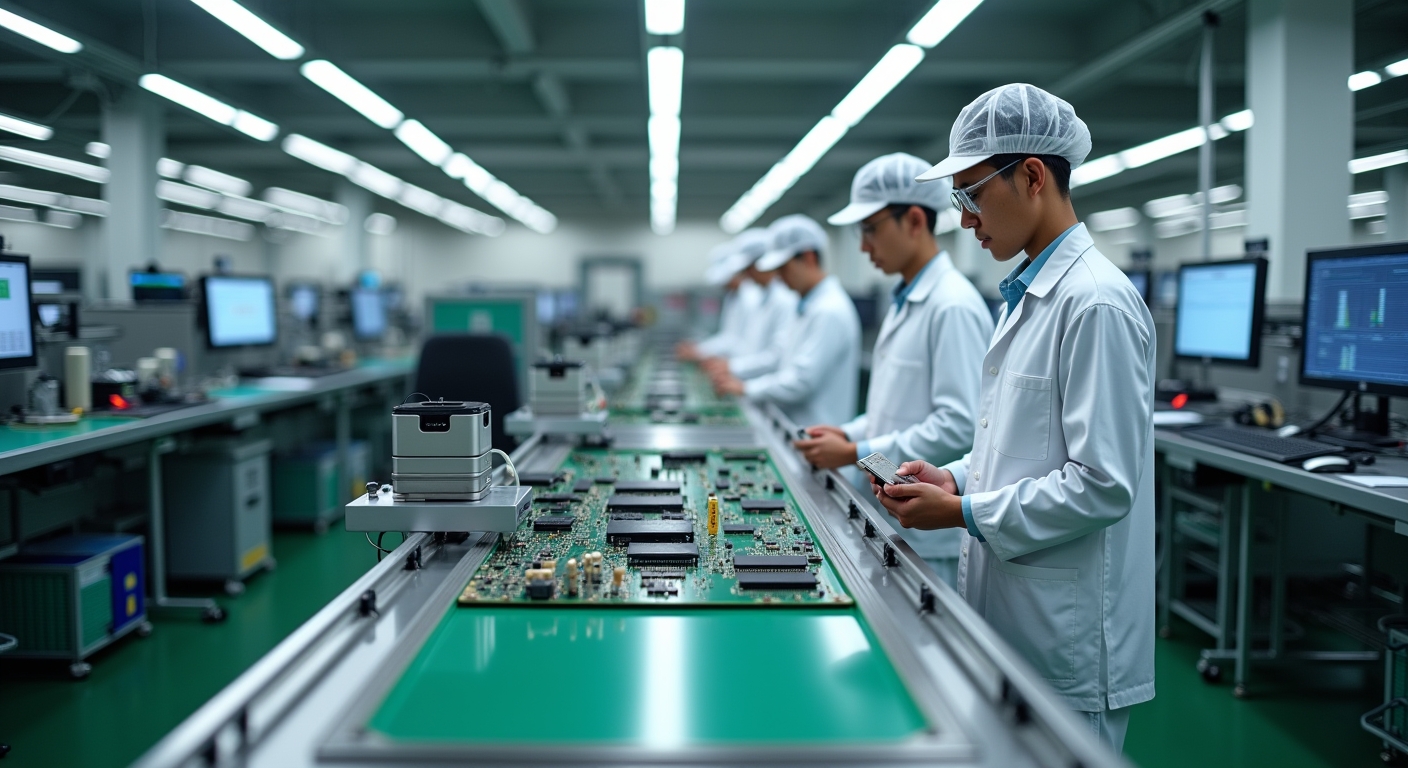
Electronics manufacturing Malaysia covers a broad set of activities, from component production and PCB assembly to testing, module integration, and finished device assembly. For businesses evaluating the sector, the key questions are usually practical: what the industry includes, how production works, which segments operate in Malaysia, and what to assess before selecting a manufacturing partner.
This guide explains the structure of the electronics industry Malaysia, the common processes used in electronics production, the industries it serves, and the operational issues that matter when planning sourcing, outsourcing, or expansion.
What is electronics manufacturing in Malaysia?
Electronics manufacturing in Malaysia is the production, assembly, testing, and packaging of electronic components, modules, and finished devices within the country. It can include component manufacturing, PCB assembly, electronic module integration, and end-product assembly, but it is broader than any single segment such as semiconductor fabrication or printed circuit board assembly alone.
In practice, the term can refer to several types of operations. Some companies focus on semiconductors or electronic components. Others provide electronics manufacturing services for customers that need PCB assembly Malaysia capabilities, product builds, testing support, or contract manufacturing. Still others assemble complete products for industrial, consumer, medical, or automotive applications.
That distinction matters because two facilities can both be described as an electronics factory Malaysia operation while having very different equipment, process controls, supply chain needs, and customer requirements.
Why Malaysia is a major base for electronics manufacturing
Malaysia is widely associated with electrical and electronics manufacturing Malaysia activities because the country has an established industrial base, long-running supplier relationships, and a business environment familiar with export-oriented production. While strengths differ by company and product segment, several practical factors explain why businesses look at Malaysia for electronics manufacturing.
- Established industrial ecosystems: Electronics operations tend to cluster around supporting suppliers, logistics providers, tooling services, testing capabilities, and technical labor pools.
- Regional supply chain integration: Many electronics businesses operate across multiple Asian locations, and Malaysia is often part of that wider production network.
- Experience with contract manufacturing: Buyers looking for EMS Malaysia providers or contract electronics manufacturing Malaysia partners often want manufacturers that can work with customer specifications, controlled documentation, and repeat production runs.
- Export readiness: Electronics production often depends on international sourcing and cross-border delivery, so manufacturers with experience in shipping, documentation, and customer quality expectations are valuable.
- Range of capabilities: The sector includes everything from components and semiconductor manufacturing Malaysia activities to PCB assembly, subsystem builds, and finished device assembly.
For readers exploring the broader manufacturing landscape, the parent guide to Manufacturing Industries in Malaysia provides wider industry context beyond electronics alone.
Key segments within the electronics manufacturing industry
The electronics industry is not one uniform activity. It includes several segments with different processes, equipment, quality expectations, and customer relationships. Understanding those segments helps businesses match their product needs to the right type of manufacturer.
Semiconductors and components
This segment focuses on the building blocks used in electronic products. It can include semiconductors, sensors, connectors, passive components, and other electronic parts that are later assembled into larger systems.
Semiconductor manufacturing is narrower and more specialized than the general electronics manufacturing process. Depending on the facility, it may involve wafer-related processes, packaging, testing, or other component-specific operations. These environments usually demand tighter process control, more specialized equipment, and highly controlled handling conditions than a standard product assembly line.
For sourcing teams, the important takeaway is that a company strong in component production is not automatically the right partner for full product assembly, just as a contract assembler may not have in-house semiconductor capabilities.
PCB assembly and electronic modules
PCB assembly Malaysia services are a core part of many electronics manufacturing services operations. PCB assembly means mounting electronic components onto a printed circuit board so the board can perform its intended electrical function.
This stage commonly includes component placement, soldering, inspection, testing, and in some cases integration into larger modules or subassemblies. A manufacturer may receive customer design files and bills of materials, source the approved components, assemble the boards, inspect workmanship, and perform functional checks before shipment.
Module assembly goes one step further by combining PCBs with cables, housings, connectors, displays, power elements, or mechanical parts into a more complete electronic unit.
Finished products and device assembly
At the finished-product level, electronics manufacturers in Malaysia may assemble complete items ready for distribution or for final integration into another system. This can include consumer products, industrial controls, telecommunications devices, automotive electronics, smart devices, medical electronics, or other application-specific equipment.
Finished assembly usually adds more complexity than board-level production because it may involve enclosure fitting, firmware loading, labeling, traceability records, final inspection, packaging, and customer-specific documentation. The manufacturer must also manage the interaction between electronic, mechanical, and sometimes software-related requirements.
How electronics manufacturing works
A typical electronics manufacturing process turns a product design or customer specification into assembled, tested, and packed goods through a controlled sequence of sourcing, assembly, inspection, and verification steps.
- Design transfer or production handover: The manufacturer receives drawings, bills of materials, assembly instructions, test requirements, and revision-controlled documents from the customer or design team.
- Materials planning and sourcing: Components, bare boards, connectors, housings, labels, and packaging are planned and procured according to approved specifications.
- Incoming inspection: Critical materials may be checked for quantity, identification, condition, and conformance before release to production.
- Board or product assembly: Components are placed and soldered onto boards, or assemblies are built into modules and finished products.
- In-process inspection: Operators or inspection systems check workmanship, component placement, solder quality, and assembly accuracy during production.
- Testing: Depending on the product, testing can include electrical checks, functional tests, programming, calibration-related steps, or reliability screening where relevant.
- Final assembly and packaging: Units are labeled, packed, documented, and prepared for storage, delivery, or export shipment.
- Shipment and traceability support: The manufacturer records batch, lot, or serial information so products can be tracked after delivery if required.
For non-engineers, the main point is simple: electronics production is not just putting parts together. It is a controlled workflow that combines documentation, sourcing, assembly discipline, inspection, and testing to reduce defects and maintain consistency.
Common processes used in electronics production
The exact process flow depends on whether the manufacturer is building components, populated boards, modules, or finished devices. Still, several processes appear frequently across E&E manufacturing Malaysia operations.
Surface-mount assembly
Surface-mount technology places small electronic components directly onto the surface of a printed circuit board. It is commonly used for compact, high-density assemblies and is a standard part of modern electronics production Malaysia environments.
Its value lies in supporting efficient component placement and consistent assembly for many board types. However, suitability depends on product design, component mix, and downstream testing requirements.
Through-hole assembly
Through-hole assembly inserts component leads through holes in the PCB before soldering. It is still used where mechanical strength, connector retention, or particular component types make it appropriate.
Some products use both surface-mount and through-hole methods in the same assembly, especially where power connections, large connectors, or mixed-technology designs are involved.
Soldering
Soldering creates the electrical and mechanical connection between the component and the board or wire. The quality of this step matters because weak, incomplete, or damaged joints can cause field failures, intermittent faults, or reliability problems.
From a buyer’s perspective, soldering quality is less about one specific technique and more about process control, operator discipline, equipment condition, and verification.
Inspection
Inspection is used to identify assembly defects before products move further into production or reach the customer. It may involve visual checks, magnification, automated inspection systems, or inspection steps placed at key stages of the process.
Common defects screened during inspection can include missing parts, wrong orientation, poor solder joints, damage, contamination, or labeling errors.
Functional testing
Functional testing checks whether the assembled board, module, or device performs its intended operation. This matters because an assembly can look acceptable visually but still fail electrically or functionally.
The depth of testing varies by product. Some items need only basic power-up verification, while others need more structured test routines, data capture, or customer-defined acceptance criteria.
Burn-in and reliability-related screening
In some applications, manufacturers may apply additional screening or controlled operating checks before release. This is more likely where product reliability is critical, though the exact approach depends on the end use and customer requirements.
It should not be assumed that every electronics manufacturer provides this capability as standard.
Final packaging
Final packaging in electronics manufacturing is not only about presentation. It often supports product protection, traceability, handling control, and shipment accuracy. For sensitive assemblies, packaging methods may also need to align with handling needs identified by the manufacturer or customer.
Industries served by electronics manufacturers in Malaysia
Electronics manufacturers in Malaysia serve a wide range of end markets. The mix varies from one company to another, and not every manufacturer is equipped for every product category.
- Industrial equipment: control boards, sensors, power-related assemblies, monitoring devices, and machine interface modules.
- Automotive electronics: assemblies used in vehicle systems, submodules, and supporting electronics, subject to customer and application requirements.
- Medical electronics: boards, modules, or devices for healthcare equipment, where documentation and product controls are often more demanding.
- Telecommunications: communication-related boards, network hardware subassemblies, and signal-processing modules.
- Consumer products: electronics for household use, personal devices, accessories, and smart connected products.
- Commercial and smart systems: displays, control units, security devices, metering products, and IoT-related hardware.
Capability differences matter here. A manufacturer suitable for consumer product volumes may not be the right fit for high-mix industrial builds, while a specialist in regulated or traceability-heavy sectors may not be optimized for low-cost mass-market production.
What businesses should evaluate before choosing an electronics manufacturer
Before choosing an electronics manufacturer in Malaysia, businesses should assess technical capability, quality controls, supply chain strength, testing support, traceability, communication discipline, and experience with products similar to their own.
- Production fit: Can the manufacturer handle your product type, build complexity, and expected volume?
- Engineering support: Can it support design transfer, manufacturability review, prototypes, and process refinement?
- Quality systems: Are processes documented, controlled, and consistently followed?
- Testing capability: Can the manufacturer perform the inspection and functional testing your product requires?
- Traceability: Can materials, revisions, and finished units be tracked adequately?
- Supply chain resilience: How does the company manage long-lead components, approved substitutes, and material disruptions?
- Lead times and planning: Can it support your scheduling, change control, and replenishment needs?
- Confidentiality and IP handling: How are drawings, files, firmware, and customer data controlled?
- Export and documentation experience: If products move across borders, can the manufacturer manage the required commercial and shipping documentation?
| Evaluation Area | What to Ask | Why It Matters |
|---|---|---|
| Product capability | Has the manufacturer built similar boards, modules, or devices before? | Past fit reduces ramp-up risk and avoidable process errors. |
| Prototype support | Can it handle pilot runs, engineering changes, and early-stage issues? | New products often require iteration before stable volume production. |
| Testing | What inspection and functional test methods are available? | Testing depth affects defect detection and shipment confidence. |
| Traceability | How are components, lots, revisions, and output records tracked? | Traceability supports quality investigations and controlled recalls if needed. |
| Supply chain | How are shortages, obsolete parts, and alternate sourcing handled? | Material disruptions can delay output or force redesign decisions. |
| Communication | How are deviations, yield issues, and engineering questions reported? | Clear communication helps customers react quickly and avoid hidden problems. |
For many buyers, the best selection process includes a technical review, sample or pilot build assessment, and a practical discussion about documentation, issue escalation, and supply continuity rather than relying on marketing claims alone.
Quality, compliance, and operational considerations
Quality in electronics manufacturing depends on repeatable processes, controlled materials, trained personnel, and clear documentation. Even when a product design is sound, poor execution in assembly or handling can create failures that only appear later in testing or field use.
Important operational considerations include:
- Process control: Work instructions, revision control, setup verification, and disciplined change management help maintain consistency.
- Component traceability: Recording material sources, lot information, and usage history helps support investigations when defects occur.
- ESD control: Electrostatic discharge can damage sensitive components, so controlled handling practices are commonly important in electronics factory environments.
- Inspection and test records: Documented results help prove that checks were completed and help identify recurring issues.
- Cleanliness and handling: Some assemblies are sensitive to contamination, moisture, or handling damage during production and storage.
- Product-specific compliance: Compliance expectations can vary by end market, customer contract, and export destination, so businesses should confirm the exact requirements for their product category.
Standards, certifications, and regulatory expectations differ significantly across medical, automotive, industrial, consumer, and export applications. They should be confirmed against the relevant customer, product, and market requirements instead of being assumed from general industry practice.
Challenges in electronics manufacturing
Electronics manufacturing offers strong opportunities, but it also comes with operational challenges that can affect cost, delivery, and product quality.
Component shortages and supply disruption
Electronic products often depend on many sourced parts from different suppliers. If even one critical component becomes unavailable, production can slow, stop, or require redesign and requalification work.
Demand volatility
Order patterns can change quickly, especially in sectors tied to product launches, customer projects, or export demand. Manufacturers need planning systems that can respond without losing control of inventory or production scheduling.
Yield management
Yield refers to the proportion of units that meet requirements without rework or rejection. In electronics production, yield can be affected by material quality, process settings, operator handling, design complexity, and test coverage.
Strong yield management matters because repeated defects can affect lead time, cost, and customer confidence even when the final shipment eventually passes inspection.
Obsolescence
Some electronic components have limited market life or may be replaced by newer versions. This creates planning pressure for long-life products, aftermarket support, and industries that require stable part availability over extended periods.
Logistics complexity
Electronics supply chain Malaysia operations often involve imported parts, controlled storage needs, and time-sensitive delivery windows. Coordinating inbound materials with outbound production schedules can be difficult when there are shipping delays or supplier changes.
How automation is shaping electronics manufacturing
Automation plays an important role in modern E&E manufacturing Malaysia environments because many electronics processes benefit from precision, repeatability, and consistent cycle control. This is especially relevant where products use small components, dense board layouts, or high-volume assembly flows.
In electronics manufacturing, automation may support:
- repeatable component placement
- controlled soldering-related steps
- automated optical or process inspection
- material handling between operations
- test execution and result recording
- traceability data capture
The practical benefit is not that automation replaces all manual work. Instead, it can improve consistency in tasks that are difficult to perform reliably by hand at scale. Manual operations still remain important in prototyping, selective assembly, rework, cable routing, mechanical integration, and quality review.
For buyers, the right question is not whether a factory is highly automated in general, but whether its level of automation matches the complexity, volume, and control needs of the product being built.
Is Malaysia a good fit for your electronics manufacturing needs?
Malaysia can be a strong fit for businesses that need access to an established electronics ecosystem, contract manufacturing experience, and integration with regional supply chains. The best fit depends less on broad country-level assumptions and more on aligning your product with the right manufacturer.
If your product needs stable documentation control, PCB and module assembly, export-ready operations, and coordinated supply chain management, electronics manufacturing Malaysia may offer suitable options. If your requirements involve specialized semiconductor processes, highly regulated end uses, or unusual testing demands, capability screening becomes even more important.
The practical takeaway is to define your product needs clearly first, then evaluate manufacturers based on process fit, technical support, quality discipline, and supply chain resilience rather than relying on broad labels such as EMS or contract manufacturer alone.
Frequently Asked Questions
What does electronics manufacturing in Malaysia include?
It can include component production, PCB assembly, module integration, product testing, final device assembly, packaging, and shipment support. The exact scope depends on the manufacturer, since some focus on components while others provide full electronics manufacturing services.
What is the difference between electronics manufacturing and semiconductor manufacturing?
Electronics manufacturing is a broad category covering the assembly and production of electronic parts, boards, modules, and finished products. Semiconductor manufacturing is a narrower, more specialized segment focused on chip-related or component-specific processes rather than general product assembly.
What types of products are commonly made by electronics manufacturers in Malaysia?
Common product categories include industrial electronics, automotive-related assemblies, telecommunications hardware, consumer devices, smart connected products, and some medical or commercial electronic systems. Actual capabilities vary by manufacturer.
How do companies choose the right electronics manufacturer in Malaysia?
They usually compare product fit, experience with similar builds, prototype support, quality systems, testing capability, traceability, supply chain management, communication practices, and ability to support the required production scale.
What quality factors matter most in electronics production?
Key factors include process control, component traceability, revision management, ESD handling, inspection discipline, test coverage, operator training, and complete production records. The importance of each factor depends on the product and end-use risk.
Why do global supply chains use Malaysia for electronics manufacturing?
Businesses often consider Malaysia because it is part of established regional electronics supply chains and offers a range of manufacturing capabilities, from components to assembly and export-oriented production support. The real advantage depends on the specific manufacturer and product segment involved.