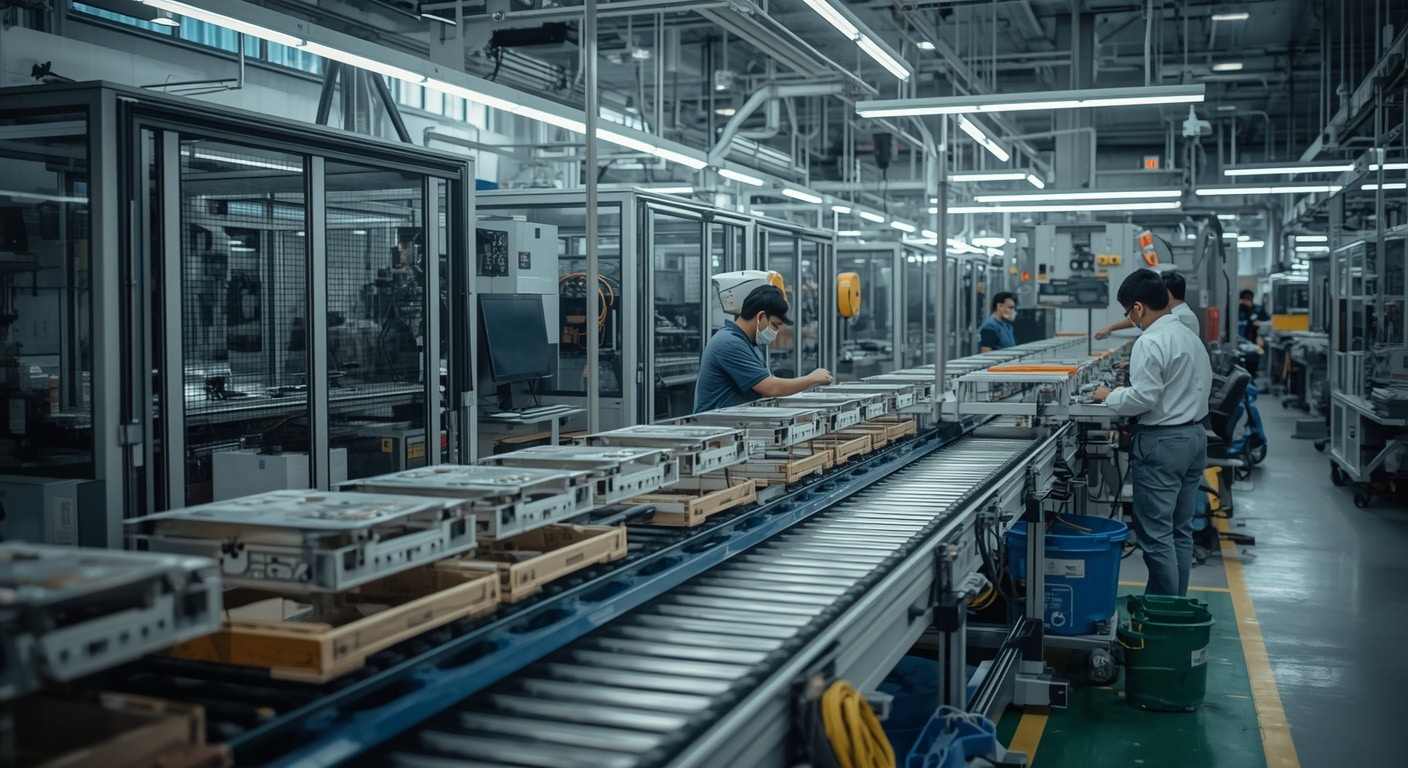
Production line balancing is the process of distributing work across stations so that each step can support the required output without creating a persistent bottleneck. In practical terms, it helps manufacturers align people, machines, and task times to improve flow, reduce waiting, and make production more predictable.
For factory teams, line balancing is not just an industrial engineering exercise. It affects daily output, operator utilization, work-in-progress levels, delivery reliability, and how much pressure the line faces during volume changes. This guide explains how production line balancing works, the key terms behind it, common warning signs of an unbalanced line, and practical ways to improve balance on the shop floor.
It also fits into the wider discipline of factory operations and production management guide, because balancing a line is closely connected to scheduling, capacity planning, standard work, and continuous improvement.
What Is Production Line Balancing?
Production line balancing is the process of assigning tasks across workstations so each station carries a suitable share of the total work content and the line can meet required output with minimal bottlenecks and idle time. The goal is smoother flow, more consistent throughput, and better use of labor and equipment.
In an assembly line or repetitive production environment, work is usually broken into a sequence of tasks. If too much work is concentrated at one station, that station slows the entire line. If too little work is assigned elsewhere, operators or machines wait unnecessarily. Assembly line balancing addresses this mismatch by adjusting how work is distributed.
A balanced line does not mean every station is perfectly identical. Real factories have process constraints, inspection points, machine dependencies, ergonomic limits, and product variation. Good production balancing means the line performs reliably under actual operating conditions, not only on paper.
Why Production Line Balancing Matters in Factory Operations
When a line is balanced well, material moves more smoothly from one stage to the next. Operators spend less time waiting, supervisors spend less time expediting, and output is easier to plan. When a line is unbalanced, even small mismatches in task time can create recurring disruption.
One overloaded workstation often becomes the bottleneck of the entire line. Downstream stations may stand idle because they are waiting for parts, while upstream stations keep building queue. This can increase work-in-progress, create congestion around certain processes, and make actual throughput lower than expected.
Balancing also matters because many factories manage output against daily schedules, customer orders, and delivery commitments. If one section of the line repeatedly falls behind, the factory may respond with overtime, rushed material handling, or last-minute rescheduling. Those actions can keep shipments moving in the short term, but they often increase operational instability.
Common operational benefits of line balancing include:
- more consistent output across the shift
- reduced idle time at underloaded stations
- better visibility of true bottlenecks
- less queue buildup between processes
- improved labor and equipment utilization
- more realistic production scheduling
- better support for throughput improvement efforts
In Malaysian factories as elsewhere, these issues are especially visible in environments such as electronics assembly, packaging, consumer goods production, metalworking support flow, and mixed-model manufacturing, where small timing differences can affect daily delivery performance.
How Production Line Balancing Works
At its core, production line balancing compares the amount of work required at each step against the output the factory needs to achieve. The aim is to spread work content across stations in a way that supports target cycle time while respecting process constraints.
- Define required output. Start with the production demand for a shift, day, or planning period.
- Break the process into tasks. Identify the individual work elements performed at each stage.
- Measure task times. Use actual observation to understand how long each task takes in normal operating conditions.
- Set the target cycle time. Compare task times against the pace needed to meet demand.
- Assign tasks across stations. Redistribute, combine, split, or sequence work so no station consistently exceeds the target.
- Review constraints and test. Check quality, safety, material flow, equipment limits, and operator practicality before confirming the new balance.
This logic sounds straightforward, but real results depend on how accurately the factory measures work and how realistically it handles constraints. A spreadsheet may suggest one arrangement, but the actual line may behave differently once product variation, machine recovery time, inspection activity, and operator movement are taken into account.
Key Terms You Need to Understand
Several terms are used repeatedly in line balancing discussions. They are related, but they are not interchangeable.
Cycle time
Cycle time is the time needed to complete one unit or one work cycle at a station or process. In workstation balancing, it is often used to compare how long each station takes relative to the target output pace.
Takt time
Takt time is the production pace required to match customer demand over the available production time. It answers the question: how often does the factory need to complete one unit to stay on schedule?
Bottleneck
A bottleneck is the step that limits total line output because it cannot process work as quickly as the rest of the line needs. If one station consistently takes longer than others, it usually governs overall throughput.
Idle time
Idle time is the time when an operator or machine is ready to work but is waiting because parts, information, or the previous process are not available. High idle time often signals an imbalance in the line.
Throughput
Throughput is the amount of finished output the line actually produces over a period of time. A line may have enough theoretical capacity, but poor balance can still reduce actual throughput.
Work content
Work content is the total amount of labor or process time required to complete all tasks for one unit. Production line balancing focuses on how that work content is distributed across stations.
Workstation
A workstation is the physical or logical point where a specific group of tasks is performed. This may be a manual station, a machine-based process, an inspection point, or a packaging position.
Line efficiency
Line efficiency is a general way of describing how effectively the line uses available time across stations relative to the output required. In practice, manufacturers look for lower waiting, better flow, and less mismatch between stations.
Understanding these terms helps teams talk about line balancing more clearly. For example, a station can have a long cycle time without necessarily being a permanent bottleneck if demand is low. Likewise, takt time may indicate the required pace, but actual balancing decisions must still consider real process capability.
Common Signs That a Production Line Is Unbalanced
An unbalanced line usually shows itself through visible operational symptoms. Common warning signs include:
- operators at some stations regularly waiting for incoming parts
- one station constantly overloaded while others finish early
- work-in-progress accumulating before the same process every shift
- downstream processes frequently starved of material
- missed output targets despite adequate staffing on paper
- supervisors repeatedly moving people to the same problem area
- frequent expediting, re-sequencing, or schedule recovery actions
- uneven operator utilization across the line
- overtime pressure caused by one recurring constraint
- material handling congestion around specific workstations
These signs do not always come from task allocation alone. Similar symptoms can also be caused by poor material supply, unstable machine performance, quality holds, or inconsistent work methods. That is why bottleneck analysis should be based on direct observation rather than assumptions.
Step-by-Step Process to Balance a Production Line
Balancing a production line works best when the team studies the real process under normal operating conditions. The following sequence is practical for many factories.
1. Map the process
Document the line in the order work is actually performed. Include manual tasks, machine cycles, inspection points, waiting points, and handoffs between stations. A simple process map often reveals that the formal route and the real route are not quite the same.
2. Measure actual task times
Observe each workstation and record the time required for key tasks. Use normal production conditions rather than idealized assumptions. If the product mix varies, note which tasks change by model, size, or configuration.
This step is critical because outdated standard times can hide current problems. A line that was balanced six months ago may no longer be balanced after engineering changes, staffing changes, or shifts in order mix.
3. Identify bottlenecks and constraints
Look for the process that repeatedly limits flow. Then separate the primary bottleneck from secondary symptoms. For example, a packing station may appear slow, but the real issue may be delayed replenishment or an upstream inspection release.
Also identify constraints such as:
- task sequence requirements
- equipment that cannot be moved
- quality checks that must remain at a specific point
- ergonomic considerations
- safety-related work limits
- space restrictions
4. Group or split tasks where feasible
Once the team understands the current work content distribution, it can evaluate whether tasks should be regrouped. In some cases, two short tasks can be combined at one station. In others, a long task can be split so part of it is performed earlier or later in the sequence.
The purpose is not to rearrange work just to make times look equal. The change must still support quality, operator practicality, and smooth flow.
5. Reassign labor or equipment
Some balancing improvements come from changing task ownership. A helper may be assigned to a constrained area during peak periods. A machine support activity may be shifted to a nearby station. Material presentation may be improved so operators spend less time walking or reaching.
In semi-automated lines, rebalancing may also involve changing the relationship between manual work and machine cycle time. Sometimes the issue is not the process itself, but how the operator interacts with it.
6. Test the new balance
Trial the revised arrangement under actual production conditions. Watch how the line behaves over enough time to see whether queues, waiting, and interruptions improve. A change that looks good during a short observation window may not hold over a full shift.
7. Monitor and adjust
Line balancing is rarely permanent. Review output, waiting patterns, WIP accumulation, and operator feedback after implementation. If product mix, demand, or process conditions shift, the line may need further adjustment.
In practice, balancing a production line is best treated as a repeating improvement cycle: observe, measure, adjust, verify, and standardize.
Factors That Affect Line Balancing Results
Production balancing often looks simpler in theory than in daily operations because real factories deal with variation. Even when task times have been measured carefully, several factors can affect results.
Product mix variation
If the line runs multiple models or product variants, the work content may change significantly from one unit to the next. A line balanced for one product family may become unstable when the mix shifts.
Changeovers and setup losses
Frequent model changes can interrupt rhythm and reduce effective capacity at specific stations. If setup activity is ignored, the line may appear balanced on paper but underperform in practice.
Operator skill differences
Not every operator works at exactly the same pace, especially on manual assembly or mixed-skill lines. Cross-training and standard work can reduce this variation, but it cannot be assumed away.
Machine downtime
Equipment interruptions can turn a non-critical station into a temporary bottleneck. A line balance that depends on a machine running consistently may be fragile if maintenance stability is weak.
Quality checks and rework loops
Inspection points, test steps, and occasional rework can change flow. If they are not considered during workstation balancing, queue buildup may continue even after tasks are redistributed.
Material supply interruptions
Lines do not run smoothly when parts arrive late, kits are incomplete, or replenishment frequency does not match consumption. In these cases, what looks like a line balancing problem may partly be a material flow problem.
Space and layout limitations
Some tasks cannot be moved easily because the layout, utilities, tools, or guarding arrangements are fixed. Physical constraints often limit how far a line can be rebalanced without broader process changes.
Safety and ergonomic requirements
A task should not be reassigned simply to equalize time if it creates excessive lifting, reaching, awkward motion, or unsafe operator movement. Sustainable line balancing must respect operational practicality.
These factors are why factory line balancing should not be treated as a purely mathematical exercise. The numbers matter, but so do the real conditions under which the line operates.
Production Line Balancing Methods and Approaches
Manufacturers use several approaches depending on process complexity, data quality, and available resources.
| Approach | How it works | Best used when | Limitations |
|---|---|---|---|
| Manual balancing using observation and spreadsheets | Supervisors or engineers observe tasks, record times, and compare station loads manually. | The line is relatively straightforward and the team wants a practical starting point. | Can miss hidden variation if the observation period is too short or data discipline is weak. |
| Time study-based balancing | Task elements are measured in more detail and then grouped into station assignments. | Task content is repetitive and the factory needs clearer standard work data. | Can become outdated if processes change and the time data is not maintained. |
| Takt-driven balancing | Workstations are arranged around the output pace needed to match demand. | Customer demand patterns strongly influence daily production rhythm. | Works best when demand assumptions and available time are realistic. |
| Software-assisted balancing | Digital tools help model task combinations, constraints, and alternative allocations. | The line is complex, has many task dependencies, or requires frequent scenario analysis. | Results still depend on accurate shop-floor data and practical validation. |
No single method is correct for every factory. A smaller manufacturer may improve line balancing substantially using careful observation, standard work review, and basic analysis. A more complex operation may benefit from more structured time study data or scenario modeling. The best choice depends on product complexity, volume stability, and how often the line changes.
Examples of Production Line Balancing in Different Manufacturing Settings
Line balancing issues appear differently depending on the manufacturing environment. The following examples show the concept in practical terms.
Assembly line
In a manual assembly line, one station may be responsible for both fitting a component and completing a detailed visual check. That station repeatedly falls behind while the next operator waits. The line can be rebalanced by moving the visual check to a nearby station, improving fixture access, or splitting part of the task into a support step performed earlier.
Packaging operation
In a packaging line, the packing station may seem slow, but observation shows the operator spends too much time reaching for cartons, labels, or inserts. The solution is not necessarily to add labor. Better material presentation and workstation layout may reduce non-value-added motion and bring the station closer to the rest of the line.
Machining support flow
In a machining environment, the machining centers may not be the only constraint. Deburring, inspection, cleaning, or staging for the next process may create uneven flow. Balancing the line can involve reorganizing support tasks, introducing parallel work for parts handling, or changing the sequence of inspection and transfer.
Electronics manufacturing
On an electronics line, test and verification activity can become the limiting step even when assembly itself appears balanced. The improvement may come from redistributing simple preparation tasks, standardizing handoff routines, or introducing parallel stations for work that does not need to be performed in a single sequence.
These examples show that production line balancing is not only about equalizing direct assembly time. It often involves reducing wasted motion, clarifying task ownership, and improving the way material and information reach each station.
Best Practices for Sustainable Line Balancing
A line can be balanced once and still drift out of balance later. Sustainable results usually depend on a few core operating disciplines.
Maintain standard work
Standard work helps ensure that task sequence, method, and expected time are understood consistently. Without it, the line may vary by shift, operator, or supervisor.
Use visual management
Simple visual controls can make imbalance easier to spot. WIP build-up, waiting zones, operator support calls, and hourly output tracking all help expose where flow is breaking down.
Review task times regularly
Task time data should be reviewed after process changes, engineering updates, tooling adjustments, or product redesigns. Old data is one of the most common reasons balancing decisions fail.
Cross-train operators
Cross-training gives supervisors more flexibility to respond to variation. If one area becomes constrained, trained operators can support it without causing disruption elsewhere.
Include operator feedback
Operators often know where time is lost, where material handling creates delay, or where tasks are difficult to perform consistently. Their input can reveal practical issues that are not obvious from a timing sheet alone.
Coordinate with maintenance
If a line depends on a machine that frequently stops, balancing work around it may not solve the root cause. Maintenance stability and line balancing should support each other.
Rebalance after meaningful change
Any change in demand, layout, process sequence, automation level, or product mix can affect balance. Review the line after these changes rather than assuming the old allocation still works.
The broader principle is simple: line balancing should be part of ongoing manufacturing workflow optimization, not a one-time project filed away after an improvement workshop.
Common Mistakes to Avoid
Even experienced teams can make line balancing decisions that look logical but do not hold up in operation.
Using outdated or idealized time data
If task times are based on old methods, uncommon product versions, or unusually smooth shifts, the new balance may fail immediately once real variation appears.
Ignoring quality requirements
Moving inspection or verification tasks without understanding their purpose can reduce apparent cycle time while creating downstream defects, rework, or escapes.
Overlooking ergonomics
Trying to reduce idle time by adding too many motions to one station can create fatigue, awkward reaching, or inconsistent work methods. A balanced line still needs to be workable for the operator.
Balancing only for average demand
If the line is balanced around a normal day but demand regularly spikes or product mix shifts, the arrangement may be too fragile. Teams should understand where the line becomes unstable.
Ignoring upstream and downstream effects
A station may appear overloaded because of poor material supply, poor scheduling sequence, or interruptions from earlier processes. Reassigning tasks alone will not fix those causes.
Skipping shop-floor validation
Changes made from office analysis alone can miss details such as walking distance, component orientation, tool sharing, or operator interference. Observing the real process is essential.
A useful rule is to treat every balancing change as a hypothesis until it has been tested under actual production conditions.
When to Rebalance a Production Line
Factories should review production line balancing whenever the work content, output requirement, or process constraints change materially.
Common trigger points include:
- new product introduction or product redesign
- significant volume increase or decrease
- recurring bottlenecks at the same process
- layout changes or workstation relocation
- automation upgrades or new equipment introduction
- staffing changes that alter skill coverage
- repeated missed delivery performance linked to line flow
- changes in inspection, testing, or packaging requirements
It is also sensible to review the line after repeated expediting, rising queue levels, or ongoing overtime at one section of the process. Those signs often indicate that the current task distribution no longer matches operational reality.
Not every review needs a major redesign. Sometimes a small change in task sequence, material presentation, support labor, or workstation balancing is enough to restore flow.
Frequently Asked Questions
What is production line balancing in manufacturing?
Production line balancing in manufacturing means distributing tasks across workstations so the line can meet required output without one station repeatedly constraining the rest. It is used to reduce bottlenecks, lower idle time, and improve workflow consistency.
What is the difference between cycle time and takt time?
Cycle time is how long a station or process takes to complete its work. Takt time is the pace required to meet customer demand within available production time. In simple terms, cycle time describes actual process speed, while takt time describes the target pace the line needs to achieve.
How do you identify a bottleneck on a production line?
Identify a bottleneck by observing where work repeatedly accumulates, where downstream stations regularly wait, and which process consistently limits throughput. The bottleneck is usually the step that cannot keep up with the rest of the line under normal operating conditions.
When should a factory rebalance its production line?
A factory should review and rebalance its line after product changes, demand shifts, layout changes, recurring bottlenecks, staffing changes, or automation upgrades. It is also worth reviewing when WIP builds up repeatedly or delivery performance starts slipping.
Can production line balancing improve output without adding new machines?
Yes, in many cases it can. Manufacturers often improve output by redistributing tasks, reducing waiting, improving material presentation, clarifying standard work, or resolving a bottleneck that is limiting flow. The result depends on the real cause of the constraint, but additional equipment is not always the first answer.
Conclusion
Production line balancing is an ongoing operational discipline that helps align work content with output needs. The practical approach is straightforward: measure the real work, identify the true bottleneck, redistribute tasks where feasible, test the new arrangement, and keep reviewing it as demand and processes change.
When manufacturers treat line balancing as part of daily factory management rather than a one-off exercise, they are more likely to improve flow, reduce idle time, and support more reliable throughput over time.