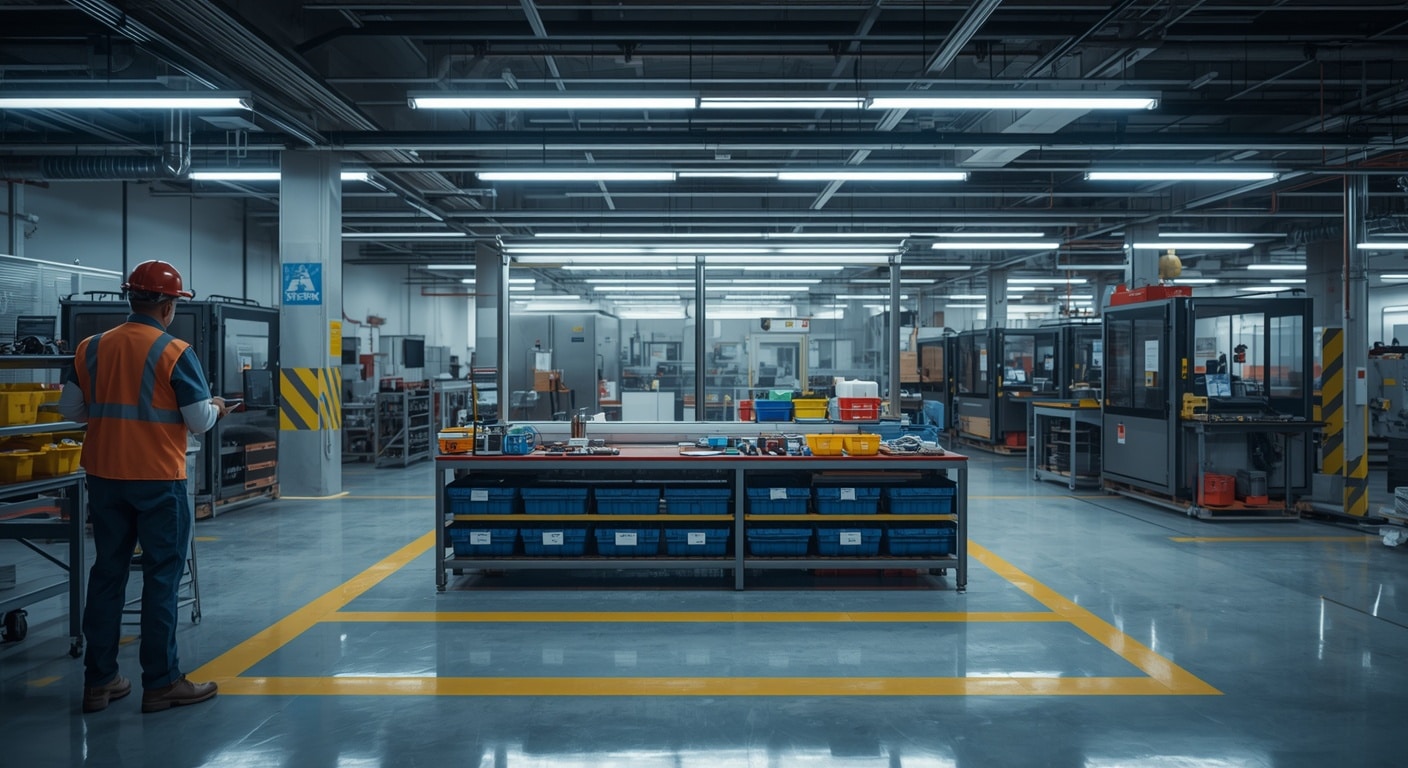
5S manufacturing is a practical workplace organization method used to create cleaner, safer and more efficient factory operations. It helps manufacturers control tools, materials, work areas and daily routines through five structured steps: Sort, Set in Order, Shine, Standardize and Sustain. When applied properly, 5S is not just housekeeping. It becomes part of how the shop floor is managed every day.
This guide explains what the 5S system means, how each step works in a factory, why it matters to production teams and how manufacturers can implement and sustain it in real operating conditions.
What is 5S manufacturing?
5S manufacturing is a workplace organization method that helps factories arrange materials, tools, equipment and work areas so they are easier to use, inspect and maintain. The five steps are Sort, Set in Order, Shine, Standardize and Sustain. Together, they improve order, efficiency, safety and consistency on the shop floor.
The method comes from five Japanese terms that are commonly translated into English as:
- Seiri – Sort
- Seiton – Set in Order
- Seiso – Shine
- Seiketsu – Standardize
- Shitsuke – Sustain
In manufacturing, 5S in manufacturing is often used as a foundation for visual management, standard work and continuous improvement. It gives teams a simple structure for deciding what belongs in a work area, where it should go, how it should be maintained and how the standard should be kept over time.
What are the 5S steps?
The five 5S steps create a practical sequence for improving workplace organization. Each step builds on the previous one, so the method works best when factories treat it as a system rather than as isolated activities.
| 5S Step | Purpose | Example on the Shop Floor |
|---|---|---|
| Sort | Remove unnecessary items from the area | Separate frequently used tools from broken, duplicate or unused items |
| Set in Order | Assign a clear location for every needed item | Use shadow boards, rack labels and marked floor locations for carts and bins |
| Shine | Clean the area and inspect while cleaning | Wipe machines, clear dust, remove spills and check for leaks or loose parts |
| Standardize | Create clear routines and visual standards | Use cleaning schedules, workstation layout photos and daily checklists |
| Sustain | Maintain the standard through discipline and review | Run regular audits, assign area ownership and include 5S in supervisor checks |
1. Sort
Sort means separating what is needed from what is not needed in a work area. On a production line, that may include old jigs, duplicate hand tools, damaged containers, excess paperwork, obsolete gauges or leftover materials from previous jobs.
The purpose is simple: if an item is not required for current work, it should not take up space next to the operator. A common factory practice is to place questionable items in a temporary holding area so the team can decide whether they should be reused, repaired, relocated or discarded.
2. Set in Order
Set in Order means placing necessary items where they are easiest to find, use and return. This is where visual management becomes visible on the shop floor. Tool positions are marked, material locations are labeled and movement paths are made clearer.
In a maintenance area, this might mean arranging spanners, screwdrivers and measuring tools by type and size. In a warehouse staging area, it may mean assigning fixed locations for incoming pallets, empty containers and finished goods awaiting transfer.
3. Shine
Shine means cleaning the workplace, but in manufacturing it also serves an inspection function. A clean machine is easier to check for oil leaks, loose fittings, unusual wear, contamination or blocked access points.
For that reason, Shine should not be treated as cosmetic cleaning alone. It is part of equipment care and workplace housekeeping in manufacturing. Operators and supervisors can often detect small issues earlier when the area is clean and orderly.
4. Standardize
Standardize means turning improved conditions into a repeatable routine. Without this step, one team may organize a workstation well while another uses a completely different method, creating inconsistency across shifts or production areas.
Standardization can include location labels, color coding, inspection checklists, workstation photos, cleaning responsibilities and simple standard operating instructions for 5S tasks. The goal is to make the expected condition obvious.
5. Sustain
Sustain means keeping 5S in place through daily discipline, not through occasional campaigns. This is usually the hardest step because it depends on habits, leadership follow-through and team ownership.
Factories that sustain 5S usually build it into shift routines, onboarding, supervisor walk-throughs and routine audits. When Sustain is weak, even a well-executed cleanup quickly slips back into disorder.
Why 5S matters in manufacturing operations
Manufacturing environments depend on repeatability, visibility and control. When work areas are cluttered, tools are misplaced or cleaning routines are unclear, small delays and errors accumulate across the day. 5S methodology gives factories a structured way to reduce that friction.
On a practical level, 5S matters because it helps teams:
- spend less time searching for tools, documents or materials
- make workstation layouts easier to understand
- improve visual control of normal versus abnormal conditions
- support better housekeeping and equipment care
- reduce confusion during shift changes or operator rotation
- create a stronger base for standard operating procedures and improvement work
It also improves readiness for broader improvement efforts. A cluttered, poorly controlled area makes it harder to introduce standard work, line balancing, visual boards or other lean manufacturing 5S practices. In that sense, 5S is often one of the first disciplines used to stabilize the workplace before more advanced operational improvement begins.
For readers looking at broader performance improvement topics, 5S fits naturally within a wider factory operations and production management guide.
Key benefits of 5S for factories
The benefits of 5S are easiest to understand when they are linked to day-to-day factory results rather than abstract theory. A strong 5S system improves how the workplace functions, how people work and how visible problems become.
Productivity and flow
When items are clearly located and only necessary materials remain in the area, operators waste less motion. They can retrieve tools faster, replenish consumables more smoothly and move around the workstation with fewer interruptions. This does not automatically solve all productivity issues, but it removes avoidable friction from routine work.
Quality and error reduction
Disorganized work areas increase the chance of mixing parts, using the wrong tool or overlooking missing items. Standard layouts and visual controls make abnormalities easier to detect. If every fixture, gauge and container has a defined place, missing or misplaced items stand out immediately.
Safety and housekeeping discipline
Clear walkways, stable storage, cleaner floors and obvious placement rules support a safer workplace. 5S does not replace formal safety management, but it supports a better safety culture by reducing clutter, confusion and poor housekeeping habits.
Training and cross-shift consistency
New operators and temporary staff learn faster in a standardized environment. When workstations are arranged consistently and simple visual standards exist, it is easier to train people on the expected setup and routine. This also helps maintain consistency across different shifts.
Equipment care and early problem detection
Shine encourages regular cleaning and inspection. During cleaning, operators may notice leaks, unusual vibration marks, loose guards, damaged cables or worn contact surfaces that might otherwise be ignored in a dirty area. This makes 5S useful for basic shop floor management and daily equipment care.
Better use of space
Factories often carry more items near the point of use than they actually need. Sorting unnecessary materials out of the area and assigning proper locations can free up floor space for movement, staging or safer access. This is especially valuable in SMEs, older industrial units and high-mix operations where space is tight.
How to implement 5S in a manufacturing environment
Successful 5S factory implementation works best when factories start with a controlled pilot rather than trying to transform every department at once. The process below is practical for assembly, machining, packaging, maintenance and warehouse-adjacent production areas.
- Select a pilot area. Choose a visible area with manageable scope, such as one line, one cell, one maintenance bench or one tool room.
- Document the current state. Take photos, list common problems and note wasted motion, clutter points and cleaning issues.
- Involve the people who work there. Operators, technicians and supervisors should help decide what is needed and how the area should function.
- Sort unnecessary items. Remove unused tools, excess materials, outdated documents and damaged storage items from the area.
- Set needed items in order. Define fixed locations, labels, markings and storage logic based on frequency of use and workflow.
- Clean and inspect. Restore the area to a controlled condition and identify any visible abnormalities while cleaning.
- Create standards. Establish photos, checklists, labels, responsibility lists and simple rules for maintaining the area.
- Assign ownership and review routines. Make 5S part of daily management through named ownership, audits and supervisor follow-up.
1. Choose a pilot area carefully
A pilot area should be important enough to show visible change, but small enough to manage properly. One workstation cluster, a packaging station, a machining cell or a spare parts counter often works better than a whole factory-wide launch.
The pilot should also have an owner. If nobody is clearly responsible for the area after the initial event, the gains are unlikely to last.
2. Capture the current condition
Before changing anything, record how the area looks and operates. This can include photos, simple sketches, item counts and notes from the team about recurring frustrations. Examples include searching for Allen keys, blocked access to bins, excess WIP containers or dirty machine bases.
This baseline helps the team focus on real problems instead of rearranging items without purpose.
3. Involve operators and technicians
5S works better when the people using the area help design it. They know which tools are used hourly, which materials should be at arm’s reach and which storage arrangements create unnecessary motion. A layout designed only by management may look tidy but be impractical in daily operation.
4. Remove what does not belong
During Sort, separate items into practical categories such as:
- needed daily
- needed occasionally
- shared with another area
- damaged or obsolete
- unclear ownership
Many factories use a temporary red-tag holding area for items that should be reviewed before final removal or relocation. The key point is to stop treating every item near the workstation as equally necessary.
5. Organize based on use and workflow
Set in Order should reflect how work is actually done. Frequently used hand tools should be closer than backup tools. Inspection items should be near the point of inspection. Cleaning tools should be easy to access, not hidden in a distant cabinet that discourages use.
Typical organizing methods include:
- shadow boards for common tools
- rack and shelf labels
- floor markings for carts, pallets and bins
- fixed drawer arrangements
- location codes for materials or components
- visual outlines for mobile equipment
6. Clean as part of control, not appearance
Shine should restore the area and make abnormalities visible. For example, while cleaning a machine, the team may identify a recurring coolant spill, loose panel fastener or damaged hose routing. Those observations are useful because they connect cleanliness to operational control.
Cleaning routines should be realistic. If the cleaning step takes too long, requires hard-to-reach supplies or is not assigned to anyone, it will not be sustained.
7. Standardize the expected condition
After the area has improved, document what “good” looks like. That may include:
- before-and-after layout photos
- daily or weekly cleaning checklists
- location names and labels
- minimum and maximum storage rules
- responsibility by shift or role
- simple visual instructions at the workstation
The aim is not to create paperwork for its own sake. It is to ensure everyone understands the same standard.
8. Build review into daily management
The final step is making 5S part of normal management. If the area is reviewed only during launch week, the discipline will fade. Supervisors should include 5S conditions in routine walk-throughs, and area owners should know what they are expected to maintain.
Practical 5S examples on the shop floor
Many manufacturers understand the concept of 5S but struggle to visualize what it looks like in practice. The examples below show how 5S workplace organization can be applied in typical factory settings.
Assembly area
- Shadow boards for screwdrivers, pliers and torque tools
- Clearly labeled component bins with fixed positions
- A photo standard showing correct workstation layout at shift start
- Separate locations for good parts, rework parts and empty containers
Machining cell
- Marked locations for chucks, fixtures, gauges and cutting tool holders
- Cleaning kits placed near the machine rather than stored remotely
- Daily chip removal and wipe-down checklist
- Defined storage for setup sheets and machine-specific documents
Packaging area
- Floor markings for cartons, pallets and finished goods staging
- Dedicated shelves for labels, tapes, knives and consumables
- Visual separation between current packaging materials and obsolete stock
- End-of-shift cleaning and reset routine
Maintenance bench or tool room
- Shadow boards for common maintenance tools
- Drawer labels by category and size
- Tagged area for broken tools awaiting repair or replacement
- Cleaning and return rule after each job
These examples are simple, but that is the point. Good 5S visual management should make the expected condition obvious without requiring long explanations.
Common 5S mistakes and why programs fail
Many 5S programs begin with enthusiasm and visible cleanup, then gradually lose discipline. Failure usually does not come from the concept itself. It comes from weak execution and poor follow-through.
Treating 5S as a one-time cleanup
If the program is launched as a cleaning campaign rather than a management system, the results are temporary. The area may look better for a week, but without standards and ownership it returns to its previous state.
Lack of leadership follow-through
Operators notice quickly whether supervisors and managers take 5S seriously. If leaders tolerate clutter, missing labels or incomplete cleaning routines, the message is clear: the standard is optional.
Poor employee involvement
When 5S is imposed without input from the people doing the work, layouts can become inconvenient and unrealistic. That often leads to workarounds, hidden storage and a gap between the displayed standard and actual practice.
Over-labeling without discipline
Labels and floor markings are useful, but they do not create control by themselves. A factory can have many visual indicators and still have poor 5S if items are not returned, cleaning is skipped or excess material keeps accumulating.
No audit routine
Without review, standards drift. Teams may gradually add extra bins, store temporary items permanently or stop completing cleaning checks. A simple audit cadence helps detect that drift early.
No connection to daily operations
5S should support production, maintenance and quality work. If it is treated as separate from actual operations, people often see it as extra work instead of as a way to make daily work easier and more reliable.
How to sustain 5S over time
Sustain is the step that determines whether 5S becomes part of factory culture or remains a short-lived initiative. Keeping standards in place requires routine, visibility and management discipline.
Factories can improve long-term 5S performance by focusing on the following practices:
- Assign clear ownership: each area should have a named owner, even if the work is shared across shifts.
- Use visual standards: photos, labels and simple checklists make it easier to see when the standard has slipped.
- Audit regularly: brief but consistent audits are usually better than rare, detailed reviews.
- Include 5S in onboarding: new staff should learn area standards from day one.
- Refresh training: short refresher sessions help reinforce why the discipline matters.
- Review problems, not just scores: when an area fails a check, the team should understand why and correct the cause.
Supervisor behavior matters here. If daily walk-throughs include questions about missing tools, overflowing bins, blocked aisles or incomplete cleaning routines, teams understand that 5S is part of normal shop floor organization. If those conditions are ignored, the standard weakens quickly.
5S audit checklist: what to review
A 5S audit checklist helps factories review whether workplace organization standards are actually being followed. It does not need to be complex. The best checklist is one that teams can use consistently and understand easily.
A basic 5S audit checklist often reviews:
- whether unnecessary items are present in the area
- whether tools and materials are in their assigned locations
- whether floors, machines and surfaces are clean
- whether labels, markings and visual controls are current and clear
- whether cleaning and inspection checklists are being completed
- whether the area matches the agreed standard layout
Simple checklist structure
A practical checklist can be grouped by the five S steps:
- Sort: Are unneeded items removed? Are questionable items separated for review?
- Set in Order: Does every required item have a defined location? Are items easy to find and return?
- Shine: Is the area clean? Are abnormalities visible and reported?
- Standardize: Are labels, photos and routines current? Is the standard clear to all shifts?
- Sustain: Are checks happening as planned? Is the team maintaining the condition without special reminders?
The purpose of an audit is not only scoring. It should prompt action when the standard is slipping and help managers understand where support or correction is needed.
5S and lean manufacturing: how they relate
5S is often described as a foundational lean practice, but it is not the same as lean manufacturing as a whole. Lean covers a wider operating philosophy focused on reducing waste, improving flow and supporting continuous improvement across the value stream. 5S supports that by creating a more organized and visible workplace.
| Topic | 5S | Lean Manufacturing |
|---|---|---|
| Main focus | Workplace organization and visual control | Overall waste reduction, flow and process improvement |
| Scope | Specific areas, workstations and routines | Broader production systems and value stream performance |
| Typical tools | Labels, shadow boards, cleaning routines, area standards | Standard work, pull systems, problem solving, flow improvement and other methods |
| Role | Foundation for stability and visibility | Wider operating approach for performance improvement |
In practice, 5S helps lean efforts work better because it supports:
- visual management
- standard work consistency
- faster detection of abnormalities
- cleaner, more stable work areas
- better readiness for Kaizen and continuous improvement activities
So the difference is not “5S versus lean” as competing methods. It is better understood as 5S being one practical part of a broader lean system.
Is 5S suitable for Malaysian manufacturers?
Yes. 5S can be useful for Malaysian manufacturers of different sizes because it addresses issues that are common across many factory settings: limited space, mixed production conditions, operator turnover, housekeeping discipline and the need for clearer visual control.
For SMEs, 5S offers a practical starting point because it can be introduced without major capital investment. It helps smaller factories gain better control over tools, materials and daily routines before taking on more complex improvement efforts.
For larger factories or export-oriented operations, 5S supports consistency across lines, shifts and departments. It can also be helpful where a workforce is multilingual, because visual standards such as labels, color coding and layout photos reduce reliance on long written instructions alone.
It is also suitable in mixed manual-automated environments. For example, even where production uses automated equipment, areas around changeover tools, consumables, cleaning supplies, material presentation and operator stations still benefit from structured shop floor organization.
The main requirement is not factory size or sector. It is management commitment to keeping the standard alive after the initial implementation.
Frequently Asked Questions
What does 5S stand for in manufacturing?
5S stands for Sort, Set in Order, Shine, Standardize and Sustain. These five steps are used to organize the workplace, control materials and tools, improve cleanliness and maintain consistent operating conditions.
How is 5S different from general housekeeping?
General housekeeping usually focuses on cleaning and tidiness. 5S is broader. It includes removing unnecessary items, creating fixed locations, establishing visual standards and maintaining those standards through routine discipline and audits.
What are the first steps to start 5S in a factory?
Start by choosing a pilot area, documenting current problems, involving the people who work there and sorting out unnecessary items. After that, organize what remains, clean the area and create simple standards for maintaining the improved condition.
How often should a 5S audit be done?
The right frequency depends on the area and how mature the system is. Many factories begin with frequent checks in pilot areas, then move to a routine cadence that supervisors and teams can maintain consistently. The key is regular follow-up, not occasional large audits.
Can small manufacturers apply 5S effectively?
Yes. Small manufacturers can often benefit quickly because tools, materials and space are usually used intensively. A simple 5S system can improve visibility, reduce wasted motion and make training easier without requiring a large or complex program.
Conclusion
5S manufacturing is a practical operating discipline that helps factories create order, improve visibility and support more consistent daily performance. Its value comes not from labels or cleanup alone, but from clear standards, shared ownership and routine follow-through.
For manufacturers that want stronger shop floor control, 5S is often one of the most useful places to start. It creates the basic conditions needed for cleaner operations, better visual management and broader continuous improvement across the factory.