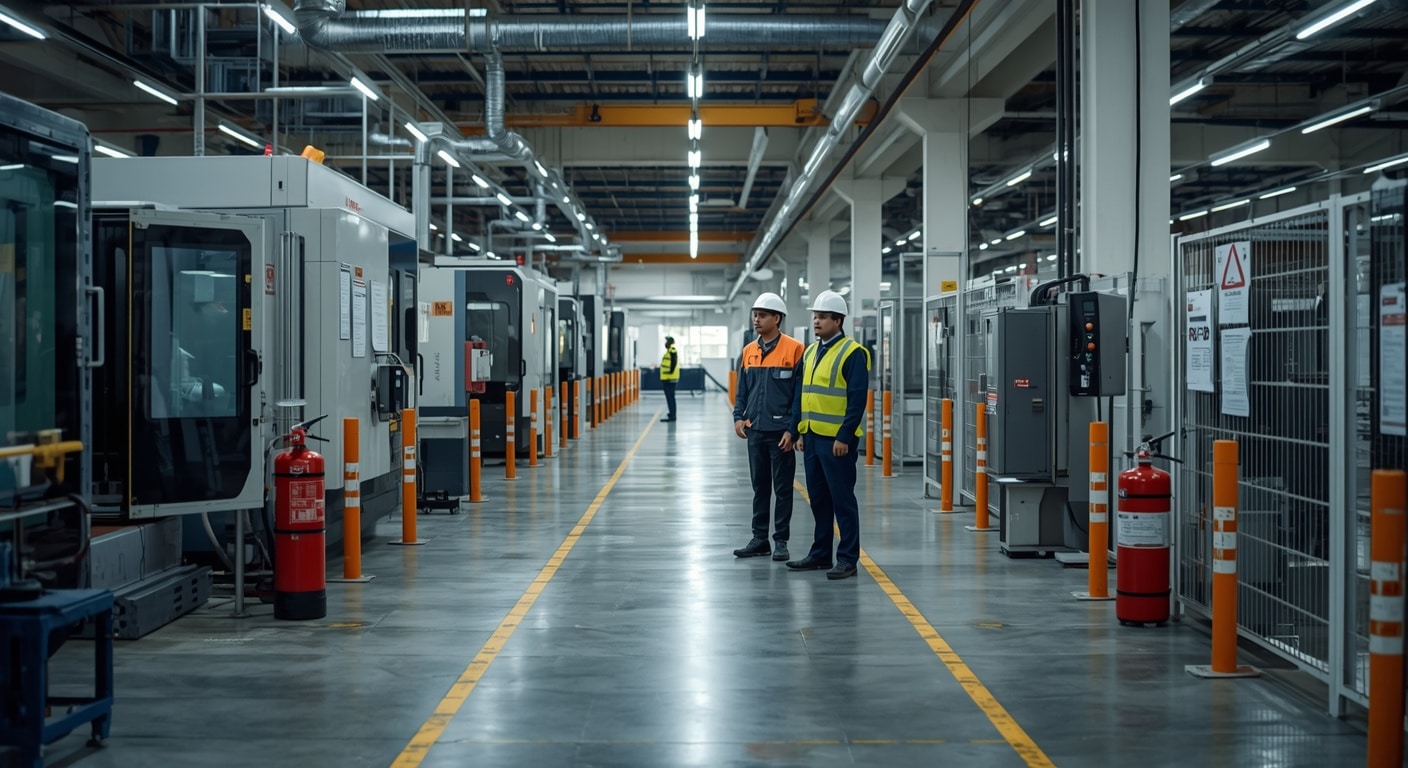
Factory safety compliance Malaysia generally means making sure a manufacturing workplace manages safety and health risks in a structured, documented and practical way. In broad terms, this includes maintaining safe systems of work, controlling hazards, training workers, keeping relevant records, and checking that site practices align with current applicable Malaysian requirements.
For manufacturers, safety compliance is not just about passing an inspection or preparing for an audit. It affects day-to-day operations, workforce confidence, downtime, equipment use, contractor control and incident response. Because legal duties can change and may depend on the factory’s activities, processes and risk profile, businesses should confirm current requirements with authoritative Malaysian sources before making compliance decisions.
This guide explains the main areas factories usually need to review, how to assess risks more systematically, what documents are commonly maintained, and practical steps manufacturers can take to improve workplace safety compliance. For a broader regulatory overview, see Manufacturing Regulations & Compliance in Malaysia.
What factory safety compliance in Malaysia means
Factory safety compliance in Malaysia refers to the practical process of identifying workplace hazards, controlling risks, training people, maintaining safe equipment and documenting safety activities so the factory operates in line with applicable occupational safety and health expectations.
In a manufacturing setting, this usually covers more than one issue. It can involve physical safety around machinery, chemical handling, emergency preparedness, worker competency, housekeeping, supervision and reporting processes. It also includes making sure safety responsibilities are understood at management, supervisory and shopfloor levels.
The exact scope will vary. A metal fabrication plant, food processing facility and electronics assembly operation do not face identical hazards. That is why manufacturing safety compliance should be treated as a management system that reflects actual site conditions, not as a generic checklist copied from another factory.
Why safety compliance matters for manufacturers
Good safety compliance protects people first, but it also supports more stable factory operations. When hazards are identified early and unsafe practices are corrected, manufacturers are less likely to face work disruptions caused by incidents, damaged equipment, unplanned stoppages or emergency investigations.
It also strengthens internal discipline. Factories with clear procedures, better supervision and consistent safety training often find it easier to maintain production routines, control contractor activity and manage changes in equipment or process layout.
From a business perspective, workplace safety compliance in Malaysia can also influence customer and supply chain confidence. Many buyers, especially those working with export-oriented manufacturers or regulated product sectors, want evidence that a supplier manages operational risk responsibly. That does not automatically mean every factory needs the same documents or certifications, but it does mean poor safety practices can create commercial friction.
Other practical benefits include:
- better readiness for internal or customer audits
- clearer accountability for supervisors and operators
- more reliable housekeeping and maintenance routines
- improved incident reporting and follow-up
- stronger worker awareness of hazards and controls
Safety compliance is therefore not separate from operational performance. In most factories, it is closely tied to consistency, reliability and management control.
The main compliance areas factories should review
Most factories need to review several core safety areas rather than focusing on only one visible issue such as PPE or signage. Applicable industrial safety requirements in Malaysia depend on the factory’s processes, equipment, materials and workforce exposure, but the following areas are commonly relevant.
Hazard identification and risk control
Every facility should understand what can cause harm, who may be exposed and what controls are already in place. This includes routine tasks, maintenance work, material handling, cleaning activities, contractor work and non-routine situations such as startup, shutdown or changeovers.
Machine safety
Machine safety compliance Malaysia concerns whether equipment can be used, cleaned and maintained without exposing people to avoidable danger. Key issues often include guarding, interlocks, emergency stops, safe access, isolation during maintenance and operator competence.
Electrical safety
Electrical risks can arise from exposed wiring, damaged plugs and cables, overloaded systems, poor maintenance practices or unsafe work near energised equipment. Factories should review both fixed installations and portable equipment use, especially in wet, hot or high-traffic areas.
Chemical handling and storage
Chemical safety manufacturing Malaysia may involve cleaning agents, solvents, production chemicals, gases, oils, coatings or laboratory materials. Manufacturers should review storage conditions, labelling, transfer procedures, worker handling practices, spill readiness and exposure controls appropriate to the materials used.
Personal protective equipment
PPE requirements factory Malaysia differ by task and hazard. Protective equipment is usually most effective when selected based on actual risk, issued properly, understood by users and supported by supervision. PPE should not be treated as the only control when a hazard can be reduced by engineering, guarding or process changes.
Housekeeping and traffic management
Poor housekeeping often signals broader control weaknesses. Spills, blocked walkways, unstable storage, unmanaged waste and mixed pedestrian-vehicle movement can increase incident risk quickly. Good housekeeping supports safer movement, clearer evacuation and better inspection outcomes.
Fire and emergency preparedness
Factories should review how they would respond to evacuation, fire, medical emergencies, utility failures or material spills where relevant. Emergency preparedness factory Malaysia is not just about equipment on the wall; it also depends on communication, roles, training and drills.
Ergonomics and manual handling
Not all factory injuries come from dramatic events. Repetitive tasks, awkward postures, lifting practices, workstation height, reach distance and forceful exertion can affect worker health and productivity over time. This area is often overlooked in fast-moving production environments.
Contractor safety
External contractors may introduce additional risk if permit controls, supervision, isolation arrangements or site rules are weak. Factories should define how contractors are inducted, monitored and separated from normal production activity where needed.
Incident reporting and corrective action
If near misses, unsafe conditions and actual incidents are not reported and reviewed properly, the same hazard can remain in place. A workable reporting process helps management identify patterns, assign corrective actions and check whether the root issue has been addressed.
How to assess factory safety risks systematically
A factory risk assessment Malaysia process should be simple enough to use consistently, but detailed enough to reflect real conditions on the shop floor. Many manufacturers use HIRARC as a commonly referenced framework, although businesses should confirm the current terminology and expectations used by relevant Malaysian authorities before formal adoption.
In practical terms, a systematic assessment process often looks like this:
- List work activities and locations. Break the factory into tasks, workstations, processes, maintenance points and support areas such as stores, loading zones and utilities.
- Identify hazards. Look for moving parts, hot surfaces, sharp edges, chemicals, electrical exposure, vehicle movement, confined access, ergonomic strain, noise, dust and unsafe behaviours.
- Decide who may be affected. Consider operators, technicians, cleaners, forklift drivers, office staff entering production areas, visitors and contractors.
- Evaluate the risk level. Review how serious the possible harm could be and how likely exposure is under normal or abnormal conditions.
- Choose controls in order of effectiveness. Prefer eliminating the hazard or reducing it through engineering and process measures before relying only on PPE or warning signs.
- Document findings. Record the hazard, current controls, additional actions needed, responsible person and review date.
- Implement and assign responsibility. Corrective actions should have clear owners, realistic timelines and follow-up.
- Review after change or incident. Reassess when equipment, layout, materials, staffing or production methods change, or after a near miss or accident.
This type of structured review helps prevent two common problems: generic assessments that do not reflect the real work, and one-time assessments that are never updated after process changes.
To keep the process useful, supervisors and operators should usually be involved. They often know where jams occur, where people bypass guards, where lifting is awkward or where temporary fixes have become normal practice.
Machine and equipment safety considerations
Machine risks are among the most serious issues in manufacturing environments, especially where rotating parts, cutting tools, conveyors, presses, mixers or automated handling systems are involved. A practical machine safety review should focus on how equipment is actually used, not just how it appears during a walk-through.
Guarding and access control
Machine guarding is intended to prevent contact with dangerous moving parts and reduce access to hazardous zones. Factories should review whether guards are present, properly positioned, securely fixed and compatible with production needs. Where guards are frequently removed or bypassed, the issue may indicate a poor design fit, weak supervision or inadequate maintenance planning.
Interlocks and emergency stops
Interlocks are features designed to help prevent operation when access points are open or safety conditions are not met. Emergency stops are meant to allow rapid shutdown in abnormal situations. In practice, factories should check whether these functions are accessible, known to operators and included in maintenance and inspection routines.
Isolation during maintenance
Many incidents happen during cleaning, setup, troubleshooting or repair rather than during normal production. For this reason, maintenance isolation matters as much as guarding. Lockout tagout practices are commonly used to control hazardous energy before work begins, but the exact approach should match the equipment and task. The important point is that isolation is planned, verified and understood by the people performing the work.
Safe operating procedures
Written procedures should explain normal operation, startup, shutdown, jam clearing, cleaning, changeover and abnormal condition response where relevant. A procedure is only useful if it reflects the actual machine and task sequence instead of repeating generic wording copied from another line.
Operator competency
Even well-designed equipment can become hazardous when operators are unfamiliar with controls, warning signals, tool changes or upset conditions. Training should cover what the machine does, what hazards exist, what protective measures are in place and what actions are prohibited.
Where complex or newly installed equipment is involved, factories may need support from qualified machine specialists or the equipment manufacturer to confirm safe operation, guarding approach and maintenance controls.
Workplace procedures, training and supervision
Procedures, training and supervision are the controls that connect management intent with actual behaviour on site. Without them, even a factory with reasonable physical safeguards may still have inconsistent safety performance.
Written procedures
Factories should document critical work methods for tasks that involve significant risk, complex sequencing or repeated operator judgment. These might include machine operation, material handling, chemical transfer, maintenance isolation, forklift movement, waste handling or emergency actions. Procedures should be clear, accessible and reviewed when process conditions change.
Induction and refresher training
Safety training for factory workers should begin before a person starts unsupervised work. Induction typically introduces site rules, reporting channels, emergency arrangements and area-specific hazards. Refresher training helps prevent drift, especially where staff turnover, process changes or recurring unsafe behaviour are observed.
Toolbox talks and short-form communication
Not all safety communication needs to be formal classroom training. Toolbox talks, pre-shift briefings and supervisor reminders can be useful for reinforcing seasonal risks, maintenance work, contractor presence, housekeeping expectations or lessons from recent incidents.
Permit and control systems where relevant
Some tasks involve higher risk or require stricter control before work starts. In those cases, manufacturers may use permit-based control systems or formal authorisation processes. The exact structure depends on the task, equipment and risk level, so factories should avoid adopting paperwork that adds complexity without improving control.
Contractor management
Contractors should not be treated as automatically familiar with site hazards. They often need induction, area restrictions, communication points, isolation coordination and monitoring while on site. Weak contractor control is a common source of preventable incidents during maintenance, installation and construction activity.
Supervision and accountability
Supervision is where procedures become real. Supervisors should know what safe work looks like, intervene when standards slip and escalate unresolved hazards instead of normalising unsafe conditions. Strong supervision also helps management detect whether training has actually been understood and applied.
Safety documents and records manufacturers should maintain
Safety documentation supports consistency, accountability and review. The exact records a factory needs can differ depending on its operations and current legal obligations, but manufacturers commonly maintain the following types of documents to support factory safety audit Malaysia readiness and internal control.
- Risk assessments for work activities, equipment, substances or departments
- Safe work procedures or work instructions for higher-risk tasks
- Training records including induction, refresher sessions and operator-specific instruction
- Inspection checklists for workplace conditions, safety devices, housekeeping or specific risk areas
- Maintenance records for machinery, safety-critical devices and corrective work
- Incident and near-miss reports with investigation notes and follow-up actions
- PPE issuance or control records where protective equipment is assigned or replaced
- Emergency drill records and response review notes
- Contractor control records such as induction confirmation or work approvals
- Chemical-related records where hazardous materials are used or stored
Documentation does not improve safety by itself. Its value comes from whether records are current, traceable and used in management review. A file full of outdated assessments or unread procedures can create false confidence.
| Document type | Why it matters |
|---|---|
| Risk assessment | Shows how hazards were identified and what controls were selected |
| Procedure or work instruction | Helps standardise how tasks are carried out safely |
| Training log | Provides evidence that workers were briefed or instructed |
| Inspection record | Tracks recurring issues such as housekeeping, guards or signage |
| Maintenance record | Supports follow-up on defects affecting safe operation |
| Incident report | Helps identify root causes and corrective actions |
| Emergency drill record | Shows whether response arrangements were tested and reviewed |
Emergency preparedness and incident response
Emergency preparedness should be designed around realistic scenarios, not only generic evacuation diagrams. A factory may need to think about fire, medical emergencies, equipment failure, utility loss, spills, release of fumes or other process-specific events.
A practical emergency response plan usually covers:
- how alarms or alerts are raised
- who coordinates the response
- evacuation routes and assembly arrangements
- first aid readiness and escalation steps
- communication with workers, visitors and contractors
- shutdown or isolation actions where safe to do so
- post-incident accounting, reporting and review
Drills can reveal issues that procedures alone do not show, such as blocked routes, unclear roles, missing contact details or slow communication between departments. Where chemicals or specialised processes are involved, spill response or process upset planning may also be relevant.
After an incident, the immediate response should be followed by review. Management should ask what happened, what controls failed, whether procedures were realistic and what action is needed to prevent recurrence. This is often where the real value of incident reporting is found.
Common factory safety compliance gaps
Many factories do not fail because they ignore safety completely. More often, gaps develop gradually as production pressure increases, staff change or old controls are not updated. Common factory safety compliance gaps include:
- outdated risk assessments that no longer match the current process or layout
- missing, damaged or bypassed machine guards
- poor housekeeping around walkways, storage areas or workstations
- inconsistent PPE use or PPE that does not suit the actual task
- unclear or outdated safety signage
- incomplete training records or weak refresher training
- maintenance delays affecting safe equipment operation
- weak contractor control during installation or repair work
- near misses not being reported or investigated
- procedures that exist on paper but are not followed in practice
This kind of checklist is useful for internal self-review because it focuses attention on the areas where everyday operational drift often appears first.
A practical step-by-step approach to improve compliance
For SMEs and operations managers, improving factory safety compliance is easiest when broken into clear steps rather than treated as a one-time project.
- Review applicable obligations. Start by identifying which current Malaysian safety and health requirements may apply to your factory, machinery, materials and workforce arrangements. Where uncertainty exists, verify with qualified advisers or relevant authorities.
- Inspect actual site conditions. Walk the facility, observe work, speak with supervisors and operators, and compare documented procedures with how tasks are really done.
- Prioritise high-risk gaps first. Focus early action on hazards with the greatest potential for serious harm or repeated exposure, such as machine access, isolation failures, chemical handling or emergency weaknesses.
- Update controls and procedures. Revise risk assessments, work instructions, signage, guarding arrangements, housekeeping rules or contractor controls so they reflect the current operation.
- Train the right people. Provide practical instruction to operators, supervisors, maintenance staff and contractors based on their actual tasks and exposure.
- Document what was done. Keep clear records of inspections, corrective actions, training, maintenance and incident follow-up.
- Monitor whether controls are working. Use routine inspections, supervisor checks, incident reviews and worker feedback to confirm that changes are being applied in practice.
- Schedule periodic reviews. Reassess after process changes, new equipment, incidents, layout changes or recurring non-conformities. Compliance is easier to maintain when review is built into normal management routines.
This approach is especially useful for smaller manufacturers that may not have a large in-house safety team. It turns compliance from a reactive exercise into a manageable operating process.
When to seek specialist advice or official guidance
Some safety issues can be handled internally through routine inspections and management review. Others need outside input because the risk, legal uncertainty or technical complexity is too high for assumptions.
Manufacturers should consider seeking specialist advice or official guidance when:
- introducing a new production line or major layout change
- installing complex or higher-risk machinery
- handling hazardous materials or unfamiliar substances
- investigating a serious incident or repeated near misses
- uncertain about the scope of current Malaysian compliance obligations
- reviewing whether existing documentation is adequate
- planning expansion, renovation or significant contractor work
Depending on the issue, this may involve qualified safety professionals, equipment specialists, legal advisers or the relevant Malaysian authority. The aim is not to outsource responsibility, but to confirm that important decisions are based on current and reliable guidance.
Final takeaway for Malaysian manufacturers
Factory safety compliance in Malaysia is best understood as an ongoing management process, not a one-off document exercise. Manufacturers need to identify hazards, control risk, train people, maintain equipment, keep meaningful records and review whether site practices still match the real operation.
The right approach is usually practical rather than complicated: focus on the highest-risk activities, correct obvious weaknesses, involve supervisors and operators, and update controls when the factory changes. Because legal and procedural expectations can evolve, manufacturers should always verify current requirements, terminology and documentation expectations with authoritative Malaysian sources before relying on any compliance checklist.
Frequently Asked Questions
What is factory safety compliance in Malaysia?
Factory safety compliance in Malaysia generally means managing workplace safety and health risks in line with applicable requirements. In practice, it includes identifying hazards, controlling risks, maintaining safe equipment, training workers, preparing for emergencies and keeping supporting records.
Which safety areas should a manufacturing facility review first?
A manufacturing facility should usually start with the highest-risk areas: hazard identification, machine safety, electrical safety, chemical handling, PPE use, housekeeping, emergency preparedness and incident reporting. The final priority should reflect the factory’s actual processes, equipment and exposure profile.
What documents are commonly used to support factory safety compliance?
Common examples include risk assessments, safe work procedures, training logs, inspection checklists, maintenance records, incident reports, PPE control records and emergency drill documentation. The exact records needed depend on the factory’s activities and current applicable obligations.
How often should a factory review its safety procedures and risk assessments?
There is no single review schedule that suits every factory. Reviews are commonly needed after process changes, new equipment installation, incidents, layout changes, staffing changes or when existing controls no longer reflect actual work conditions. Periodic scheduled review is also good practice.
When should a manufacturer seek external safety or compliance advice?
External advice is often appropriate when the factory is introducing complex machinery, handling hazardous materials, expanding operations, investigating serious incidents or unsure about legal scope, documentation expectations or risk controls. Where requirements are unclear, current guidance should be confirmed with the relevant authoritative source.