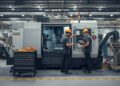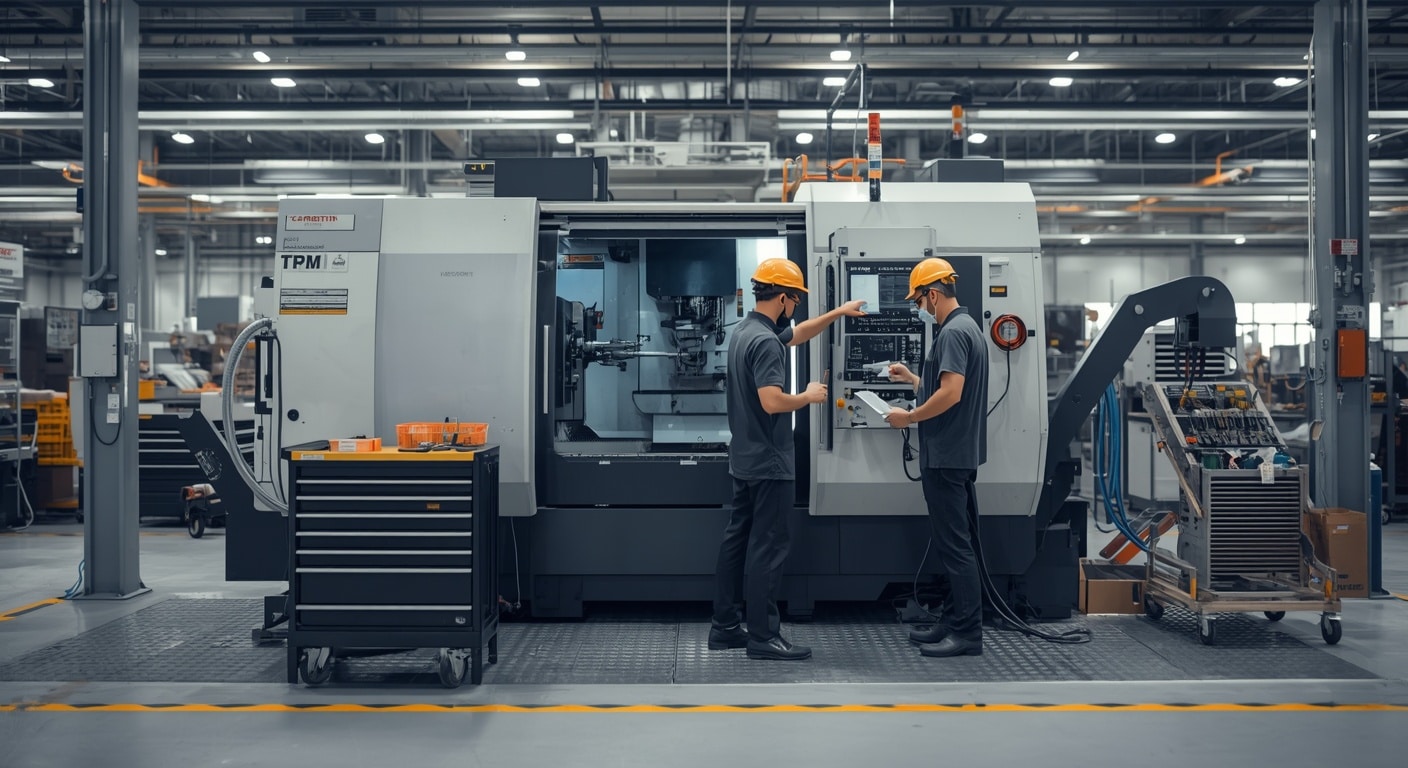
Total productive maintenance is a factory-wide approach to improving equipment reliability by involving operators, maintenance personnel, and management in routine care, problem-solving, and continuous improvement. Instead of treating maintenance as a separate department task, TPM connects production, maintenance, and quality to reduce downtime, prevent recurring equipment losses, and support more stable operations.
In practice, TPM in manufacturing is not just about fixing machines faster. It is about creating shared ownership of equipment, standardising basic care, identifying losses early, and building a maintenance system that supports production goals. For manufacturers reviewing broader operational improvement priorities, this sits naturally within a wider factory operations and production management guide.
What is total productive maintenance?
Total productive maintenance is a company-wide system for improving equipment performance through shared responsibility, routine care, planned maintenance, and continuous improvement. Its purpose is to reduce machine losses, improve equipment reliability, and involve both operators and maintenance teams in keeping production assets in better working condition.
The term TPM is often associated with lean manufacturing maintenance and continuous improvement programs. While naming and structure can vary by organisation, the core idea is consistent: equipment performance improves when maintenance is proactive, operators are engaged, and recurring problems are solved systematically.
Why total productive maintenance matters in factory operations
Many factories do not struggle only with major breakdowns. They also lose time and output through small stoppages, repeated adjustments, quality issues linked to equipment condition, delayed maintenance response, and unclear ownership of basic machine care. These losses can quietly affect delivery, labour efficiency, and customer consistency even when there is no dramatic failure.
Total productive maintenance is designed to address these operational gaps. It helps factories move from a reactive pattern, where people respond only after something goes wrong, to a more controlled system where potential issues are noticed earlier and routine tasks are clearly assigned.
This matters for several reasons:
- Unplanned downtime disrupts production flow. A single equipment issue can delay upstream and downstream processes.
- Inconsistent equipment condition affects quality. Wear, contamination, looseness, or poor settings can contribute to defects and rework.
- Maintenance teams become overloaded. When technicians spend most of their time on emergency work, planned improvement work often gets postponed.
- Operators may lack ownership. If production teams see maintenance as someone else’s job, small abnormal conditions can go unreported until they become larger problems.
- Management lacks visibility of real losses. Without structured tracking, recurring equipment problems may be treated as normal production variation.
For factory managers, engineers, and SME owners, TPM offers a practical way to connect maintenance discipline with production stability. It is especially useful where equipment reliability directly affects schedule adherence, output consistency, and product quality.
How total productive maintenance works
Total productive maintenance works by treating equipment care as a shared operating system rather than a standalone maintenance calendar. The goal is not only to schedule servicing, but to create day-to-day routines and cross-functional habits that prevent losses from building up.
At a high level, TPM usually includes the following elements:
- Shared responsibility: Operators, maintenance technicians, supervisors, and managers each have defined roles in equipment upkeep.
- Routine basic care: Cleaning, inspection, lubrication, tightening, and simple abnormality checks are done consistently.
- Structured maintenance planning: More technical maintenance work is planned based on intervals, operating history, or equipment condition.
- Root cause problem-solving: Teams investigate recurring breakdowns, defects, and small stops instead of repeatedly treating symptoms.
- Continuous improvement: The system is refined over time using actual performance data, operator feedback, and maintenance findings.
This is why TPM is broader than preventive maintenance alone. Preventive maintenance focuses mainly on scheduled servicing and replacement tasks. TPM includes that, but also adds operator involvement, loss analysis, skills development, and equipment-focused improvement across departments.
In a well-run TPM environment, production teams do not simply run the machine until it fails, and maintenance teams do not operate in isolation. Instead, there is a shared method for identifying early warning signs, reporting issues, following standards, and improving equipment reliability over time.
The core pillars of TPM
Factories commonly describe total productive maintenance through a set of TPM pillars. The exact presentation can vary by company or training framework, but the following pillars are widely referenced because they cover the main behaviours and systems needed to support equipment reliability.
Autonomous maintenance
Autonomous maintenance refers to routine equipment care carried out by operators. This usually includes cleaning, visual inspection, lubrication, basic tightening, and early issue detection.
The purpose is not to turn operators into maintenance technicians. It is to make sure the people closest to the machine can recognise abnormal conditions before they develop into larger failures. Oil leaks, unusual vibration, loose guards, contamination, worn hoses, or recurring minor jams are often easier to detect through regular operator attention than through occasional breakdown response.
Autonomous maintenance also improves equipment ownership. When operators understand how their daily actions affect equipment condition, TPM becomes part of production discipline rather than an extra maintenance instruction.
Planned maintenance
Planned maintenance covers scheduled maintenance activities performed at defined intervals or based on equipment condition, maintenance history, and operating patterns. It includes the more technical work that operators are not expected to do, such as component inspection, alignment, replacement planning, and deeper servicing tasks.
The aim is to reduce reactive work by organising maintenance before failure occurs. In mature systems, planned maintenance may use preventive maintenance schedules, condition-based checks, or predictive maintenance tools where appropriate. However, the basic principle remains the same: maintenance is prepared and prioritised instead of being driven mainly by emergency breakdowns.
Focused improvement
Focused improvement is a small-team effort to remove chronic losses and recurring equipment problems. Rather than accepting repeated stops, jams, defects, or long changeovers as normal, teams investigate root causes and implement practical corrective actions.
This can involve production, maintenance, engineering, and quality personnel working together on a specific problem area. For example, if a machine keeps stopping due to sensor contamination, focused improvement would not stop at repeated cleaning. It would ask why contamination builds up, whether shielding or access design can be improved, and how the condition can be prevented from recurring.
Quality maintenance
Quality maintenance connects equipment condition with product quality. Some defects are not caused by raw materials or operator error alone. They can result from worn tooling, unstable machine settings, contamination, inaccurate movement, temperature variation, or poor calibration.
Within TPM, quality maintenance means identifying which equipment conditions influence defects and controlling those conditions more deliberately. The goal is not only to repair machines after bad output has appeared, but to prevent defect causes linked to equipment performance.
Training and skills development
TPM depends on people knowing what to look for, what to do, and when to escalate. Training and skills development therefore support both operators and maintenance teams.
Operators may need training in routine care tasks, abnormality recognition, and basic machine function. Maintenance technicians may need stronger troubleshooting methods, planning discipline, and equipment-specific knowledge. Supervisors also need to understand how TPM routines should be reviewed and sustained.
Without capability building, TPM often becomes a paperwork exercise. Teams may complete checklists without really understanding equipment condition.
Early equipment management
Early equipment management applies TPM thinking to new machines, lines, or process changes. Instead of waiting until equipment is already difficult to maintain, factories consider maintainability, accessibility, cleanliness, and reliability during selection, installation, or modification.
For example, a machine may meet production requirements but create maintenance problems if inspection points are hard to reach or components are difficult to replace. Bringing maintenance and production input into early equipment decisions can reduce future downtime and simplify routine care.
Safety, health and environment
TPM should support safer and cleaner operations by keeping equipment in controlled condition, reducing leaks and abnormal states, and improving housekeeping around machines. A neglected machine is more likely to create unsafe situations, poor visibility of defects, and more difficult working conditions.
Specific safety, health, or environmental requirements can vary depending on the process, industry, equipment, and location, so factories should verify current obligations with the relevant authorities and internal compliance personnel where necessary. From an operational standpoint, TPM supports safety by making abnormal conditions more visible and by encouraging disciplined machine care.
Administrative or office TPM
TPM is not limited to the production floor. Support functions such as planning, purchasing, stores, engineering documentation, and reporting also affect equipment reliability.
If spare parts are poorly controlled, work orders are delayed, maintenance records are incomplete, or planning changes constantly disrupt scheduled maintenance windows, the technical team will struggle no matter how committed it is. Administrative or office TPM focuses on removing those support-process losses so that factory maintenance strategy can work more effectively.
TPM vs preventive maintenance: what is the difference?
Preventive maintenance is one important part of total productive maintenance, but it is not the whole system. Preventive maintenance focuses on scheduled work to reduce failures. TPM is broader and includes operator involvement, loss elimination, skills development, and cross-functional ownership of equipment performance.
| Aspect | Total Productive Maintenance | Preventive Maintenance |
|---|---|---|
| Scope | Factory-wide equipment improvement system | Scheduled maintenance program for equipment care |
| Ownership | Shared across operators, maintenance, supervisors, and management | Mainly handled by maintenance personnel |
| Main goal | Reduce multiple equipment-related losses and improve reliability, quality, and stability | Prevent breakdowns through planned servicing and replacement |
| Daily practices | Includes cleaning, inspection, reporting abnormalities, problem-solving, training, and improvement routines | Includes inspections, servicing, replacement, and scheduled maintenance tasks |
| Approach to recurring issues | Emphasises root cause analysis and continuous improvement | May address recurrence if built into the maintenance plan, but often focuses on task completion |
| Role of operators | Active involvement through autonomous maintenance and early issue detection | Usually limited unless the factory deliberately includes operator checks |
In simple terms, preventive maintenance asks, “What service should be scheduled?” TPM asks, “How does the whole factory prevent equipment-related losses?”
Key metrics used in TPM
TPM works best when factories measure actual equipment losses instead of relying on assumptions. The right metrics depend on the process, but several are commonly used to understand whether equipment reliability is improving.
- Downtime: Tracks how much production time is lost due to equipment stoppages.
- Breakdown frequency: Shows how often failures occur, which helps identify unstable assets.
- Minor stops and small interruptions: Highlights repeated disturbances that may not appear as major breakdowns but still reduce output.
- Defects linked to equipment condition: Helps connect maintenance performance with quality outcomes.
- Maintenance compliance: Monitors whether planned maintenance and routine checks are being completed as intended.
- Response and repair patterns: Useful for understanding whether technicians are trapped in emergency work.
- Overall Equipment Effectiveness (OEE): A broader measure often used to review availability, performance, and quality together.
OEE can be useful in TPM because it encourages teams to look beyond breakdowns alone. However, it should be interpreted carefully. A factory does not improve by chasing a generic OEE target. It improves by understanding which losses matter most on its own equipment and using a realistic baseline for comparison.
For that reason, factories should track trends over time on key assets rather than forcing every line into the same reporting model. A packaging machine, machining centre, and process line may each require different emphasis.
How to implement total productive maintenance in a factory
Factories do not need to launch TPM across every machine at once. A practical TPM implementation usually starts with one pilot area, clear routines, and visible problem-solving.
- Select pilot equipment or a pilot line. Choose an asset that has meaningful operational impact and recurring losses that the team can actually work on.
- Assess current losses. Review breakdown history, small stops, quality complaints linked to equipment condition, and maintenance workload patterns.
- Define roles and ownership. Clarify what operators will do daily, what maintenance technicians will do, and what supervisors will review.
- Standardise routine care tasks. Create simple standards for cleaning, inspection, lubrication, abnormality reporting, and escalation.
- Train the team. Make sure operators understand basic machine condition checks and technicians understand the expected maintenance planning and follow-up process.
- Track issues visibly. Record abnormalities, recurring problems, completed actions, and open items so that the team can see whether the system is working.
- Review results regularly. Use short review cycles to identify what is improving, what is repeatedly missed, and what root causes still need attention.
- Expand gradually. After stabilising the pilot area, apply the same TPM structure to other assets with appropriate adjustments.
A few practical points make implementation more realistic:
- Keep the first version simple enough for the team to sustain.
- Use checklists only where they support action, not paperwork for its own sake.
- Separate operator routine care from technical maintenance responsibilities.
- Focus on visible abnormality detection, not administrative form filling.
- Review real equipment losses, not just task completion percentages.
For SMEs, TPM implementation often works best when introduced as a disciplined operating method rather than a large transformation program. One stable, well-maintained machine area can build credibility faster than an ambitious factory-wide rollout that no one sustains.
Common TPM challenges and how to avoid them
TPM often sounds straightforward, but implementation can fail if the routines are unclear or the culture does not support them. Several problems appear repeatedly across factories.
Weak management support
If supervisors and managers treat TPM as an extra activity rather than part of normal operations, teams usually drop the routines when production pressure increases. The fix is to include TPM reviews in regular management follow-up, not as a side project.
Poor operator buy-in
Operators may resist autonomous maintenance if they believe extra tasks are being pushed onto them without explanation. This improves when management clearly defines the purpose, keeps tasks practical, and removes non-value-added paperwork.
Unclear ownership
Some factories launch TPM without defining who checks what, who repairs what, and who closes recurring issues. A basic responsibility matrix helps prevent confusion between production and maintenance teams.
Overcomplicated forms and standards
When teams spend more time filling out forms than improving equipment condition, TPM loses credibility. Use simple visual controls, clear standards, and short check routines that support actual action.
Lack of training
People cannot identify abnormal conditions if they have never been shown what normal looks like. Training should be practical, equipment-specific, and reinforced by supervisors on the shop floor.
Failure to sustain routines
Many factories begin strongly and then slowly return to reactive habits. Sustaining TPM requires regular audits of basic conditions, review of open abnormalities, and visible correction of missed tasks. The system must remain part of daily management, not a temporary campaign.
Where TPM fits in Malaysian manufacturing
For Malaysian manufacturers, total productive maintenance is relevant wherever equipment reliability affects delivery performance, export quality expectations, customer consistency, or labour productivity. This includes both larger factories and SMEs that depend on a limited number of critical machines.
In practice, local manufacturers often face a familiar challenge: production schedules leave little room for maintenance discipline until a machine starts causing major disruption. TPM helps address that by making machine care more routine, visible, and shared across functions.
It can be especially useful in operations where:
- a small number of machines create bottlenecks
- quality variation is linked to inconsistent equipment condition
- maintenance teams are constantly pulled into emergency work
- production and maintenance communication is weak
- growth has outpaced the factory’s original maintenance system
Not every manufacturer needs a formal TPM program with extensive terminology. But the underlying principles, such as operator involvement, planned maintenance, and focused improvement, are highly relevant to factories that want more stable output and fewer preventable equipment losses.
When TPM is a good fit and when another maintenance approach may be enough
Total productive maintenance is a good fit when equipment uptime, recurring minor losses, and production stability are major business issues. It is especially valuable when factories need stronger coordination between operators, maintenance technicians, and quality teams.
TPM is often a strong choice when:
- breakdowns and small stops are frequent
- equipment condition affects product quality
- operators currently have little role in machine care
- maintenance work is largely reactive
- management wants a more structured continuous improvement approach around equipment
However, a full TPM system may not be the first priority for every site. Some factories should begin by strengthening basic preventive maintenance discipline first. If work orders are inconsistent, maintenance records are weak, and routine servicing is not even being completed reliably, a simpler maintenance foundation may deliver better results before expanding into broader TPM elements.
In other words, TPM is not automatically the starting point. It is often the next step after a factory recognises that maintenance management in factories must move beyond emergency repairs and isolated service schedules.
Frequently Asked Questions
What does total productive maintenance mean in manufacturing?
In manufacturing, total productive maintenance means a structured approach to improving equipment reliability by involving operators, maintenance teams, and management in routine care, planned maintenance, and continuous improvement. The goal is to reduce downtime, stabilise production, and prevent equipment-related losses.
What are the main pillars of TPM?
Commonly referenced TPM pillars include autonomous maintenance, planned maintenance, focused improvement, quality maintenance, training and skills development, early equipment management, safety, health and environment, and administrative or office TPM. Companies may group or name these slightly differently, but the purpose is broadly similar.
How is TPM different from preventive maintenance?
Preventive maintenance is mainly a scheduled maintenance approach. TPM is broader. It includes preventive maintenance but also adds operator involvement, root cause problem-solving, equipment ownership, skills development, and cross-functional improvement of equipment performance.
Can small and medium factories use TPM?
Yes. Small and medium factories can use TPM by starting with one critical machine or process area, defining simple operator care tasks, improving maintenance planning, and solving recurring losses step by step. SMEs usually benefit from keeping the system practical rather than overly formal.
What metrics should a factory track for TPM?
A factory may track downtime, breakdown frequency, minor stops, maintenance compliance, defects linked to equipment condition, and OEE. The most useful metrics depend on the process, so factories should use their own baseline rather than generic benchmarks.
Who is responsible for TPM in a factory?
TPM is a shared responsibility. Operators handle routine care and early abnormality detection, maintenance technicians perform technical maintenance and repairs, supervisors review discipline and follow-up, and management provides direction, resources, and accountability.
Conclusion
Total productive maintenance is best understood as a practical system for improving equipment reliability through shared ownership, routine care, planned maintenance, and continuous improvement. Factories that apply TPM well do not succeed because they use the term itself. They succeed because they build clear routines, train their teams, solve recurring losses, and sustain equipment discipline over time.