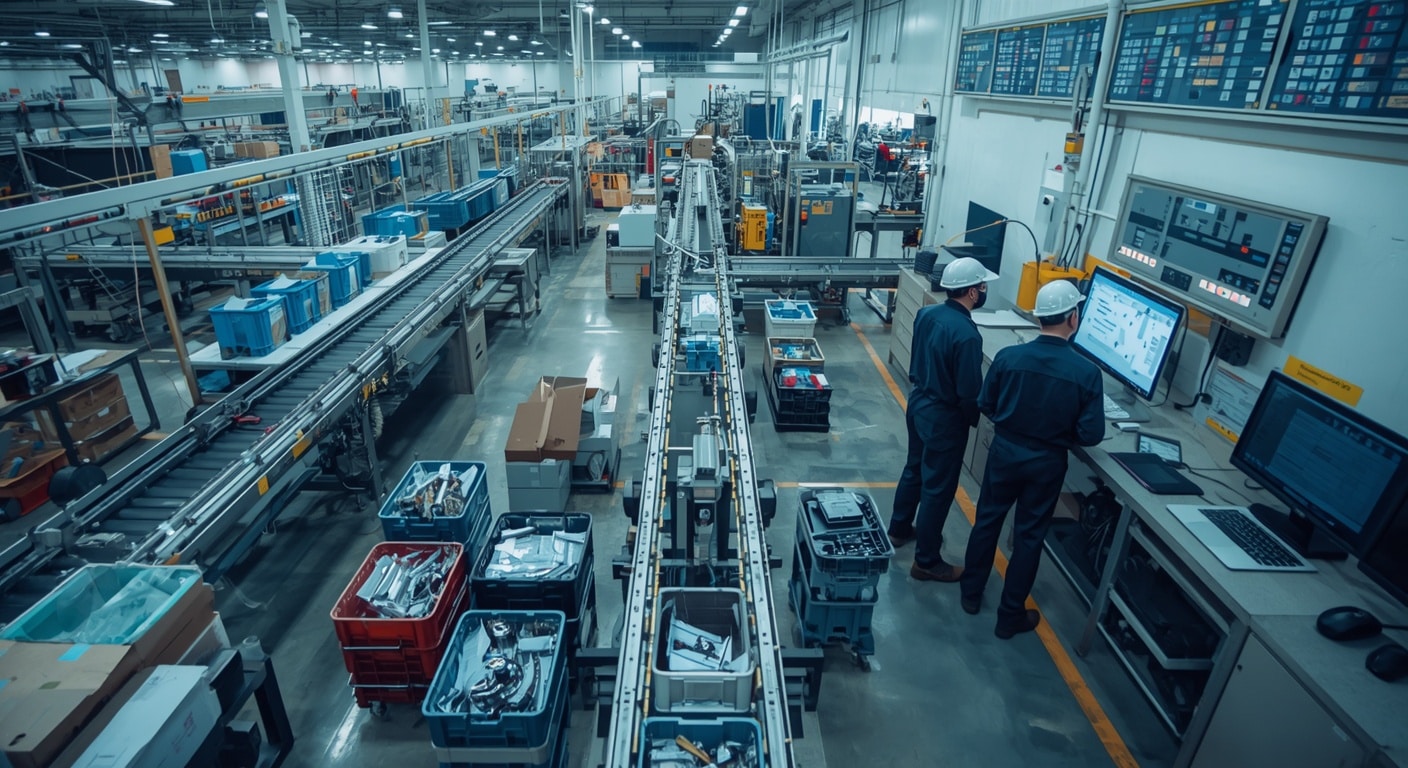
Production planning manufacturing is the process of deciding what a factory should make, how much it should produce, when each order should run and which materials, machines and people are needed to deliver it. In practice, it connects demand, inventory, capacity and shop floor timing so production can run in a controlled and realistic way.
Without a clear plan, factories often struggle with conflicting priorities, missed delivery dates, excess work-in-progress and constant rescheduling. A good planning process helps manufacturers translate sales demand into workable production instructions, then turn those instructions into schedules that the shop floor can actually execute.
This guide explains the basics of production planning and scheduling, the main steps involved, common methods, typical operating problems and practical ways manufacturers can improve day-to-day control.
What Is Production Planning in Manufacturing?
Production planning in manufacturing is the structured process of deciding what to produce, how much to produce, when to produce it and what resources are required. It brings together demand, materials, labour, machine capacity and delivery commitments so a factory can release work in an organized and realistic sequence.
In simple terms, manufacturing production planning sits between customer demand and shop floor execution. It converts sales forecasts and orders into a practical plan that purchasing, stores, production, quality and logistics can all work from.
This usually involves:
- reviewing expected demand and confirmed orders
- checking raw material and component availability
- assessing machine and labour capacity
- preparing work orders and routing information
- setting production priorities
- coordinating timing with delivery targets
Production planning and control works best when it is treated as an ongoing process rather than a one-time document. Orders change, materials arrive late, machines go down and urgent jobs appear. A useful plan must therefore be stable enough to guide operations but flexible enough to adjust when factory conditions change.
Production Planning vs Production Scheduling: What Is the Difference?
Production planning is the broader process of aligning demand, materials and capacity. Production scheduling is the detailed task of deciding the exact timing and sequence of jobs on the shop floor.
| Aspect | Production Planning | Production Scheduling |
|---|---|---|
| Scope | Overall production requirements and resource alignment | Detailed timing and job sequence |
| Timeframe | Usually medium-term to short-term | Usually short-term and day-to-day |
| Main focus | What to make, how much, and what is needed | When each job runs and in what order |
| Typical outputs | Production plan, capacity view, material requirements, work order release priorities | Machine schedule, line schedule, shift plan, dispatch list |
| Main users | Planners, production managers, purchasing, operations teams | Supervisors, planners, shop floor coordinators, line leaders |
A useful way to think about the difference is this: planning decides the overall path, while scheduling decides the precise timing. A factory may have a sound monthly plan, but if daily shop floor scheduling is weak, jobs can still miss deadlines. The opposite is also true. A detailed schedule cannot work if the underlying plan ignored material shortages or capacity limits.
Why Production Planning Matters in Manufacturing Operations
Production planning matters because it improves operational control. Factories rarely fail because people do not work hard enough; they fail because priorities, materials and capacity are not aligned.
When production planning is done well, manufacturers can:
- use machines and labour more effectively
- reduce avoidable waiting time between processes
- improve on-time delivery performance
- limit excess inventory and unnecessary work-in-progress
- spot bottlenecks earlier
- coordinate purchasing, stores, production and dispatch more clearly
- respond to customer changes with less disruption
It also supports better decision-making. For example, if a planner can see that a key machine is already fully loaded, the business can decide whether to move work, split batches, subcontract a step or negotiate a later delivery date before the order becomes late.
In many factories, production workflow planning also improves communication. Sales understands what capacity is available. Purchasing knows what materials must arrive first. Supervisors know which orders have true priority. Quality teams can plan inspections within the production flow instead of reacting at the last minute.
For readers looking at the wider operating picture, the Factory Operations & Production Management Guide provides broader context on how planning fits into overall factory performance.
The Main Steps in the Production Planning Process
A practical production planning process usually follows these steps:
- Review demand: Gather sales forecasts, confirmed orders and customer due dates.
- Set priorities: Decide which orders must run first based on delivery commitments, customer importance and production constraints.
- Check material availability: Confirm whether raw materials, components and packaging are available or still inbound.
- Assess capacity: Review machine time, labour availability, shift patterns and known downtime.
- Prepare routing and work orders: Define the production steps, work centres and instructions needed for each job.
- Create the schedule: Sequence jobs by machine, line or process based on capacity and due dates.
- Monitor execution: Track actual progress on the shop floor against the plan.
- Adjust when needed: Reschedule when orders change, materials are delayed or bottlenecks appear.
Although the production planning process looks straightforward on paper, execution depends on data quality and coordination. A schedule built on outdated inventory balances or unrealistic cycle assumptions will create confusion instead of control.
Key Inputs Needed for Effective Production Planning
Reliable planning starts with reliable inputs. Even experienced planners struggle when the information they receive is incomplete, late or inaccurate.
Demand Forecasts, Sales Orders and Customer Deadlines
Demand is the starting point for any production plan. Some factories rely heavily on forecasts because they produce standard items for stock. Others work mainly from confirmed customer orders because they build to order or customize output.
In a make-to-stock environment, forecast accuracy helps determine how much inventory the business should produce before actual orders arrive. In a make-to-order environment, confirmed order details and delivery deadlines usually carry more weight than forecast volumes.
Planners need to understand:
- which demand is forecasted and which is confirmed
- the promised delivery dates
- whether partial shipment is acceptable
- which orders are firm and which may still change
- which products or customers carry higher priority
When these details are unclear, production sequencing often becomes reactive. The result is frequent schedule changes and unnecessary firefighting.
Bills of Materials, Inventory and Material Availability
A bill of materials, or BOM, lists the raw materials, components and subassemblies needed to make a product. If the BOM is inaccurate, the production plan may call for work that cannot actually be completed.
Inventory visibility matters just as much. Planners need confidence in stock records, incoming material status and supplier lead times. A plan may appear feasible in the system, but if the physical stock is short, blocked for quality reasons or already allocated elsewhere, the schedule will fail on the shop floor.
Material planning manufacturing typically depends on three areas:
- BOM accuracy: the correct materials and usage quantities must be defined
- Inventory accuracy: stock records should reflect what is physically available
- Procurement visibility: purchasers and planners should know what is ordered, what is delayed and what can be substituted
Where material requirements planning is used, the system helps translate demand into purchase and production requirements. Even then, the output is only as good as the underlying data and planning rules.
Machine Capacity, Labour Availability and Lead Times
Capacity planning manufacturing is about understanding whether the factory has enough time and resources to meet demand. This includes machine hours, labour availability, setup needs, maintenance downtime and shift structure.
For example, a plan might look achievable if total machine time is considered in aggregate. But if one critical process is carried out on only one machine, that work centre can become the bottleneck even when other departments have spare capacity.
Planners should consider:
- available operating hours by machine or line
- planned maintenance and known downtime
- operator skill availability across shifts
- setup or changeover implications
- realistic internal lead times between operations
- inspection, rework or staging time where relevant
Lead time planning in manufacturing is especially important because order completion is rarely determined by processing time alone. Waiting between operations, queue time and dependencies on materials or approvals can affect the true delivery date.
Common Production Planning Methods and Scheduling Approaches
Factories use different planning and scheduling approaches depending on product mix, demand stability, production flow and system maturity. Four common scheduling methods are forward scheduling, backward scheduling, finite scheduling and infinite scheduling.
| Approach | How it works | When it is useful | Main trade-off |
|---|---|---|---|
| Forward scheduling | Schedules work from the earliest possible start date forward | Useful when materials are available and the goal is to start work quickly | Can create early completion and excess work-in-progress if demand timing is not controlled |
| Backward scheduling | Schedules work backward from the required delivery date | Useful when due dates are firm and inventory should be limited | Leaves less buffer if disruption occurs |
| Finite scheduling | Builds schedules within known capacity limits | Useful where bottlenecks and machine loading must be realistic | May show that some demand cannot fit without rescheduling or reprioritisation |
| Infinite scheduling | Schedules demand without strict capacity limits at the planning stage | Useful for rough planning and fast scenario review | Can produce plans that look workable on paper but overload the shop floor |
Forward scheduling is common when a factory wants to release work as soon as materials and capacity are available. It supports fast start dates, but if downstream processes are constrained, it can increase work-in-progress.
Backward scheduling starts from the committed delivery date and works in reverse through the required production steps. This approach is often useful when delivery commitments are fixed and inventory should be kept under control.
Finite scheduling respects available capacity. If a machine or work centre is full, the schedule pushes additional work to another slot or another resource. This makes the schedule more realistic, especially in bottleneck-driven operations.
Infinite scheduling does not strictly limit work by available capacity during initial planning. It is useful for rough-cut views and demand evaluation, but it requires further review before release to the shop floor.
In practice, many factories combine methods. A planner might use infinite logic for an early demand review, then apply finite scheduling for detailed shop floor release.
Common Challenges in Production Planning Manufacturing
Production planning manufacturing becomes difficult when the operating environment changes faster than the planning process can respond. Most planning problems are not caused by one issue alone, but by several weak points interacting at the same time.
Common challenges include:
- Demand changes: customer orders move, quantities change or urgent jobs override the original plan
- Material shortages: missing components or delayed inbound supply interrupt otherwise ready work orders
- Inaccurate data: incorrect stock balances, outdated BOMs or missing routing details lead to unrealistic plans
- Machine downtime: breakdowns or unplanned maintenance reduce actual available capacity
- Bottlenecks: one constrained process delays several downstream orders
- Poor communication: sales, purchasing, planning and production work from different assumptions
- Weak priority rules: teams keep changing what is most urgent, causing instability on the factory floor
A typical example is a factory that releases too many work orders at once. On paper, this appears proactive. In reality, it can flood the floor with partially completed jobs, hide the true bottleneck and make it harder to track which order should move first.
Another common issue is treating every order as urgent. When planners and supervisors have no agreed priority logic, production sequencing turns into constant escalation. This often hurts dependable customers as much as late ones because the schedule loses structure.
How to Improve Production Planning on the Factory Floor
Factories do not always need complex software to improve planning. Many gains come from better discipline, clearer rules and more reliable information.
Use this practical checklist to strengthen production planning and control:
- Improve data accuracy: review BOMs, routings, inventory records and lead times regularly.
- Standardise work orders: make sure every released job includes the correct product, quantity, routing and due date information.
- Set clear priority rules: define how planners and supervisors should decide between due dates, customer urgency, bottleneck loading and batch efficiency.
- Run routine schedule reviews: short daily or shift-based reviews help planners catch slippage early.
- Protect bottleneck resources: monitor constrained machines or processes closely and avoid starving them of materials or labour.
- Manage buffers carefully: allow reasonable time or inventory buffers where variability is high, but avoid uncontrolled excess work-in-progress.
- Coordinate with purchasing: planners should know which inbound materials are secure, delayed or at risk.
- Use visual tracking: boards, dispatch lists or digital dashboards can help teams see status quickly.
- Limit unnecessary rescheduling: frequent changes reduce stability and often create more problems than they solve.
- Review actual versus planned performance: use completed work data to improve future planning assumptions.
For SMEs, one of the most practical improvements is to simplify the planning process before digitising it. If priorities, work order structure and stock discipline are unclear, a new system alone will not fix the underlying problem.
Tools and Systems Used for Production Planning
Production planning tools range from simple manual methods to integrated digital systems. The best choice depends on product complexity, order volume, process variability and the level of coordination required across departments.
Spreadsheets are widely used because they are flexible and familiar. They can work for small operations with limited product variety, but they become harder to control when many orders, revisions and dependencies must be tracked together.
Simple planning boards or visual scheduling boards can help teams manage job status by machine, line or process. These are useful when the shop floor needs fast visibility, especially in smaller factories or areas with stable workflows.
ERP systems support broader manufacturing operations planning by linking sales orders, inventory, purchasing, production and dispatch information. Their benefit is coordination: planners can work from a more connected data set instead of separate files maintained by different departments.
MRP functions help translate demand into material needs based on items such as BOMs, inventory records and planned orders. This supports material planning, but the outputs still require human review when supplier delays or operational changes occur.
MES, or manufacturing execution systems, focus more on shop floor control and real-time production tracking. These systems can help compare planned work with actual progress, giving planners better visibility into what has started, what is delayed and where intervention is needed.
When choosing a tool, manufacturers should consider:
- how many products and process steps must be planned
- how often schedules change
- whether multiple departments need shared live information
- how critical material status visibility is
- how much discipline exists in existing master data
- whether the operation really needs detailed finite scheduling or simply better basic control
The most important point is that tools support the process; they do not replace it. Even advanced systems depend on clean data, practical planning rules and regular review.
A Practical Example of Production Planning in a Manufacturing Workflow
Consider a factory that receives several customer orders due within the same week. One order is high priority because the delivery date is fixed, another is a repeat stock item, and a third requires a component from a supplier that has not yet arrived.
The planner first reviews confirmed orders and due dates, then checks the inventory status for all required materials. Two jobs are material-ready, but one cannot start because a key component is delayed. The planner then reviews machine availability and notices that one work centre already has a heavy load midweek.
Based on that information, the planner may take the following actions:
- release the high-priority order first because both materials and capacity are available
- schedule the repeat stock item around open capacity to keep the line productive
- hold the third job until its material arrival is confirmed
- sequence work to reduce unnecessary changeovers where possible
- monitor the delayed material and prepare an alternate schedule in case the supplier timing slips further
If the delayed component arrives later than expected, the planner adjusts the production schedule instead of disrupting all current work immediately. That may mean moving another ready job forward temporarily, then inserting the delayed order into the next feasible slot. This is a simple example of shop floor scheduling in action: the plan provides direction, but daily control depends on informed adjustments.
What Malaysian Manufacturers Should Consider
Production planning in Malaysia often includes the same core principles used anywhere else, but local operating conditions can affect how plans are built and maintained.
For many manufacturers, supplier coordination is a major planning consideration. Some materials may be sourced locally, while others depend on imported supply with longer or less predictable lead times. When inbound timing is uncertain, planners need better visibility and more active communication with purchasing.
Multi-shift operations are another practical factor. A schedule that looks balanced on total hours may still fail if the required skills, approvals or support functions are not consistently available across shifts.
Export-oriented manufacturers may also work to strict shipping windows or customer dispatch deadlines. In these environments, planning must consider not only internal completion but also packing, staging and readiness for outbound logistics.
SMEs often face additional constraints such as smaller planning teams, less formal master data and limited system integration. In these cases, simple improvements can have a strong impact:
- one clear production priority list
- accurate daily material status updates
- standard work order formats
- short routine planning meetings between production and purchasing
- basic visual control for work-in-progress and bottlenecks
The goal is not to copy the systems of a much larger factory. It is to build a planning process that matches the actual complexity of the operation and can be maintained consistently.
Frequently Asked Questions
What is production planning in manufacturing?
Production planning in manufacturing is the process of deciding what to make, how much to make, when production should happen and which materials, machines and labour are needed. It links customer demand with factory resources so work can be released in a practical and controlled way.
What is the difference between production planning and production scheduling?
Production planning sets the overall production requirements by aligning demand, materials and capacity. Production scheduling handles the detailed timing and sequence of jobs on the shop floor. Planning defines the route; scheduling decides the exact order and timing of execution.
What information is needed to create a production plan?
A usable production plan typically requires demand forecasts or confirmed orders, customer due dates, bills of materials, inventory availability, supplier status, machine capacity, labour availability, routing information and realistic lead times.
What are the common challenges in production planning manufacturing?
Common challenges include changing customer demand, material shortages, inaccurate stock data, machine downtime, bottlenecks, urgent orders and weak communication between departments. These issues often lead to rescheduling, delays and unstable shop floor priorities.
Which tools are used for production planning in factories?
Factories use a mix of spreadsheets, visual planning boards, ERP systems, MRP functions and MES platforms. The right tool depends on how complex the operation is, how often schedules change and how much shared visibility different departments need.
Conclusion: Building a More Reliable Production Planning Process
Effective production planning manufacturing connects demand, materials, capacity and scheduling into one workable operating process. It helps factories make realistic commitments, use resources more effectively and respond to disruption with better control.
The strongest planning systems are not always the most complex. They are the ones built on accurate data, clear priorities, disciplined work order release and regular review. When those basics are in place, manufacturers can improve scheduling decisions and reduce day-to-day firefighting across the shop floor.