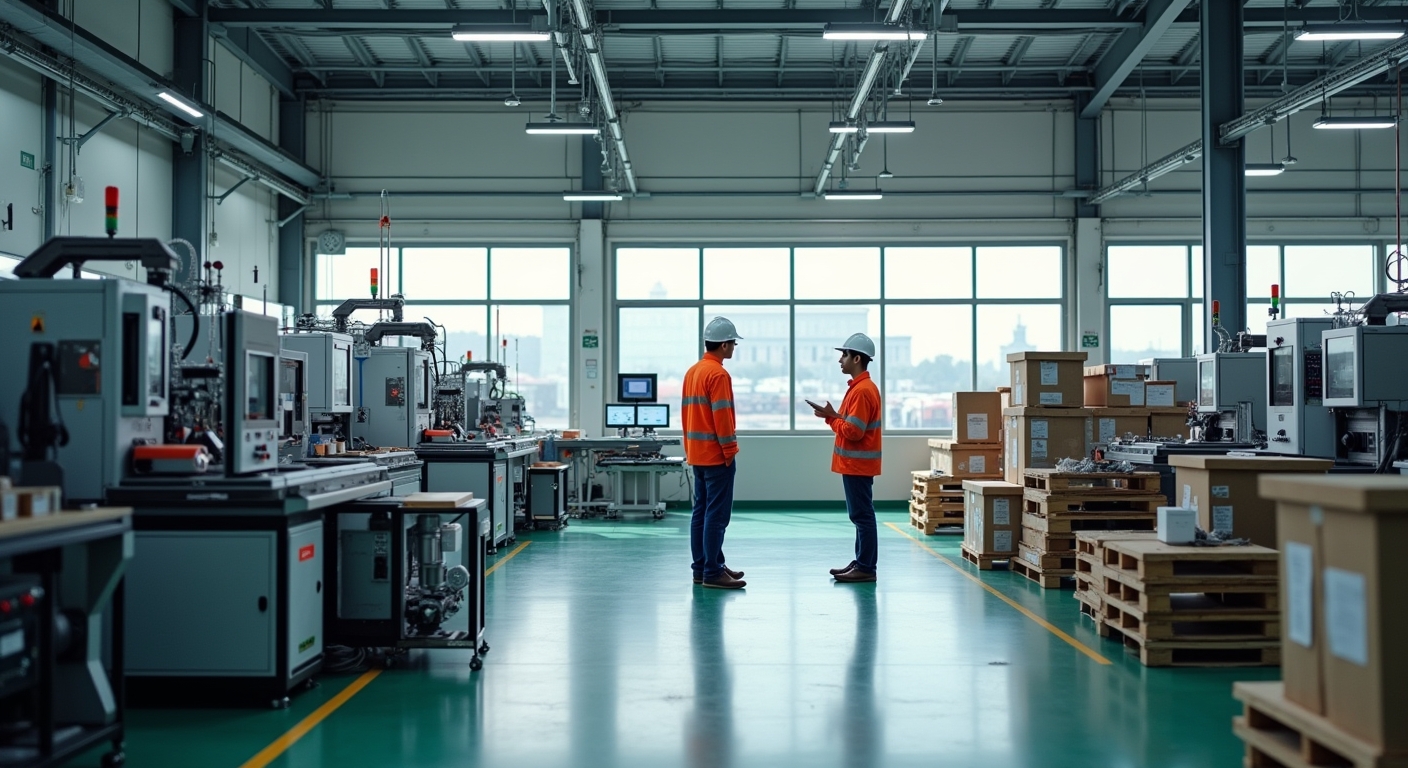

Manufacturing in Malaysia refers to the production of goods through industrial processes such as assembly, machining, fabrication, molding, testing and packaging across sectors including electronics, food, plastics, metal products and medical-related production. It covers both export-oriented manufacturing and goods made for the domestic market, supported by factory operations, supplier networks and logistics systems.
For investors, SME owners, factory managers and procurement teams, Malaysia’s manufacturing sector matters because it combines established industrial capabilities with a broad mix of local and regional supply chain connections. This guide explains what the Malaysia manufacturing industry looks like, why companies consider it, how factories typically operate, what costs shape investment decisions and what to evaluate before setting up or outsourcing production.
What manufacturing in Malaysia looks like today
The manufacturing sector in Malaysia includes a wide range of industrial activities, from highly structured export manufacturing to smaller-scale production serving local business needs. In practical terms, it spans everything from component assembly and food processing to metal fabrication, plastic product manufacturing, packaging and contract manufacturing.
One reason industrial manufacturing Malaysia remains important to many businesses is its diversity. A manufacturer may operate as an original producer, a contract manufacturer, a toll processor or a specialist supplier handling one part of a broader production chain. Some factories focus on high-volume repeat output, while others support lower-volume, more customized production.
In business terms, manufacturing in Malaysia is often associated with:
- Production for both domestic and export markets
- A mix of multinational plants, local manufacturers and SME factories
- Supplier ecosystems that support raw materials, components, tooling and packaging
- Industrial parks and factory clusters that help with logistics and workforce access
- Increasing use of automation, traceability and data-driven quality control
That said, no single description fits every factory. A food processor, electronics assembler and metal fabrication shop operate very differently. The right way to assess the market is by looking at industry fit, process requirements, buyer expectations and operating conditions rather than assuming all manufacturing companies in Malaysia offer the same capabilities.
Why Malaysia is an important manufacturing location
Malaysia is often considered by manufacturers because it offers an established industrial base, accessible infrastructure and a business environment that can support both domestic production and regional supply chain activity. For many companies, the attraction is not one single advantage but the combination of industrial capability, supplier access, workforce availability and practical market reach.
Companies evaluating manufacturing business in Malaysia typically look at the following decision factors:
- Industrial ecosystem: Many production activities benefit from nearby suppliers, service providers, tooling support, maintenance partners and packaging vendors.
- Infrastructure: Factory operations depend on roads, ports, warehousing, utilities and communications systems that support steady production flow.
- Workforce access: Manufacturers need operators, technicians, supervisors, engineers, planners and quality personnel, though availability can vary by location and industry.
- Regional market access: Malaysia can be relevant for companies serving Southeast Asia or building export-oriented production models.
- Production diversity: Businesses can find capabilities ranging from precision assembly and testing to food production, plastics and fabrication.
- Business continuity potential: Some firms use Malaysia to diversify production risk across more than one country or region.
There are also practical limitations to consider. Costs can vary significantly by location, industrial property type, utility demand and labor needs. Not every factory cluster is suitable for every product. Lead times, compliance obligations, supplier depth and technical capability also differ across sectors.
For that reason, Malaysia is best assessed as a manufacturing platform with multiple viable use cases rather than a universally ideal location. The right fit depends on what you make, how you make it, who buys it and what level of control you need over quality, lead time and scale.
Key manufacturing industries in Malaysia
The Malaysia manufacturing industry covers many sectors, but several industries stand out because they appear frequently in sourcing, investment and factory expansion decisions. Each has distinct operating requirements, equipment needs and customer expectations.
Electronics and electrical manufacturing
Electronics and electrical production is one of the most recognized parts of manufacturing in Malaysia. This category may include component assembly, wiring, testing, enclosure integration, control systems and finished electrical product manufacturing. Operations in this space often emphasize clean process control, traceability, testing accuracy and supplier consistency.
Buyers in this segment usually focus on process discipline, documentation, quality systems, engineering support and the ability to maintain repeatable output at scale.
Food processing and packaging
Food manufacturing includes processing, blending, filling, packing, labeling and secondary packaging. Compared with many other industrial sectors, food production places greater emphasis on hygiene, raw material handling, shelf-life considerations, packaging integrity and product traceability.
This area is relevant for local brands, export-oriented producers and contract packers. Operational success depends not only on equipment but also on workflow design, storage conditions, quality checks and production scheduling.
Metal fabrication and machining
Metal-related manufacturers may provide cutting, forming, welding, machining, surface finishing and assembly services. These factories often support industrial equipment, construction-related products, automotive-related production, electrical enclosures and custom fabricated parts.
Operational characteristics in this segment include material planning, tooling management, machine utilization, dimensional inspection and job sequencing. Some manufacturers specialize in repeat production, while others focus on project-based or custom work.
Plastics, molding and polymer-based products
Plastic product manufacturing can involve injection molding, blow molding, extrusion, thermoforming or secondary finishing, depending on the product. Typical buyer concerns include mold quality, material suitability, consistency, cosmetic finish, cycle stability and packaging protection.
For many businesses, plastics manufacturing is closely linked to tooling decisions and production volume. A factory that is suitable for commodity packaging may not be the right fit for technical components that require tighter process control or validation.
Medical-related and controlled manufacturing environments
Some factories support medical-related devices, disposables, packaging or controlled production processes. These operations generally require disciplined documentation, stronger process validation, tighter cleanliness controls and more structured quality oversight than general manufacturing work.
Requirements vary widely by product category and customer expectations, so buyers should verify the exact process controls, certifications and documentation capabilities required for their product rather than assuming all manufacturers work to the same standard.
Automotive-related manufacturing
Automotive-related production may include parts, sub-assemblies, fabricated items, molded components, wiring, packaging and aftermarket products. This type of manufacturing often places high importance on consistency, supplier reliability, change control, defect prevention and delivery performance.
Factories operating in this space may be integrated into broader tiered supply chains, which means schedule discipline and documentation can matter as much as manufacturing capability.
Chemicals, packaging and industrial consumables
Chemical processing and industrial consumable production can support sectors such as cleaning products, coatings, packaging inputs and other downstream industrial uses. These businesses typically require careful process control, material handling procedures, storage planning and risk management.
Packaging manufacturing, meanwhile, serves many other sectors and often acts as a bridge industry. It supports food, consumer goods, industrial products and export supply chains, making it an important part of Malaysia manufacturing supply chain activity.
Common manufacturing processes used across Malaysian factories
Factories differ not just by industry but by the manufacturing processes they use. Understanding these process categories helps non-technical decision-makers compare suppliers, investment options and production models more effectively.
Assembly
Assembly is the process of putting components together into a sub-assembly or finished product. It may be manual, semi-automated or highly automated, depending on product complexity and production volume.
Assembly matters when product quality depends on correct fit, sequence, torque, wiring, labeling or final testing. In practical terms, assembly-heavy factories often need strong work instructions, operator training and line balancing.
Machining
Machining refers to removing material from a workpiece to achieve a required shape, dimension or surface. Common machining activities include turning, milling, drilling and finishing.
This process matters for products that need precision features or engineered tolerances. For buyers, the key questions usually involve process capability, inspection discipline, tooling control and consistency across batches.
Fabrication
Fabrication usually involves cutting, bending, forming and joining materials to create a part or structure. It is common in sheet metal work, enclosures, frames, brackets and industrial components.
Fabrication quality depends on material preparation, fixture accuracy, welding control, finishing and inspection. It is often suitable for both custom and repeat production, but process selection depends heavily on design complexity and volume.
Molding
Molding shapes material in a mold or die to produce a repeated form. In plastics manufacturing, this is often used for parts that need consistent geometry at scale.
Molding decisions are closely tied to tooling investment, material choice, expected volume and quality requirements. A molding operation may be efficient for repeat production, but it requires careful control of process settings, mold maintenance and defect prevention.
Packaging
Packaging is not just the final step of putting products into boxes. In many industries, it is a controlled manufacturing process involving filling, sealing, labeling, coding, inspection and transport protection.
Packaging matters because it affects product integrity, presentation, traceability and logistics efficiency. For export manufacturing, packaging design may also influence handling performance and compliance expectations.
Testing and quality inspection
Testing confirms whether a product performs as intended, while quality inspection checks whether it meets defined specifications or visual requirements. These activities may happen during production, at the end of the line or both.
For many manufacturing companies in Malaysia, testing and inspection are critical differentiators. A supplier with similar equipment but stronger measurement discipline, documentation and defect control may be the lower-risk choice.
Across all of these processes, the best method depends on:
- Product type
- Required volume
- Material characteristics
- Customer specifications
- Quality and traceability expectations
- Available skills and equipment
- Compliance obligations linked to the product category
How manufacturing operations typically work
Most Malaysia factory operations follow a similar production flow, even though the details vary by sector and factory size. At a business level, manufacturing works as a coordinated sequence from supply planning to finished goods movement.
- Sourcing and procurement: The factory identifies required raw materials, components, consumables and packaging, then purchases them based on production demand, lead times and supplier availability.
- Inbound receiving and storage: Materials are checked, recorded and stored according to their handling needs so production can access them in a controlled way.
- Production planning: The business schedules jobs, allocates labor, equipment and materials, and sets priorities based on customer orders, forecast demand or replenishment needs.
- Production execution: Materials move through the relevant process steps such as machining, molding, assembly, filling, fabrication or finishing.
- Quality control: Operators, inspectors or quality teams check output during and after production to identify defects, confirm specifications and reduce rework risk.
- Maintenance support: Equipment is maintained to reduce unexpected downtime and protect output consistency.
- Finished goods handling: Completed products are packed, labeled, stored and prepared for shipment.
- Warehousing and distribution: Goods are dispatched to customers, distributors or export channels based on delivery schedules and logistics arrangements.
In well-run operations, these steps are linked by production data, inventory visibility and clear communication between procurement, planning, production, quality and logistics teams. When one stage is weak, the effect usually spreads across lead time, quality, cost or delivery performance.
Costs and investment considerations for manufacturing in Malaysia
Manufacturing costs in Malaysia vary widely depending on sector, product complexity, facility type, automation level and operating model. A small batch-processing business has a very different cost structure from a continuous production plant or a high-mix contract assembly operation.
Rather than relying on generic setup estimates, decision-makers should break costs into categories.
Main cost categories
| Cost category | What it typically includes | Why it varies |
|---|---|---|
| Factory space | Land, leasing, fit-out, utilities preparation, layout changes | Location, building type, infrastructure needs, zoning suitability |
| Machinery and equipment | Production machines, tooling, inspection equipment, material handling systems | Capacity needs, automation level, customization, product requirements |
| Utilities | Electricity, water, compressed air, process-related consumption | Industry, equipment intensity, operating hours, process type |
| Labor | Operators, technicians, engineers, supervisors, quality staff, planners | Skill level, shift pattern, location, labor model, training needs |
| Materials | Raw materials, purchased parts, packaging, consumables | Commodity movements, customer specifications, sourcing strategy |
| Logistics | Inbound freight, warehousing, outbound shipping, distribution handling | Supplier distance, market served, packaging, transport mode |
| Compliance and quality | Testing, documentation, audits, process validation, product assurance activities | Industry requirements, customer demands, product risk profile |
| Maintenance | Spare parts, preventive maintenance, repair support, calibration-related activities | Equipment complexity, age, uptime requirements |
| Working capital | Inventory, receivables, safety stock, startup operating buffer | Lead times, payment cycles, production scale, supply volatility |
What changes the cost structure
The same product can carry a very different cost profile depending on how the operation is designed. Key cost drivers include:
- Location: Industrial area, logistics access and labor availability affect more than rent alone.
- Production volume: Higher volumes may justify automation or dedicated tooling, while lower volumes may need more flexible but labor-intensive setups.
- Product complexity: More parts, tighter tolerances, specialized handling or detailed documentation usually increase cost.
- Automation level: Automation may reduce some recurring labor dependence but can raise upfront capital, integration and maintenance needs.
- Supply chain design: Imported inputs, dual sourcing, safety stock and custom packaging all affect landed production cost.
- Quality requirements: Additional testing, traceability and inspection increase control but also add process cost.
Cost questions to ask before setting up or outsourcing production
- What fixed costs are required before production starts?
- Which equipment is essential, and which can be phased in later?
- How sensitive is the business model to utility usage, labor availability or raw material price movement?
- What inventory levels are needed to protect customer service?
- How much rework, scrap or process loss should be expected under the planned operating model?
- Will the production model require specialized testing, clean handling or additional documentation?
- What logistics costs apply to inbound materials and outbound finished goods?
- How much working capital is needed to support purchasing, production and payment cycles?
For most businesses, the right question is not simply whether manufacturing in Malaysia is cheap or expensive. The more useful question is whether the full operating model can deliver acceptable quality, lead time, resilience and margin for the target product.
Technology and automation trends in Malaysian manufacturing
Automation in Malaysian manufacturing is increasingly discussed because factories are under pressure to improve output consistency, reduce avoidable downtime and handle more complex customer requirements. In practice, automation does not always mean fully robotic production. It often means selective use of systems that improve control, visibility and repeatability.
Where automation is commonly applied
Manufacturers may introduce automation in areas such as:
- Repetitive assembly tasks
- Material handling and transfer
- Packaging and labeling
- In-line inspection
- Machine monitoring
- Production data capture
- Traceability and batch tracking
These tools can range from simple sensors and counters to more integrated robotics, vision systems or digitally connected equipment.
ERP, MES and production visibility
Enterprise resource planning systems help businesses manage purchasing, inventory, orders and planning. Manufacturing execution systems sit closer to the shop floor and track what is happening during production. Not every factory needs a full MES environment, but many benefit from better production visibility.
This matters because hidden problems in output, downtime, scrap or material usage can erode margins without being obvious in daily operations. Even smaller manufacturers can improve decisions by tracking basic production and quality data more consistently.
Traceability and quality data
Traceability means being able to identify the origin, movement and status of materials or finished goods throughout the production process. It is particularly important where customer requirements, regulated products or recall risk make documentation essential.
Data-driven quality control helps factories move from reactive inspection to earlier problem detection. Instead of finding defects only at the end, manufacturers can monitor process conditions, operator checks or machine signals during production.
Predictive maintenance and machine health
Predictive maintenance uses equipment condition signals, operating history or performance trends to identify maintenance needs before failure happens. It is different from purely reactive maintenance, where repair only begins after a breakdown.
For larger plants, this can support uptime and planning stability. For SMEs, full predictive systems may be difficult to justify everywhere, but condition-based maintenance on critical assets can still be useful.
Benefits and limitations for SMEs versus larger factories
| Area | Potential benefit | Common limitation |
|---|---|---|
| Selective automation | Improves repeatability and reduces manual variation | May require process redesign and training |
| Robotics | Useful for repetitive, hazardous or high-volume tasks | Higher capital and integration complexity |
| Digital production tracking | Better visibility into output, downtime and defects | Data discipline is often harder than software selection |
| Traceability systems | Supports customer confidence and product control | Implementation can be burdensome if workflows are weak |
| Predictive maintenance tools | Reduces unplanned downtime on critical equipment | Not every machine or plant justifies advanced deployment |
The practical lesson is that technology should support a clear operating need. Manufacturers usually get better results by solving a defined bottleneck first than by buying systems without a strong process foundation.
How to evaluate a manufacturing opportunity in Malaysia
Whether you are considering investment, contract manufacturing or production expansion, a structured evaluation process reduces risk. The goal is to move beyond broad market interest and test whether the opportunity works operationally and financially.
- Define the product and market need. Clarify what will be made, who will buy it, expected demand patterns and whether the product needs local, regional or export support.
- Map the required production process. Determine whether the product needs assembly, molding, fabrication, machining, controlled packaging, testing or a mix of processes.
- Check supplier availability. Identify whether materials, components, tooling support and maintenance services are realistically available within the required lead times.
- Assess site suitability. Confirm whether the factory location or industrial park can support logistics, utilities, workforce access and process-specific operating needs.
- Review workforce requirements. Match the process with the operators, technicians, engineers and supervisors needed to run it reliably.
- Test quality system fit. Make sure inspection methods, documentation, traceability and corrective action disciplines align with buyer and product needs.
- Model scale-up potential. Evaluate whether the operation can handle volume growth, new product introductions or customer concentration risk.
- Examine logistics and customer service demands. Consider inbound supply risk, outbound delivery expectations, warehousing needs and packaging requirements.
- Verify compliance exposure. Check what approvals, standards, product obligations or site-level requirements may apply to the specific activity.
- Stress-test the economics. Review margins, working capital, inventory exposure, scrap risk and the cost of failure or disruption.
This framework is useful for foreign investors, local SMEs and procurement teams comparing manufacturing companies in Malaysia. It also helps prevent a common mistake: selecting a site or supplier based on headline cost before confirming technical fit and operational resilience.
Regulatory and compliance considerations to verify before operating
Regulatory requirements for manufacturing in Malaysia depend on the type of product, process, location and business activity involved. A light assembly business, food processor, chemical manufacturer and medical-related producer may all face different obligations.
Before operating, manufacturers commonly need to verify issues such as:
- Business registration and company setup requirements
- Use of industrial premises and site-related approvals
- Sector-specific licences or product-related permissions
- Environmental obligations connected to emissions, waste, water use or process impact
- Worker safety and health responsibilities
- Import and export controls for materials, equipment or finished goods
- Product standards, labeling or conformity expectations
- Tax, customs or incentive matters relevant to the operating model
These issues should not be treated as one-size-fits-all. Requirements can vary by industry, product category, location and whether the business is manufacturing for domestic sale, export or both. Any company making investment or launch decisions should verify current obligations with the relevant Malaysian authorities and qualified advisers before committing capital or signing long-term contracts.
It is also important to separate different types of requirements. Some obligations are legal, some are customer-imposed, and others are voluntary standards or industry practice. Confusing those categories can lead to poor decisions about cost, timing and factory readiness.
Challenges manufacturers may face in Malaysia
Like any industrial market, Malaysia presents both opportunities and operating challenges. Recognizing these early helps businesses design more realistic production models.
Labor constraints
Some manufacturers may face difficulty finding or retaining the right mix of operators, technicians and technical supervisors, especially where shift work, process discipline or specialized production skills are required.
Mitigation: Simplify workflows where possible, invest in training, reduce avoidable manual complexity and build supervisors who can stabilize shop-floor execution.
Rising input and operating costs
Raw materials, utilities, logistics and support services can affect competitiveness over time, particularly for businesses with thin margins or volatile demand.
Mitigation: Use cost modeling, supplier diversification, yield improvement and better production planning rather than relying only on purchase price negotiation.
Supply chain disruption
Lead time delays, imported component dependence and supplier inconsistency can interrupt production even when factory execution is strong.
Mitigation: Review alternative suppliers, safety stock strategy, approved substitutions and critical component risk mapping.
Technology adoption barriers
Some factories know they need automation or digital systems but struggle with capital prioritization, implementation skills or workforce readiness.
Mitigation: Start with focused use cases such as inspection bottlenecks, recurring downtime or weak production visibility before scaling wider investment.
Quality consistency pressure
As buyer expectations rise, even small process variation can create returns, rework, line stoppages or customer complaints.
Mitigation: Standardize work instructions, strengthen in-process checks, improve root cause analysis and treat quality as a production discipline, not only a final inspection function.
Lead time and responsiveness demands
Customers increasingly expect shorter lead times, more flexible order handling and better communication around delays or change requests.
Mitigation: Improve planning accuracy, bottleneck management, inventory control and cross-functional communication between sales, planning and production.
Compliance complexity
As products, markets and processes become more specialized, compliance and documentation demands can become harder to manage.
Mitigation: Clarify applicable obligations early, assign ownership and build compliance checks into product development and launch planning rather than addressing them late.
Best practices for building a resilient manufacturing operation
Resilient manufacturing operations are not built through cost cutting alone. They depend on visibility, discipline, supplier strength and a realistic view of process capability. Across many sectors, several practices consistently improve performance.
- Strengthen supplier relationships: Work with suppliers on forecasting, quality feedback and contingency planning instead of managing only through reactive purchasing.
- Improve production visibility: Track output, scrap, downtime, plan attainment and delays so management can respond before problems compound.
- Invest in maintenance: Preventive and condition-based maintenance protect capacity and reduce disruption from avoidable breakdowns.
- Train people systematically: Process stability depends on operator competence, supervisory control and clear work standards.
- Standardize quality procedures: Inspection criteria, escalation rules and corrective action processes should be consistent across shifts and lines.
- Review capacity planning regularly: Factories often face problems not because demand is high, but because labor, materials, machines and schedules are misaligned.
- Adopt automation selectively: The best automation investments usually target repetitive errors, labor bottlenecks, traceability gaps or safety-sensitive tasks.
- Build operational buffers wisely: Appropriate safety stock, alternate suppliers or flexible labor arrangements can improve resilience without excessive overhead.
For many manufacturers, resilience is less about having the most advanced technology and more about having consistent control over the basics: materials, people, machines, methods and information.
Who should consider manufacturing in Malaysia
Malaysia can make sense for several types of manufacturing decision-makers, but not always for the same reasons.
SMEs starting production
Local SMEs or growing brands may consider manufacturing in Malaysia when they need more control over product quality, lead time or customization than trading alone can provide. Their next step is usually to validate process fit, site needs and working capital rather than jump immediately into full-scale facility investment.
Foreign firms seeking regional capacity
Companies expanding into Southeast Asia may view Malaysia as one option for regional production, supplier diversification or customer support. Their key decision factors often include supply chain design, export logistics, workforce capability and the ability to meet customer-specific quality requirements.
Brands looking for contract manufacturers
Businesses that do not want to build their own factory may look for contract manufacturing partners in sectors such as food, plastics, assembly or packaging. Their most important step is to assess whether the manufacturer’s process controls, documentation and capacity really match the product’s commercial and technical needs.
Existing local factories upgrading operations
Established manufacturers may consider automation, layout redesign, better planning tools or stronger quality systems to improve competitiveness. For these firms, the opportunity is often operational improvement rather than market entry.
In short, Malaysia may suit companies that need a practical industrial base with diverse production capabilities, but the right choice depends on product type, scale, customer expectations and risk tolerance.
Conclusion: making informed manufacturing decisions in Malaysia
Manufacturing in Malaysia offers a broad industrial base across sectors such as electronics, food, metalwork, plastics, packaging and contract production. For many businesses, its value lies in the combination of manufacturing capability, supplier ecosystems and regional market relevance.
Still, good manufacturing decisions require due diligence. Costs, process fit, supplier depth, workforce access, quality systems and compliance obligations vary significantly by product and location. Use this guide as a starting point, then validate the operational, financial and regulatory details that apply to your specific manufacturing model before moving forward.
Frequently Asked Questions
What are the main manufacturing industries in Malaysia?
Common industries include electronics and electrical manufacturing, food processing, metal fabrication, plastics and molding, packaging, automotive-related production, chemicals and medical-related manufacturing. The right sector to target depends on product type, process needs and buyer requirements.
Why do companies choose Malaysia for manufacturing?
Companies often consider Malaysia because of its industrial ecosystem, factory infrastructure, supplier networks, workforce access and regional market connectivity. The decision is usually based on overall operating fit rather than one factor alone.
What costs should businesses consider before starting manufacturing in Malaysia?
Key cost categories include factory space, machinery, utilities, labor, raw materials, logistics, quality-related activities, maintenance and working capital. Actual cost structure varies by industry, location, product complexity and automation level.
How automated are manufacturing operations in Malaysia?
Automation levels vary widely. Some factories use advanced robotics, digital tracking and in-line inspection, while others rely more on manual or semi-automated processes. Many manufacturers adopt automation selectively in areas where it improves consistency, visibility or labor efficiency.
What should a company check before setting up a factory in Malaysia?
A company should review product-market fit, required processes, supplier availability, location suitability, workforce needs, quality systems, scalability, logistics and applicable compliance requirements. It is also important to verify any legal or sector-specific obligations with the relevant authorities before proceeding.